
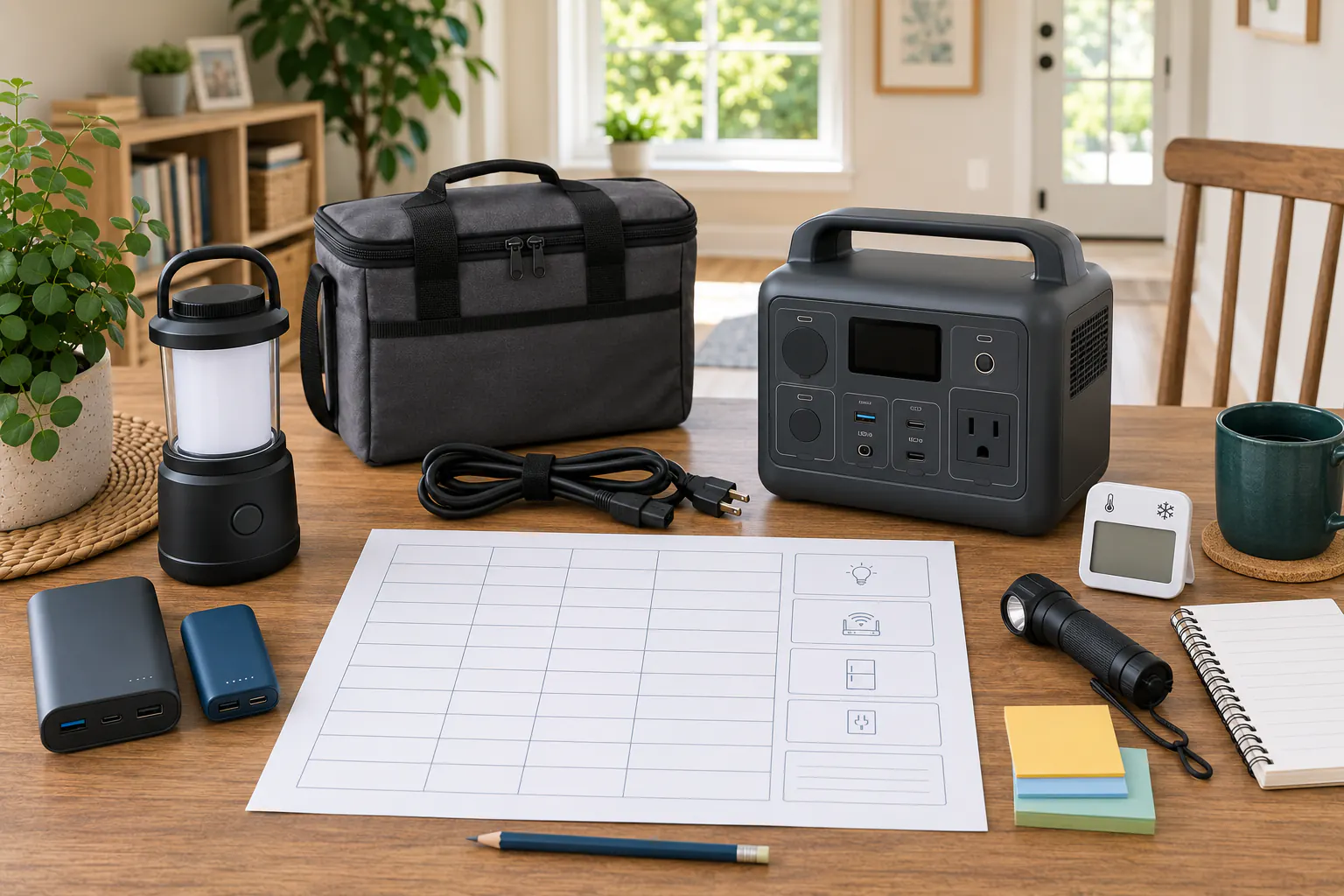
Choose one job before comparing batteries or generators: keeping phones charged, supporting a refrigerator, or another need you have already identified. Write down the devices and how long they need power. Capacity, output, compatibility, and a safe fallback are separate questions, not one big number on a box.
Use this guide before buying or installing anything. If the outage is happening now, begin with first outage actions; if utility work is scheduled, use the planned-outage checklist. Both routes return here when the household is ready to define loads, runtime, and a safe fallback.
Which backup power source fits your home
- Phones, radios, and small lights: start by checking compatible USB power banks and the charging reserve you need.
- A few plug-in appliances: compare a portable power station with the devices’ running watts, startup surge, and energy use. A battery’s capacity alone does not establish compatibility or runtime.
- Larger loads or a longer outage: a portable generator adds a fuel-based option only where safe outdoor operation, fuel storage, and approved connections are practical. The CPSC warns never to use a portable generator inside a home or garage, even with doors and windows open.
- Selected household circuits or automatic backup: discuss a permanently installed system and transfer equipment with a qualified electrician. A portable station is not automatically a whole-home backup system.
If you are unsure what needs power in the first place, the household power-outage path starts with light, communication, food, and water. Otherwise, list the devices below and use the runtime calculator once you have a load estimate.
Start with loads, not products
Write down each device you may power, its running watts, expected hours of use, and startup surge where applicable. Use the device label, manual, manufacturer data, or a plug-in electricity monitor. The Department of Energy notes that actual power use can differ from nameplate estimates.
For energy:
watts × hours ÷ 1,000 = kilowatt-hours (kWh)
A 100-watt load running for 8 hours uses 800 watt-hours, or 0.8 kWh. In practice, include conversion losses and avoid assuming every advertised watt-hour is usable.
Sort loads by consequence
Critical
Prescribed medical equipment, certain heat controls, sump pumps, or other loads whose loss can threaten health or the building. These need a professionally confirmed continuity plan, not only a consumer calculator.
Essential
Refrigeration, communication, selected lighting, a well pump, or limited climate control. These may run in scheduled cycles to reduce energy use if the appliance and safety plan permit it.
Deferrable
Laundry, most entertainment, electric resistance cooking, and convenience loads. Removing one high-watt device can radically change the required battery or generator size.
Compare the main approaches
| System | Strong fit | Main limits |
|---|---|---|
| USB power banks | Phones, small lights, radios | Low capacity; cannot run AC appliances without separate equipment |
| Portable power station | Quiet indoor battery supply for electronics and some appliances | Finite stored energy; inverter and surge limits; recharge dependency |
| Portable generator | Longer outages and larger loads where outdoor operation and fuel are practical | Carbon monoxide, fuel, noise, weather, maintenance, and connection hazards |
| Permanently installed standby system | Automatic support for selected circuits or much of a home | Higher cost, fuel dependency, permits, professional installation and service |
A battery can operate indoors because it has no engine exhaust, but its charger, cables, cells, and inverter still require correct use and ventilation according to the manufacturer. A portable generator can never operate indoors.
Choose the guide for your next question
| Decision | Focused guide |
|---|---|
| Build the load and energy budget | Calculate home backup power needs |
| Estimate a battery runtime transparently | Portable power station runtime calculator |
| Choose for an apartment or rental | Portable power stations for apartment blackouts |
| Compare battery and fuel-based backup | Generator vs. portable power station |
| Protect refrigerated food with temperature evidence | Power a refrigerator during an outage |
| Build a clinician-led CPAP plan | CPAP backup power planning questions |
| Estimate realistic solar recharge | Portable solar panels for outages |
| Store and rotate generator fuel safely | Generator fuel storage safety |
| Adapt power planning for wildfire smoke | Wildfire smoke during a power outage |
| Plan for a multi-day hurricane outage | Hurricane power outage plan |
| Plan a household by 4, 12, and 24-hour horizons | Power continuity at home |
| Keep a bounded home-office layer available | Remote work during a power outage |
| Use advance notice without scrambling | Prepare for a planned utility outage |
| Rebuild household readiness after service returns | Household reset after a power outage |
Start with the load worksheet. The other guides answer one constraint at a time and link back to the same watts, watt-hours, reserve, recharge, testing, and fallback model.
Size a battery system
- Add the watt-hours of loads you plan to support.
- Divide by the fraction of advertised capacity you expect to be usable.
- Check continuous inverter watts.
- Check short startup surge for compressors, pumps, and motors.
- Add a realistic reserve for cold, age, conversion losses, and plan changes.
- Test the actual load before an emergency.
Use the power station runtime calculator for a transparent first estimate. It deliberately does not choose a product for you.
Build a load worksheet
Use measured average watts whenever practical. A nameplate may describe a maximum design limit rather than normal consumption; DOE guidance recommends measuring actual use when possible. (Source: U.S. Department of Energy, Estimating Appliance and Home Electronic Energy Use.)
| Load | Running or average watts | Startup surge | Hours or duty cycle | Daily Wh | Consequence if unavailable |
|---|---|---|---|---|---|
| Refrigerator | Measure | Check manual/test | Compressor cycles | Watts × estimated run hours | Food temperature must still be monitored |
| Router/ONT | Measure combined | Usually low | Continuous | Watts × 24 | Internet may fail upstream despite local power |
| Phones/radio | Charger input | Low | Intermittent | Add each charge | Preserve at least one communication reserve |
| Lighting | Rated/measured | Low | Planned hours | Watts × hours | Use task lighting, not whole-home lighting |
| Medical equipment | Manufacturer/care plan | Verify | Prescribed use | Confirm professionally | Do not use a generic estimate as sole backup |
Add daily watt-hours, then multiply by the number of days between realistic recharge opportunities. Apply a reserve after that calculation rather than pretending the advertised capacity is fully usable.
Continuous output and stored energy are different
A 1,000-watt inverter rating describes how much AC power the station may supply at once. A 1,000-watt-hour battery rating describes stored energy. Neither number guarantees that a compressor, pump, microwave, heater, or medical device will work. Check continuous output, surge behavior, port limits, waveform, grounding instructions, and runtime separately.
High-watt heat-producing appliances empty batteries quickly. A 1,500-watt space heater can consume 1.5 kWh in one hour if it runs continuously. For many households, insulation, safe relocation, bedding, or a professionally designed heating plan is more realistic than trying to reproduce electric heat with a small portable station.
Central air conditioners, heat pumps, furnaces, mini-splits, and shared HVAC also have startup, control, hardwiring, and manufacturer requirements that a consumer load estimate cannot authorize. Use the HVAC resilience hub and its post-outage restart checklist before treating climate control as a backup-power load.
Size a generator system
Add running watts for simultaneous loads and verify the largest startup surge. Decide how power reaches loads: direct cords, a listed inlet and transfer equipment, or a permanently installed system. Never feed a home through a receptacle.
Before buying, establish the outdoor operating position, fuel storage method, maintenance schedule, cord route, and how CO alarms will be maintained. Read generator carbon monoxide safety first; placement is a design constraint, not an afterthought.
Direct cords versus selected circuits
Directly powering a small number of appliances with properly rated cords can avoid household wiring, but the route must remain dry, protected from damage, and within all product instructions. It is not appropriate for every load.
Use the power-outage extension-cord guide to verify temporary-use limits. Any panel, inlet, transfer, grounding, bonding, or circuit work belongs inside the licensed-electrician boundary, not a generator improvisation.
Powering selected household circuits requires listed transfer equipment or an interlock arrangement permitted for the panel and jurisdiction, installed by a qualified electrician. Never use a double-male cord or connect a generator through a receptacle. Backfeeding can energize wiring unexpectedly and endanger occupants and utility workers.
A plug-in monitor can support load research only within its documented rating. The electrical safety-tool comparison explains why consumer indicators do not approve building wiring or panel work.
Fuel is part of runtime
Generator runtime claims depend on load and tank size. Your plan also needs legal, fire-safe fuel storage; rotation; cooling before refueling; transportation; and a realistic resupply route. Do not store fuel in living areas or beside ignition sources. Local fire codes, lease terms, condominium rules, and insurance requirements can be more restrictive than generic guidance.
The CPSC instructs consumers to shut a generator down and let it cool before refueling, and to follow the manufacturer’s maintenance and weather instructions. (Source: CPSC, 2026 winter storm and power outage safety warning.)
Plan how the battery will be recharged
A battery is not an energy source; it is stored energy. Identify at least two replenishment options and their constraints:
- Grid charging: fastest and simplest when utility power returns, but unavailable during the outage.
- Vehicle charging: usually limited compared with wall charging; keep the vehicle outdoors and follow both vehicle and station instructions.
- Portable solar: output changes with weather, season, shading, panel angle, temperature, controller limits, and daylight hours.
- Generator charging: can reduce generator run time but retains every CO, fuel, noise, and weather constraint.
- Another safe location: a workplace, relative, cooling center, or community charging site may be more reliable than owning more panels.
Compare the station’s maximum input with the energy you expect to consume each day. A nominal 200-watt panel does not deliver 200 watts continuously from sunrise to sunset. Use measured local results or a conservative range, then keep a non-electric fallback for essential routines.
Choose by housing type
Apartment or rental
Prioritize quiet battery storage, phone and task-light charging, measured refrigeration support, and a relocation plan for loads that exceed the battery. Confirm charging, balcony, hallway, and storage rules. A portable generator is not made safe by placing it outside your unit if exhaust can enter any apartment, corridor, window, vent, or shared space.
Detached home
You may have more options for generators, permanent systems, solar, and selected circuits, but more loads can also hide behind the panel. A well pump, sump pump, furnace blower, refrigerator, freezer, septic components, garage door, and internet equipment can all compete for capacity. Inventory first.
Medical-device household
The care plan takes precedence over this guide. Ask the manufacturer and clinician about approved batteries, DC adapters, alarms, humidifier settings, oxygen interaction, expected outage duration, and when to relocate. Register with the utility’s medical program when one exists, while recognizing that registration may not guarantee faster restoration.
What to check before choosing equipment
I do not treat a capacity label as enough evidence to recommend a power station or generator. When you compare an exact model, look for:
- tested usable energy at relevant loads;
- inverter continuous and surge behavior;
- low-load operation and automatic shutoff behavior;
- recharge time from each supported input;
- noise, thermal management, and cold-weather limits;
- port layout, cable quality, display accuracy, and manual quality;
- battery chemistry, cycle-life claim, warranty, repair path, and replacement options;
- generator CO shutoff features without treating them as permission for unsafe placement;
- exact test conditions, product source, firmware, and measurement tools.
The guides here explain planning and researched category differences. They are not hands-on tests of an exact model. A household observation can help your own plan, but it does not establish how every unit or setup will perform.
Test the complete plan
Check ordinary non-medical loads in normal, dry conditions, only within the equipment instructions and any already approved connection plan. Do not interrupt care or building-critical systems, run equipment to failure, or improvise a connection for a drill. Stop for a fault, unusual heat, odor, damage, or other abnormal condition and follow the responsible manufacturer or qualified professional. Record permitted power and runtime observations without deliberately creating an outage.
Record the date, loads, duration, battery percentage or fuel used, ambient temperature, and any problem. Keep it with your household plan so the next sizing decision has a clear basis.
A conservative decision sequence
- Reduce the load before increasing the power source. The home energy efficiency cluster is where that reduction happens; every watt you stop wasting is a watt you do not have to store.
- Separate medical or building-critical continuity from convenience loads.
- Measure watts and observe cycling over enough time to be meaningful.
- Calculate energy for the expected duration and the longest gap between recharges.
- Check continuous output, surge, ports, cords, and environmental limits.
- Design generator placement and fuel handling before considering generator capacity.
- Test the system with the real load under controlled conditions.
- Keep a departure or non-electric fallback when the system cannot meet the requirement.
Return to the complete power outage plan, and use the food safety guide rather than assuming that occasional refrigerator operation preserved food.
Sources reviewed
- U.S. Department of Energy: Estimating Appliance and Home Electronic Energy Use
- CPSC Carbon Monoxide Information Center
Sources reviewed July 13, 2026.