
Power returning does not prove that an HVAC system is ready. The outage may have followed lightning, flooding, wind, smoke, ice, extreme voltage, equipment failure, or a utility operation. A thermostat display may return before the outdoor unit, blower, pump, fuel controls, shared-building systems, or communication network is stable.
This checklist covers normal occupant decisions after restoration. It does not provide a breaker-reset sequence, internal inspection, electrical test, fuel-appliance startup, or universal waiting period. The equipment manual, utility, property authority, and qualified service provider control the actual restart.
Use the HVAC and climate-control hub to prepare the records, maintenance baseline, surge questions, and fallback plan before the next outage.
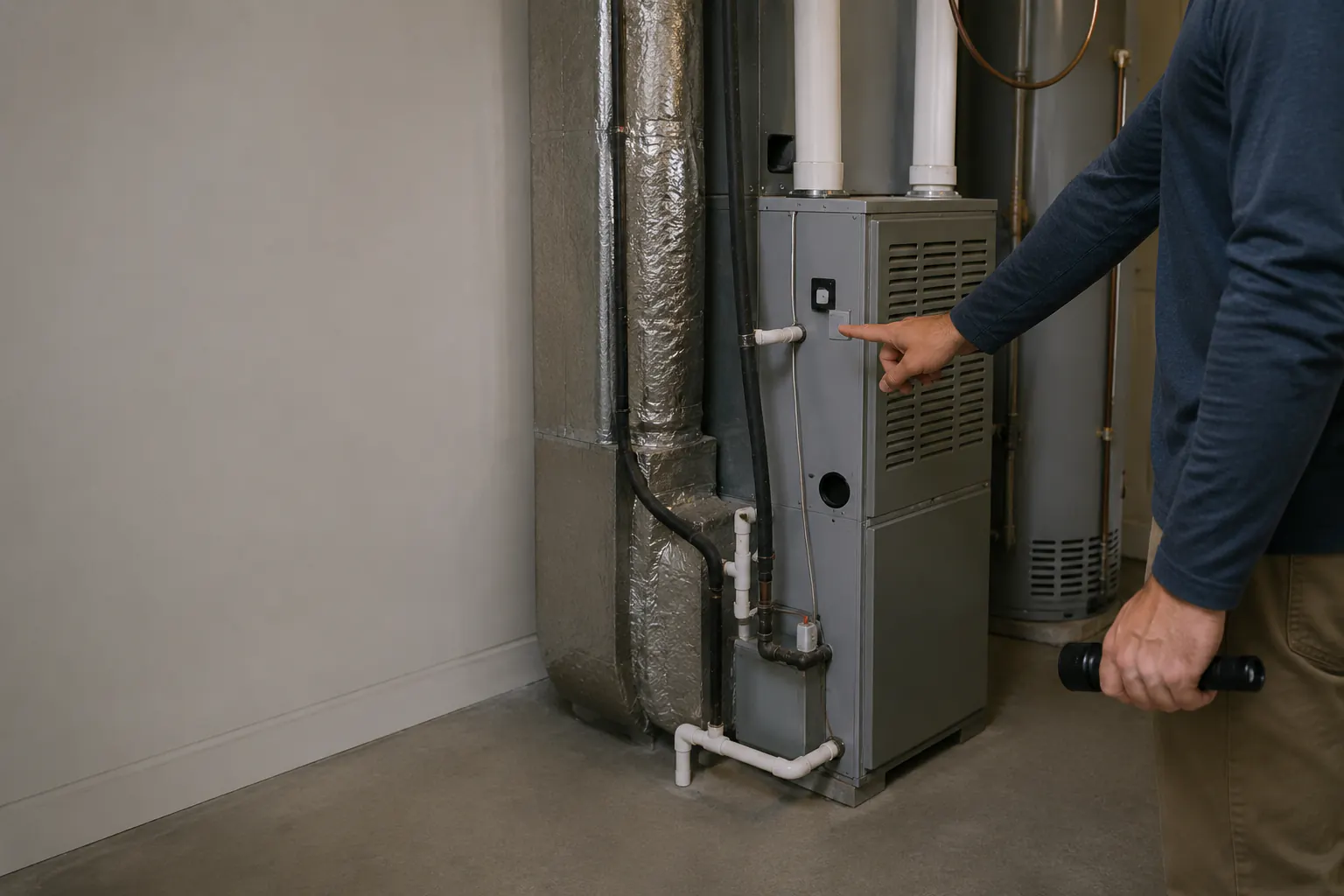
Leave for immediate hazards
Call 911 for fire, smoke, active arcing, explosion, shock injury, a carbon monoxide alarm, severe symptoms, or immediate danger. Follow the gas utility’s current instructions for a gas odor. Stay away from downed lines, damaged service equipment, floodwater, and unstable structures.
Do not enter, touch, or energize HVAC that is:
- wet, flooded, snow-packed, contaminated, or standing near water;
- burned, melted, discolored, sparking, smoking, hot, buzzing, or giving off an unusual odor;
- damaged by wind, tree, debris, impact, animals, theft, or structural movement;
- connected to visibly damaged wiring, receptacle, disconnect, panel, meter, generator, solar, or battery equipment;
- under a recall, service lockout, red tag, landlord restriction, or prior repair isolation;
- associated with a sewage, mold, fire-residue, or contaminated-air event;
- repeatedly tripping, faulting, starting, or stopping.
Dry appearance is not clearance after flooding. EPA advises not running HVAC known or suspected to be contaminated with mold because it can spread contamination. (Source: U.S. Environmental Protection Agency, A Brief Guide to Mold, Moisture and Your Home.)
Confirm the utility and building status
Check the utility’s official outage message and any property-management notice. One lamp returning may reflect partial, temporary, or local service. In a multifamily building, central ventilation, pumps, elevators, fire systems, cooling towers, boilers, and controls may have a separate restoration schedule.
Ask:
- Has the utility declared service restored at this address?
- Did the building authority release the HVAC system for normal use?
- Was there a flood, lightning, fire, surge, gas, or equipment incident?
- Did a technician isolate any component before or during the outage?
- Are water, gas, condensate, exhaust, and shared mechanical services available?
- Is an emergency alert still advising evacuation or reduced electrical use?
Do not repeatedly operate a thermostat or breaker to test unstable service.
Review the pre-outage state
Retrieve the equipment record from the HVAC maintenance checklist. Write down:
- mode, setting, and operation before power failed;
- any unusual sound, odor, water, ice, fault, trip, or comfort problem already present;
- whether the system stopped normally or during a severe event;
- generator, transfer equipment, solar, battery, or load-management state;
- service work, recalls, warranty restrictions, and manufacturer notices;
- occupants who depend on heating, cooling, air quality, or medical plans.
Do not use restoration to retry an unexplained pre-outage fault.
Separate plug-in room units from hardwired systems
A window or portable room air conditioner may have a normal user restart process in its manual. A central air conditioner, furnace, boiler, heat pump, mini-split, geothermal system, or shared-building plant may be hardwired and can involve multiple disconnects, controls, pumps, fuels, protections, and professional procedures.
Never assume the household general load-restoration checklist authorizes HVAC. It establishes the broad rule: restore ordinary loads deliberately and leave specialized equipment to its responsible procedure. HVAC remains specialized.
Do not:
- open a panel or disconnect;
- reset a breaker, GFCI, AFCI, float switch, limit, lockout, or fault repeatedly;
- remove a fuse or cover;
- bypass a delay, safety, alarm, or control;
- connect a hardwired system through a cord, inverter, generator, or portable battery;
- change a thermostat to an extreme setting to force operation;
- add refrigerant, fuel, water, or chemical;
- break ice or clear an internal blockage.
Use only the documented normal-control sequence
If the building and equipment are clear of every stop condition, locate the exact manufacturer restart instructions. The safe occupant scope may be limited to a thermostat, remote, equipment power button, or plug-in unit control.
Before using that control:
- Confirm the correct system and zone.
- Restore the normal pre-outage mode and a reasonable setting, not the maximum demand.
- Respect every manufacturer delay. Compressors and controls may intentionally wait before starting.
- Keep people, pets, tools, and debris away from fans and equipment that can start automatically.
- Observe from a normal occupied position without opening or touching equipment.
- Stop through the same normal control if there is a new fault, abnormal sound, odor, water, vibration, repeated cycle, or no expected response.
No universal five-minute, thirty-minute, or multi-hour delay applies to every HVAC system. Publishing one would hide differences among controls, utility conditions, refrigerants, compressors, fuel appliances, and manufacturer protections.
Observe one complete normal cycle
If the system starts normally, record:
- thermostat and equipment status;
- start time and any intentional delay;
- normal airflow at occupied registers or the room unit;
- whether heating or cooling progresses without extreme settings;
- new sound, odor, vibration, water, ice, or fault code;
- whether the system stops or modulates normally;
- indoor temperature and humidity trend, not a single instant reading.
Do not place a hand inside a grille, remove a cover, touch refrigerant lines, measure live voltage, or hold a loose part. If the cycle differs materially from the documented baseline, stop and call service.
Protect against a second transition
Utility service can fail again. Ready.gov advises unplugging appliances, equipment, and electronics where safely possible during an outage to avoid surge damage and using surge-protection devices. (Source: Ready.gov, Power Outage Hazard Information Sheet.) Hardwired HVAC requires the system-specific plan described in HVAC surge protection planning.
Ask the electrician and HVAC contractor before the next event:
- what protective devices serve the equipment;
- how their status is checked;
- what components remain unprotected;
- whether protection needs replacement after a major event;
- who isolates and restores the equipment;
- how generator or transfer equipment changes the sequence.
A generic plug-in strip is not a universal answer for central HVAC.
If the system does not restart
Do not repeat the command. Record exactly what happened:
- utility and building status;
- thermostat display, mode, and any code;
- equipment sound or silence;
- visible exterior condition from ground level;
- water, ice, odor, heat, or damage;
- breaker or alarm indication observed without operating it;
- outage timing and weather exposure;
- model and service history.
Call the property contact or qualified service provider. A filter can be inspected only through its normal approved access, but replacing a filter is not a general cure for a post-outage fault.
Manage dangerous indoor temperature separately
Troubleshooting must not consume the time needed to protect people. If indoor heat or cold is becoming unsafe, use the extreme-heat outage plan or winter outage heat plan. Move early to an appropriate cooling or warming location when the household plan says to go.
Follow clinician and device plans for people with medical risk. Call emergency services for severe symptoms. HVAC restoration is not a substitute for a health response.
Renter and apartment sequence
Report the outage and loss of HVAC through the building’s emergency channel. Include indoor temperature trend, unit number, time, vulnerable-occupant needs, visible leak, odor, alarm, and whether neighboring units or common systems are affected.
Use only the thermostat, remote, filter, or plug-in control that the lease and building instructions assign to you. Do not enter a mechanical room, roof, utility closet, neighboring unit, or locked area. Do not hire a contractor for owner equipment without authorization.
Local housing and emergency rules vary. Document the request and use local authorities rather than assuming a universal repair deadline.
Close the incident record
After normal operation is confirmed or professional service is complete, add:
- outage and restoration times;
- cause if officially known;
- authorization and service contact;
- observed behavior;
- repair, replacement, or protection change;
- updated manual or restart instructions;
- filter or maintenance due date;
- changes to backup, surge, heat, cold, and relocation plans.
The objective is not to make every system restart immediately. It is to avoid turning a grid outage into fire, shock, contamination, equipment damage, or dangerous delay.
Sources reviewed
ReadyLience reviewed current power-outage, HVAC maintenance, appliance-fire, recall, and mold guidance from Ready.gov, ENERGY STAR, the U.S. Fire Administration, the U.S. Consumer Product Safety Commission, and the U.S. Environmental Protection Agency on July 14, 2026. Current emergency orders, utilities, property authorities, equipment instructions, recalls, and qualified trades control every actual restart.