
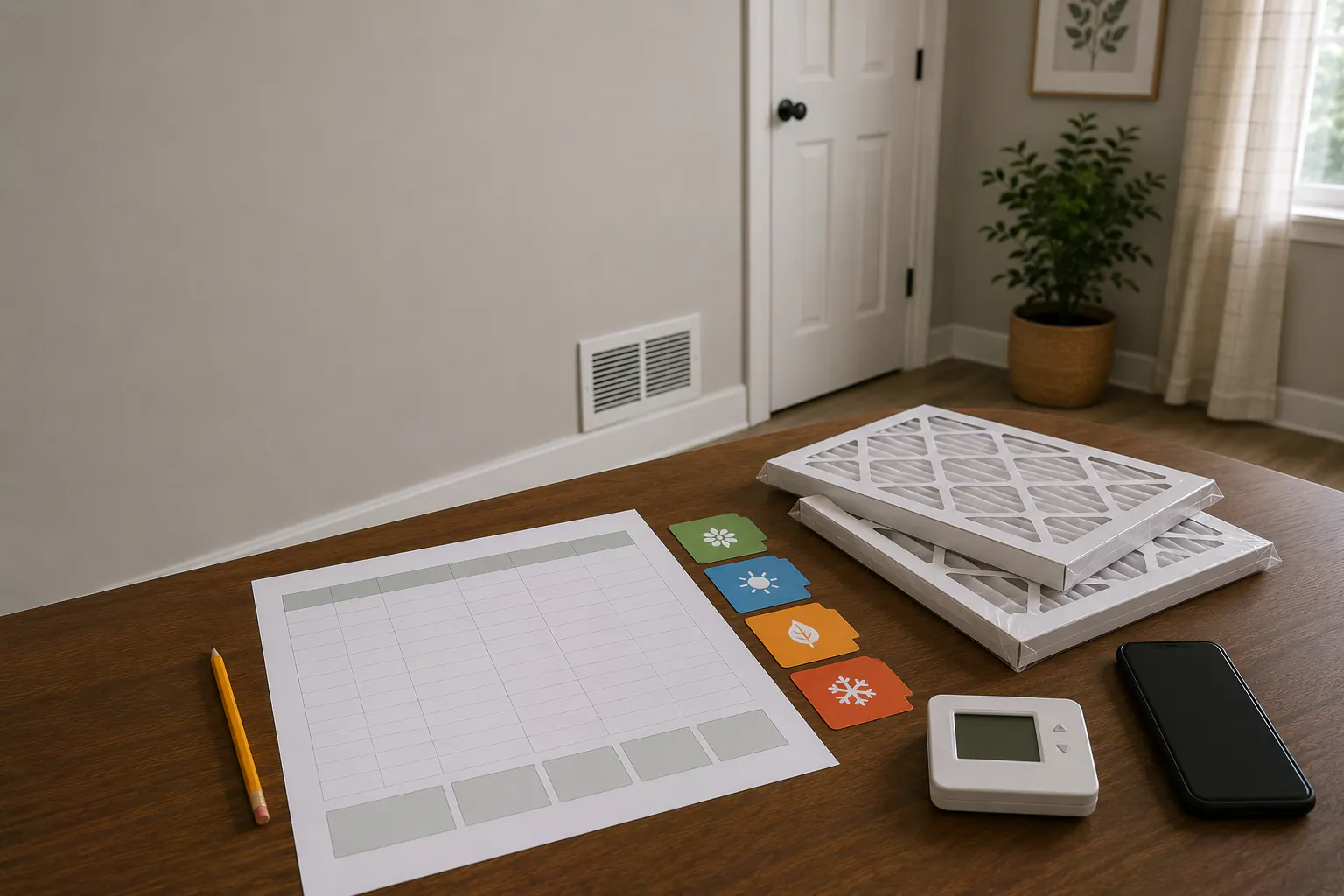
Heating and cooling equipment is easy to ignore while it works. Then a filter loads up during smoke season, a condensate line overflows above a ceiling, or the system refuses to restart after a summer outage. A resilient HVAC plan makes those transitions less surprising.
This cluster is not a repair manual. It is a household operating system for routine care, documented decisions, early escalation, and a workable fallback when mechanical climate control is unavailable. It separates actions an occupant can usually perform through normal controls from work that belongs to the property manager or a qualified technician. HVAC is the largest load in most homes, which is why this cluster sits inside the home energy efficiency and resilience plan.
Start with the four jobs HVAC performs
HVAC is shorthand for heating, ventilation, and air conditioning, but a home system may also manage filtration, air movement, humidity, and combustion exhaust. Those jobs interact.
- A dirty or incompatible filter can reduce airflow.
- Oversized cooling equipment may reach the thermostat setting before removing enough moisture.
- Aggressive air sealing can change how a combustion appliance receives air.
- Longer fan operation may increase filtration while also increasing electricity use and changing humidity behavior.
- A power outage can remove heating even when the primary fuel is gas because controls and blowers still need electricity.
That is why one symptom rarely proves one diagnosis. Keep the household role to normal controls, approved filters, clear exterior space, and observation. Use the separate HVAC warning-sign guide when the system changes sound, odor, cycling, airflow, temperature, or moisture.
Build the maintenance baseline
ENERGY STAR recommends annual pre-season professional checkups: cooling before summer and heating before winter. Its maintenance checklist places electrical connections, motor measurements, refrigerant charge, combustion, internal coils, blower adjustment, and system controls inside the contractor visit. (Source: ENERGY STAR, Maintenance Checklist.)
The occupant baseline is simpler:
- Record the equipment make, model, serial number, fuel, normal thermostat mode, filter size, filter direction, and service contact without removing a panel.
- Follow the manufacturer schedule for filters and other user-serviceable items.
- Keep ordinary furniture, storage, vegetation, snow, and debris away from grilles, returns, and exterior equipment according to the manual.
- Check visible occupied areas for water, unusual residue, damaged cords, blocked airflow, and changed sounds or odors.
- Schedule professional work before peak weather instead of after the system has failed.
Use the seasonal HVAC maintenance checklist to turn those tasks into a repeatable record. It deliberately excludes opening a cabinet, reaching through a guard, cleaning an internal coil, handling refrigerant, adjusting fuel, or measuring live electricity.
Treat filters as fitted components
A filter is not automatically better because its number is higher. EPA recommends MERV 13, or the highest rating the system fan and filter slot can accommodate, for improved particle filtration. EPA also says every filter needs periodic replacement and that a technician may need to determine what a system can support. (Source: U.S. Environmental Protection Agency, Guide to Air Cleaners in the Home.)
The useful household record contains:
- exact dimensions and whether they are nominal or actual;
- manufacturer-approved type and rating;
- airflow arrow direction;
- installation date and inspection date;
- conditions such as pets, renovation dust, smoke, or unusually heavy operation;
- what changed after replacement.
The HVAC filter schedule guide explains why a calendar interval is a starting point rather than a universal rule. Never force, bend, stack, or improvise a filter to make it fit.
Choose room cooling by the actual room
A room air conditioner is a focused cooling tool, not a whole-building promise. ENERGY STAR says correct sizing starts with the room area and notes that an oversized unit can cool too quickly to remove humidity effectively. Installation, window type, electrical supply, drainage, shading, ceiling height, occupancy, and heat-producing appliances also matter. (Source: ENERGY STAR, Room Air Conditioners.)
The room air-conditioner planning guide helps build a requirements sheet before comparing models. It does not authorize a window installation, structural support, extension cord, altered receptacle, or unsafe egress.
Plan mini-splits as building systems
Ductless heat pumps can heat and cool zones without conventional ductwork. They are not merely large plug-in appliances. Sizing, equipment matching, condensate routing, exterior-unit location, electrical work, wall penetration, permits, refrigerant handling, cold-weather capacity, and backup heat all affect the plan.
ENERGY STAR advises having a contractor use the home’s actual heating and cooling load rather than a rule of thumb. EPA states that work expected to open a refrigerant circuit, including connecting or disconnecting precharged mini-split lines, requires Section 608 technician certification. (Sources: ENERGY STAR, Ductless Heating & Cooling; U.S. Environmental Protection Agency, Homeowners and Consumers FAQ.)
Use mini-split planning before installation to define zones, questions, records, and outage expectations. It contains no refrigerant or installation procedure.
Prepare for the outage transition
When utility power fails, HVAC usually stops. Do not improvise a connection from a portable generator, power station, vehicle, cord, or transfer device to hardwired equipment. Central systems and many room units have startup, voltage, wiring, and control requirements that a nameplate wattage alone does not explain.
Ready.gov advises unplugging equipment and electronics where safely possible to reduce surge damage and using surge-protection devices. Hardwired HVAC, however, needs a system-specific plan made before the outage. The HVAC outage restart checklist covers records, stop conditions, normal controls, and professional authorization. The separate HVAC surge-planning guide explains questions for the electrician, utility, manufacturer, and HVAC contractor without recommending a universal device.
For actual outage comfort, move to the scenario plan:
- cool a home without air conditioning;
- stay warm during a winter power outage;
- work through the extreme cold and emergency heating hub when the system is down in cold weather;
- plan backup power for the home.
Give renters a usable lane
Renters can document symptoms, keep accessible vents clear, use normal controls, replace a filter only when the lease and management procedure assign that task, and report loss of service promptly. They should not open shared equipment, enter roofs or mechanical rooms, alter wiring, drill the envelope, clear an internal drain, or assume another resident’s system is identical.
The renter HVAC maintenance and escalation guide separates reversible occupant care from management work. Local lease terms, building rules, housing codes, climate, and emergency orders control the legal answer; ReadyLience does not provide a universal habitability deadline.
Manage moisture before it becomes a second failure
Cooling equipment removes moisture, which means it also creates condensate. ENERGY STAR warns that a plugged drain can cause water damage and affect indoor humidity. EPA says moisture control is the key to mold control and advises against running HVAC known or suspected to be contaminated with mold. (Sources: ENERGY STAR, Maintenance Checklist; EPA, A Brief Guide to Mold, Moisture and Your Home.)
Add visible drain termination, ceiling stains near equipment, pan alarms, musty odor, and recurring humidity to the household observation list. Do not pour an improvised chemical into a drain, bypass a float switch, open an air handler, or keep operating equipment that is leaking into the building. The maintenance checklist gives the prevention boundary; the HVAC warning-sign guide handles escalation.
Keep smoke filtration in its own decision path
Wildfire smoke creates a different intent from routine HVAC care. A cleaner-air room combines room choice, filtration, heat limits, evacuation, power, and vulnerable occupants. The cleaner-air room guide covers that setup, while the air purifier and HVAC filter guide explains CADR, MERV, ozone, fit, and replacement without inventing product tests.
Neither guide turns HVAC filtration into protection from every pollutant, gas, or health risk. Current air-quality alerts, evacuation orders, clinician plans, and manufacturer instructions remain controlling.
Decide whether repair or replacement is the real project
Age alone is not a diagnosis, and a sales estimate is not a load calculation. A sound decision compares the documented fault, repair scope, equipment history, safety, comfort, measured energy trend, refrigerant availability, warranty, envelope and ducts, installation quality, climate performance, and a second qualified proposal.
The research-only repair-or-replace HVAC decision guide organizes those questions. It does not rank brands, promise savings, or replace a technician’s diagnosis.
A resilient HVAC record
Keep one paper copy and one secure digital copy containing:
- equipment identity and current manuals;
- normal settings and filter specification;
- service, filter, and repair dates;
- landlord, contractor, utility, and emergency contacts;
- warranty and recall checks;
- outage shutdown and restart instructions from the responsible sources;
- household relocation thresholds for dangerous heat, cold, smoke, or medical need.
Update it after every equipment, occupant, or building change. The objective is not to maintain comfort at any cost. It is to recognize when the system is normal, when it needs service, and when the home needs a safe fallback.
Sources reviewed
ReadyLience reviewed current household HVAC guidance from ENERGY STAR, the U.S. Department of Energy, the U.S. Environmental Protection Agency, Ready.gov, and the U.S. Fire Administration on July 14, 2026. Current manufacturer instructions, recalls, utilities, emergency orders, property rules, local codes, permits, and qualified HVAC, electrical, combustion, refrigeration, structural, indoor-air, and remediation professionals control the actual system.