
The shortest honest answer is: inspect the filter on the equipment manufacturer’s schedule and replace or clean it when that schedule, the filter condition, or the operating environment says it is due. A universal number of days cannot account for filter depth, fan runtime, pets, smoke, renovation dust, occupancy, or the system’s airflow limit.
ENERGY STAR recommends checking filters monthly during heavy-use winter and summer periods, changing a visibly dirty filter after a month, and changing at least every three months as a general efficiency baseline. Its maintenance checklist uses an even more conservative monthly inspect, clean, or change reminder. These are planning intervals, not permission to ignore the manual. (Source: ENERGY STAR, Heat & Cool Efficiently and Maintenance Checklist.)
This filter decision sits inside the broader HVAC and climate-control hub, where maintenance, equipment, outages, renters, and smoke have separate paths.
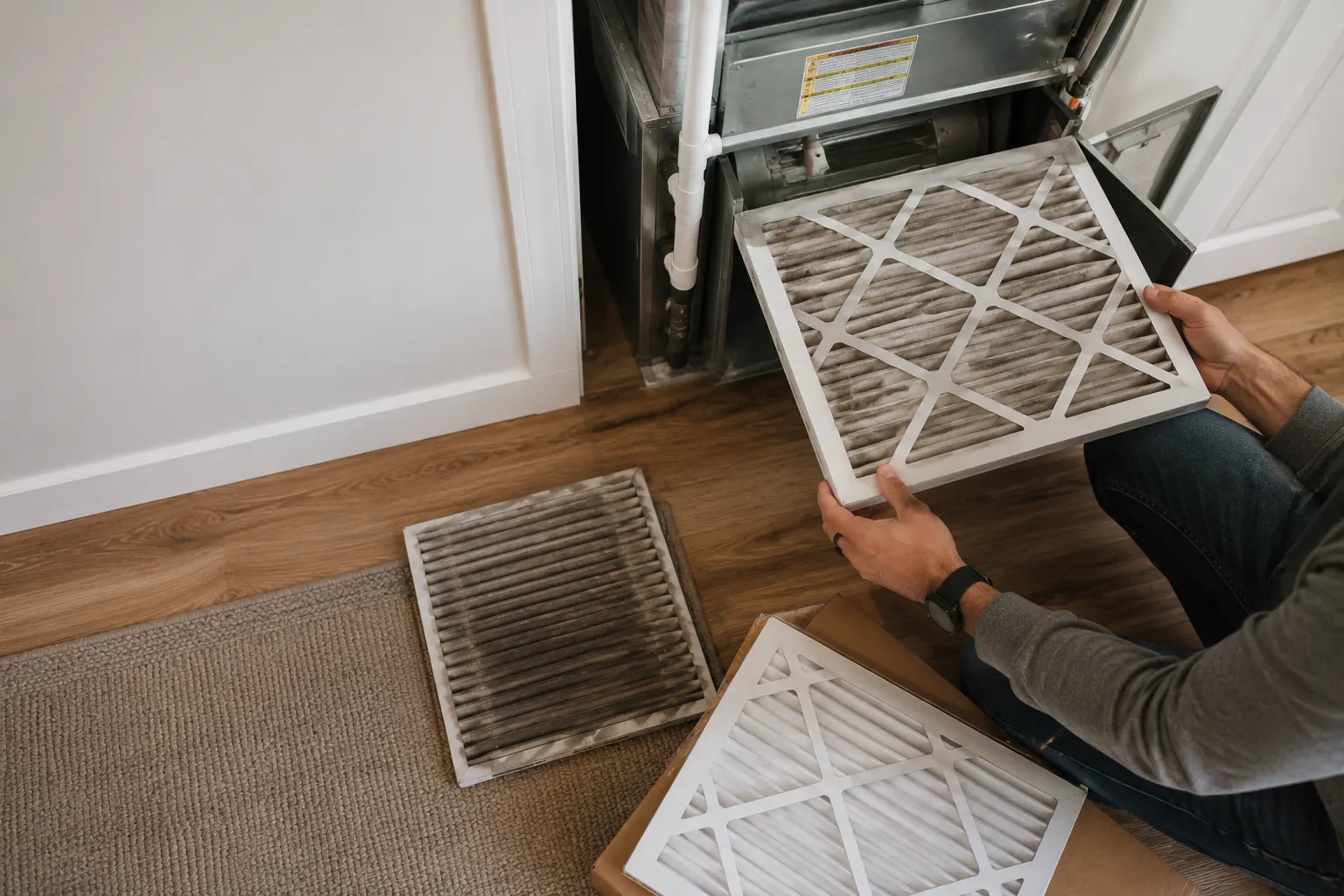
Keep the filter decision tied to the actual system
The manual and approved access method lead this cycle; a calendar reminder is only the prompt to inspect.
Record the exact approved filter
Keep the manufacturer-authorized type, dimensions, rating, orientation, and access rule with the household equipment record.
Inspect at the right trigger
Use the manufacturer schedule, heavy-use months, and changed conditions such as smoke, pets, or renovation dust to decide when to look.
Replace or escalate
Replace or clean only as the exact equipment instructions allow; stop for uncertain fit, access, airflow, or equipment changes and use the responsible professional.
Identify the exact filter before buying
Record five facts from the current approved filter, manual, lease procedure, or service invoice:
- Location. Return grille, furnace cabinet slot, air handler, room unit, or mini-split head.
- Dimensions. Nominal dimensions on packaging may differ from the actual measured frame.
- Type. Disposable pleated, washable, electronic component, or model-specific mesh.
- Efficiency rating. MERV or another stated rating, not a color or marketing phrase.
- Airflow direction. The arrow normally points in the direction air travels toward the blower, but follow the exact equipment layout and instructions.
Do not assume two filters labeled 16 by 25 by 1 fit the same slot. Do not stack thin filters, trim the frame, crush the media, leave gaps, tape a filter into equipment, or substitute a material not designed for the system.
If the access requires removing an equipment panel, reaching near wiring or moving parts, climbing, or entering a restricted mechanical room, stop. Ask the property manager or technician to handle it.
Use inspection intervals and replacement triggers
Start with the manufacturer’s interval. Then shorten the inspection interval when the system runs more or the environment changes.
| Condition | Scheduling response |
|---|---|
| Peak heating or cooling season | Inspect more frequently because fan runtime is higher |
| Wildfire smoke or outdoor particle event | Follow current EPA and manufacturer guidance; inspect after the event and expect faster loading |
| Renovation, sanding, or construction dust | Isolate the work correctly and ask whether HVAC should run; inspect after authorized operation |
| Multiple pets or visible shedding | Check more often rather than assuming a fixed pet formula |
| New home, new filter, or changed rating | Inspect early to establish the actual loading pattern |
| Long vacancy | Check before return and investigate moisture, pest, or equipment concerns before operation |
| Unexplained weak airflow or longer cycles | Do not diagnose only from the filter; call service if replacement does not resolve a normal-condition issue |
Replace or clean the filter when the manual says it is due, a normal visual check shows loading, a filter indicator follows its documented replacement trigger, or a qualified service professional directs it. Do not rely on a single photograph, a homemade pressure test, or the filter’s color alone.
Understand MERV without chasing the highest number
MERV stands for Minimum Efficiency Reporting Value. EPA explains that the rating describes a filter’s ability to capture particles in tested size ranges. A higher MERV generally captures more particles, but the filter must still fit and the system must be able to move air through it. (Source: U.S. Environmental Protection Agency, What is a MERV rating?.)
EPA recommends MERV 13, or the highest rating the system fan and filter slot can accommodate, when improved fine-particle filtration is the goal. It also advises consulting the manual or an HVAC professional before changing the filter. That qualification matters.
Do not upgrade based only on a health concern, smoke forecast, or package claim if system compatibility is unknown. An unsupported filter can change airflow and equipment behavior. Ask the technician to document:
- the highest compatible efficiency and filter depth;
- whether fan settings or hardware need professional adjustment;
- how often to inspect under the household’s conditions;
- what airflow or comfort changes require a callback;
- whether portable filtration is a better supplement for a specific room.
The wildfire filtration guide covers MERV, portable cleaners, CADR, smoke, ozone, and power as one decision rather than turning a filter number into a universal promise.
Replace an accessible disposable filter safely
Use only the manufacturer or property procedure. A typical household-level sequence is limited to:
- Confirm the exact replacement filter before disturbing the current one.
- Use the normal control or procedure specified by the manufacturer so the fan cannot start during the user-authorized change.
- Keep children, pets, water, and loose objects away from the work area.
- Note the existing airflow arrow and installation orientation before removal.
- Remove the filter without forcing it or striking nearby components.
- Bag a heavily dusty filter without shaking or vacuuming it in the occupied area.
- Insert the exact approved replacement squarely, with no bend, gap, stacking, or improvised seal.
- Restore only the normal control specified by the procedure.
- Record the date, filter identity, condition, and any abnormal sound, odor, airflow, or fault.
Stop if the filter will not release normally, the replacement does not fit, the slot or grille is damaged, water or mold-like growth is present, wiring or a moving part is exposed, or the equipment behaves abnormally after the change.
ReadyLience cannot provide a universal shutdown or access sequence because equipment designs differ. The exact manual controls the job.
Handle washable and mini-split filters differently
“Washable” is not a generic instruction. Use only the cleaning method, drying time, reinstallation condition, and replacement interval in the exact manual. Never reinstall a wet filter unless the manufacturer explicitly describes that state. Do not add fragrance, disinfectant, oil, coating, or household chemical.
Ductless mini-splits often use model-specific screens or filters at each indoor head. EPA notes that a mini-split primarily filters air in the room where it operates and may not have a high-efficiency filter. Check the verified rating rather than assuming a mesh screen performs like MERV 13 or HEPA media. (Source: EPA, Do ductless mini-split heat pumps filter fine particles?.)
Do not open a head beyond the user-access method, wash an electrical section, reach near louvers or a fan, or treat the unit for mold. Use qualified service for internal cleaning, drainage, contamination, unusual odor, or performance changes.
Do not run contaminated HVAC to test it
If there is known or suspected mold in the system, visible growth near an intake, sewage or flood exposure, smoke damage, pest contamination, wet insulation, or standing water in equipment, do not turn the system on as a test. EPA warns that contaminated HVAC can spread mold through the building.
Use the HVAC warning-sign guide and qualified indoor-air, remediation, and HVAC professionals. A clean replacement filter does not clear contaminated ductwork, insulation, coils, pans, or a moisture source.
Create a household filter card
Keep a small card near the maintenance records, not inside equipment:
- system and zone;
- exact filter location;
- dimensions and approved model/type;
- approved rating range;
- responsible person under the lease or service agreement;
- last inspection, replacement, and next inspection;
- seasonal, pet, smoke, and renovation notes;
- service contact and stop conditions.
Take a new photo of the packaging and date field after every change. Remove private address or account data before sharing it.
Know what a filter cannot prove
A clean filter does not prove that ducts are clean, refrigerant is correct, a heat exchanger is safe, airflow is balanced, indoor air is healthy, a room is protected from smoke, or the system is ready for peak weather. It is one fitted maintenance component.
Pair the filter record with the seasonal HVAC checklist, the equipment manual, and professional service. That combination turns an arbitrary reminder into a traceable maintenance system.
Sources reviewed
ReadyLience reviewed current filter, MERV, mini-split filtration, and HVAC maintenance guidance from ENERGY STAR and the U.S. Environmental Protection Agency on July 14, 2026. Exact manufacturer instructions, property procedures, current air-quality guidance, recalls, and qualified HVAC or indoor-air review control the filter used in a particular system.