
The best wildfire-smoke air cleaner is not the device with the most dramatic marketing language. It is one that delivers enough verified particle-free airflow for the real room, runs safely at a tolerable noise level, uses replaceable filters you can obtain, and fits the household’s power plan.
This guide explains how to compare equipment. ReadyLience has not yet completed hands-on product testing for this category, so it does not name a “best” model or present affiliate recommendations as evidence.
This is the smoke-specific extension of the HVAC and climate-control hub. Use the routine filter schedule for ordinary maintenance outside a smoke event.
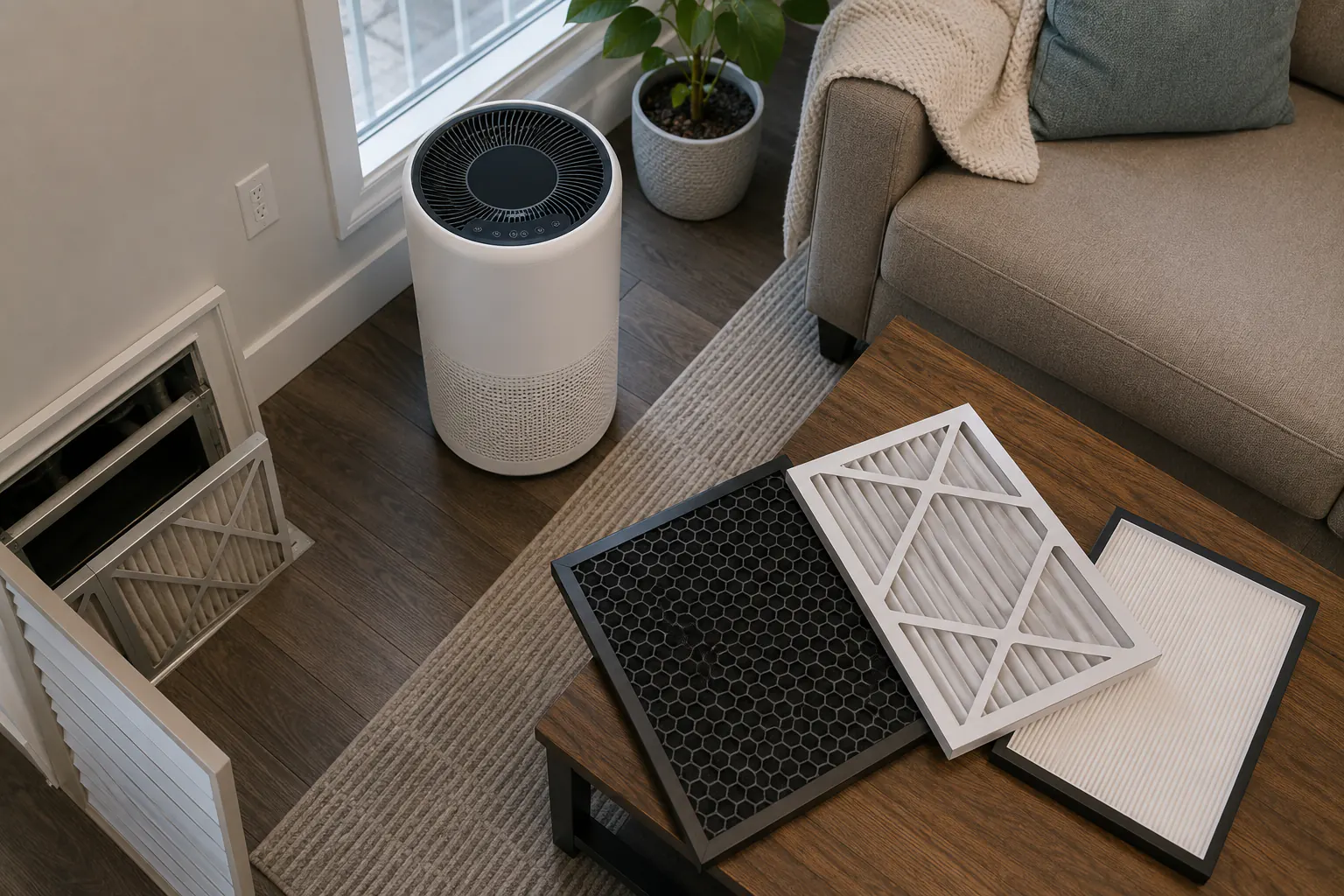
Begin with what filtration can do
Mechanical filters can remove fine particles, including PM2.5 in wildfire smoke, from air that passes through them. Filtration can reduce exposure indoors when smoke enters a building.
It cannot make these conditions safe:
- an evacuation zone or approaching wildfire;
- carbon monoxide or oxygen deficiency;
- every gas, vapor, odor, or combustion chemical;
- dangerous indoor heat;
- structural fire residue, asbestos, lead, or hazardous ash;
- a failed electrical system;
- severe symptoms requiring medical care.
Use the wildfire smoke preparedness hub to decide whether the household should remain, move to a cleaner-air space, or evacuate.
Compare the three practical filtration paths
| Path | Useful scope | Main selection evidence | Main limitations |
|---|---|---|---|
| Portable mechanical air cleaner | One room or occupied zone | Smoke CADR, room size, HEPA or verified particle filtration | Noise, filter cost, power, placement, one-room coverage |
| Central forced-air HVAC filter | Multiple rooms served by the system | Compatible filter dimensions and MERV, system airflow, fan operation | System compatibility, duct leakage, fan energy, no help when power is off |
| DIY fan-and-filter cleaner | Temporary lower-cost room filtration | Current EPA design and safety guidance, MERV 13 filters, newer certified fan | Variable construction and performance, exposed fan, larger footprint, no standardized unit-to-unit result |
Many households use more than one path. A central filter can reduce whole-home particle levels while a portable unit provides more clean air in the occupied room.
Size a portable cleaner by clean-air delivery
Room square-foot claims are easy to compare but can hide ceiling height, test assumptions, fan speed, and target air changes. Clean Air Delivery Rate, or CADR, expresses filtered airflow in cubic feet per minute for a pollutant category.
For wildfire smoke, use the smoke CADR, not pollen CADR. A larger CADR delivers more particle-filtered air per minute under the rating conditions.
One useful cross-check is:
air changes per hour = smoke CADR × 60 ÷ room volume in cubic feet
A 300-square-foot room with an 8-foot ceiling has 2,400 cubic feet of volume. A smoke CADR of 200 cfm would provide a theoretical five air changes per hour before accounting for outdoor infiltration, room mixing, open doors, filter loading, and real operating speed.
Do not treat one air-change number as a universal medical threshold. Use current EPA and local public-health guidance, the actual smoke severity, vulnerable occupants, room leakage, and clinician plans. Oversizing can help a unit deliver useful clean air at a quieter lower speed, but it costs more and may draw more power.
Understand HEPA without stopping at the label
HEPA describes a high-efficiency particle filter. It does not state the complete appliance airflow, room coverage, noise, leak control, replacement availability, or smoke CADR.
A small device can contain HEPA media and still deliver too little clean air for a large room. Conversely, a high CADR depends on both filter efficiency and airflow through the complete unit.
Compare:
- smoke CADR at a documented speed;
- room-size assumptions and ceiling height;
- noise at the speed you will actually tolerate;
- replacement-filter model, price, and availability;
- electrical watts at useful settings;
- physical stability, control lock, and clearance needs;
- whether optional ionization or another electronic feature can be disabled;
- warranty, parts, and filter-change instructions.
Avoid a unit that requires an unavailable proprietary filter during smoke season. Keep at least one correctly stored replacement when regional smoke is likely.
Exclude intentional ozone generation
Ozone is a lung irritant. EPA states that no federal agency has approved ozone generators for use in occupied spaces, and its current wildfire guidance does not recommend electronic air cleaners for smoke removal.
Marketing terms such as ionizer, plasma, electrostatic, hydroxyl, active oxygen, photocatalytic oxidation, or ultraviolet do not prove smoke-particle removal. Some technologies may produce ozone or other byproducts, and UV treatment does not physically remove smoke particles.
Prefer straightforward mechanical filtration with performance evidence. California’s CARB-certified list is useful for ozone-emission screening, but certification does not prove adequate smoke CADR, room sizing, quiet operation, filter value, or product quality.
Fit the HVAC filter to the actual system
MERV rates the particle-removal efficiency of filters used in many forced-air systems. EPA commonly recommends MERV 13 for wildfire smoke, or the highest efficiency the system fan and filter slot can accommodate.
Before upgrading, record:
- exact length, width, and depth printed on the current filter;
- actual measured dimensions when nominal sizing is ambiguous;
- airflow arrow direction;
- filter-rack condition and bypass gaps;
- equipment model and manufacturer limits;
- whether the system supplies outdoor air;
- whether fan operation can be set to run more frequently.
Do not force a filter into the rack, stack filters, reverse airflow, or improvise a restrictive insert. Excessive pressure drop can reduce airflow and affect comfort or equipment. A qualified HVAC professional can evaluate compatibility when documentation is unclear.
High-efficiency filtration works only while air moves through it. EPA guidance often recommends running a compatible system fan as much as possible during smoke. Consider fan energy, noise, filter loading, cooling demand, and system condition.
The system may still draw outdoor air through a dedicated intake, economizer, ventilation controller, or building-wide system. Learn how recirculation works before the event; renters should coordinate with management rather than alter shared controls.
Treat room air conditioners separately
A cooling appliance is not automatically a smoke filter.
- Window units may have an outdoor-air vent or leakage path; identify and configure the actual model.
- Single-hose portable air conditioners exhaust indoor air and can pull smoky air through building leaks.
- Dual-hose units separate intake and exhaust paths differently, but installation and sealing still matter.
- Evaporative coolers rely on outdoor air and are difficult to reconcile with heavy smoke.
- Ductless mini-splits recirculate room air, but their internal screens or filters do not automatically equal a high-CADR smoke cleaner.
When heat and smoke overlap, the system must manage both. The cleaner-air room guide and extreme heat preparedness guide define the decision to stay, cool, or move.
Use DIY air cleaners as a deliberate fallback
EPA recognizes DIY air cleaners as a temporary alternative when commercial products of known performance are unavailable or unaffordable. Its current research shows that design, filter thickness, shrouds, and number of filters materially change CADR.
Use a current EPA design rather than an improvised photograph. EPA safety guidance calls for a newer box fan, generally 2012 or later, with a recognized UL or ETL safety marking and the added safety features found in newer models.
Follow fan instructions. Do not use a damaged fan or cord, an extension cord prohibited by the instructions, an unstable assembly, or blocked airflow. Keep children and pets supervised, maintain working smoke alarms, and stop use for heat, odor, noise, vibration, or electrical abnormality.
DIY performance varies between assemblies and after filter replacement. It should not be presented as identical to a standardized commercial unit merely because the filter has the same MERV rating.
Plan replacement filters and handling
Heavy smoke can load filters faster than a normal calendar interval. EPA advises changing a filter when it becomes dirty or begins releasing smoke odor and keeping extras available.
Also follow the manufacturer and HVAC instructions. A rising noise level, reduced airflow, visible loading, service indicator, or system problem may require attention before the nominal date.
Turn equipment off before service. Avoid shaking or brushing a loaded filter. Remove it gently, bag it when appropriate, wash hands, and follow local disposal guidance. People who should avoid ash or smoke exposure should not handle heavily contaminated filters.
Never wash a disposable filter unless the manufacturer explicitly designed and instructs it for washing. Water can damage filter media and create biological growth.
Include noise, heat, and electricity in the comparison
An air cleaner must run to work. Compare noise at the useful smoke setting, not only sleep mode. A quiet low speed with very low CADR may not meet the room plan.
Measure watts at intended speeds when possible. Estimate usable battery runtime with the power-station runtime calculator. Include inverter losses, battery reserve, changing filter load, charging limits, and other critical devices.
Do not place an air cleaner on an overloaded circuit or daisy-chain power strips. Do not run a generator indoors to preserve filtration. The planned wildfire-smoke outage guide will prioritize cleaner-air movement before unsafe backup power.
Build a truthful product test later
Any future ReadyLience “best air purifier” comparison should document:
- purchased or transparently supplied products;
- room volume and controlled particle source;
- calibrated reference instrument and sensor limitations;
- particle reduction over time at multiple speeds;
- measured watts and noise at a fixed distance;
- filter fit, replacement cost, and availability;
- controls, error states, stability, and child/pet considerations;
- ozone certification and whether electronic features can be disabled;
- repeated trials and raw-data retention;
- conflicts, affiliate relationships, and update dates.
Until that work exists, manufacturer claims and research-based selection guidance must remain visibly distinct from hands-on testing.
Pre-season selection checklist
- Measure the occupied room and ceiling height.
- Compare smoke CADR, not only advertised square feet.
- Prefer documented mechanical particle filtration.
- Exclude intentional ozone generation and unsupported technology claims.
- Confirm exact HVAC dimensions and system compatibility.
- Understand outdoor-air and recirculation controls.
- Compare useful-speed noise and power.
- Price and source replacement filters before purchase.
- Keep one correctly stored replacement for smoke season.
- Measure the real load for outage planning.
- Test placement without blocking exits or airflow.
- Write the conditions that trigger movement to a public cleaner-air location.
Filtration is a system: clean-air delivery, room leakage, operating time, indoor sources, heat, filter condition, and occupant needs all determine whether the equipment meaningfully reduces exposure.
Sources reviewed
- U.S. EPA: Wildfire Smoke: A Guide for Public Health Officials, 2026
- U.S. EPA: Wildfires and Indoor Air Quality
- U.S. EPA: Research on DIY Air Cleaners to Reduce Wildfire Smoke Indoors
- U.S. EPA: Air Cleaners and Air Filters in the Home
- U.S. EPA: Frequent Questions About Wildland Fire Smoke for Individuals
- California Air Resources Board: Certified Air Cleaning Devices
Sources reviewed July 14, 2026. Product specifications, filter availability, system compatibility, and current official smoke guidance require rechecking before purchase or use during a smoke event.