
Before smoke arrives, choose one room where everyone can sit comfortably and leave without moving supplies. Then identify where you would go if smoke, heat, or a power loss makes that room unusable. Confirm the destination is open, reachable, outside any evacuation threat, and able to meet the household’s needs.
A cleaner-air room reduces smoke-particle exposure while it remains safe to stay indoors. It is not a sealed bunker or a fire shelter. During an event, follow current evacuation and public-health instructions first; do not delay help or movement to finish this checklist.
This is the smoke-specific extension of the HVAC and climate-control hub. Routine maintenance and filter scheduling remain separate from event decisions.
Confirm that staying is still allowed
Check local emergency-management and fire information before changing the room. An evacuation order, approaching fire, structure fire, gas odor, carbon-monoxide alarm, electrical hazard, or unsafe building overrides cleaner-air-room use.
Keep alerts audible and the wildfire evacuation plan ready. Do not tape a required exit shut, bury keys under supplies, or place equipment and cords in the travel path.
Call 911 for an immediate threat or severe medical emergency. Follow clinician action plans for asthma, COPD, heart disease, pregnancy, medication, oxygen, or another condition affected by smoke.
Choose the room before the event
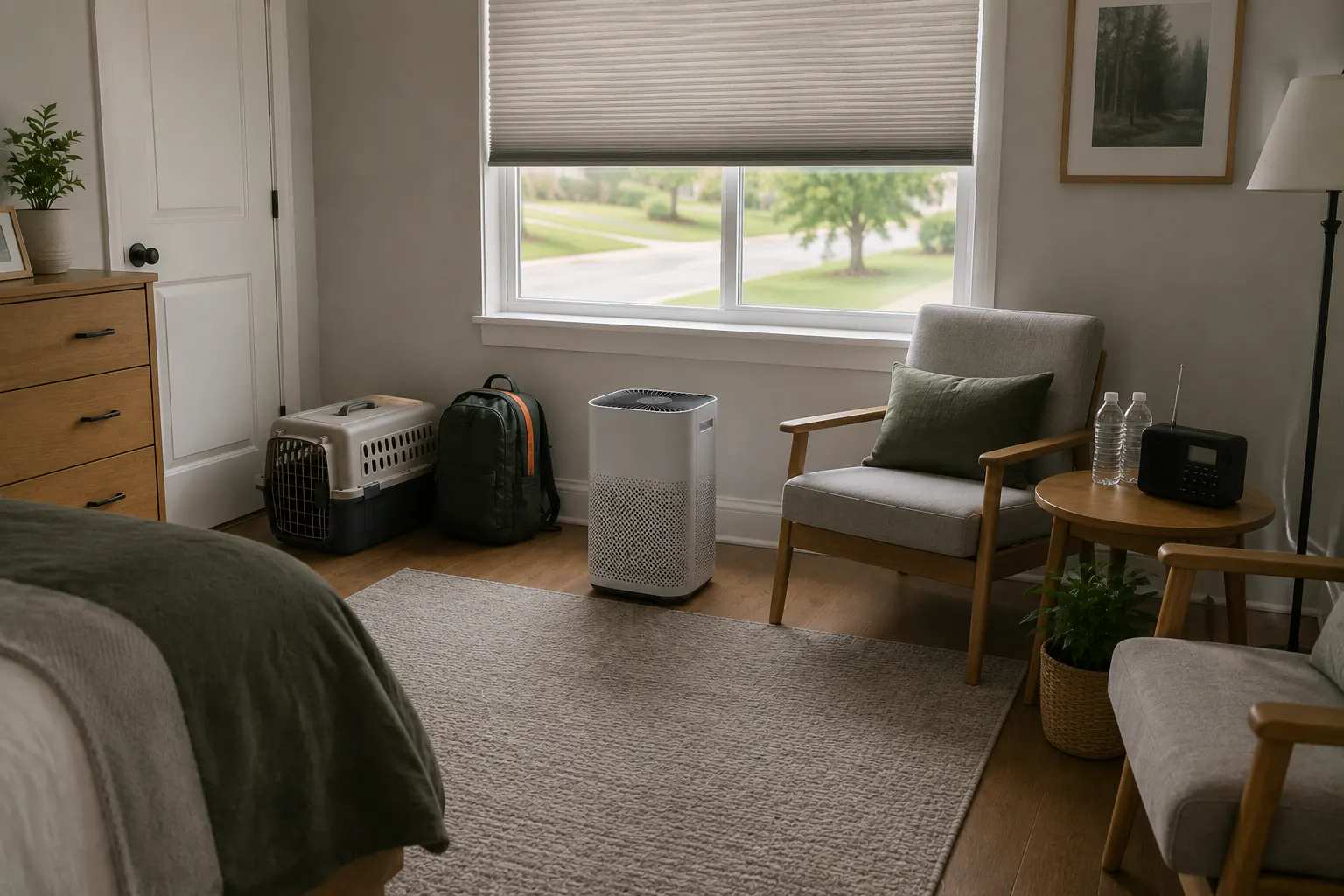
EPA’s How to Create a Cleaner Air Room at Home recommends a comfortable room large enough for everyone, with cooling and a clear way out. An attached bathroom can reduce trips through other rooms, but it is not essential.
Prefer a room with:
- enough floor area and seating for people and household pets;
- a door that closes normally;
- few exterior openings and no obvious large leaks;
- reliable electrical receptacles without daisy-chained cords;
- safe cooling or a realistic route to a cleaner-air cooling location;
- working smoke and carbon-monoxide alarms appropriate for the home;
- phone or radio reception and accessible charging;
- a direct, unobstructed route to an exit.
Avoid a garage, workshop, utility room, unfinished attic, crawlspace, or another area with fuel, solvents, combustion appliances, contaminated dust, poor egress, or dangerous heat. Do not select a room merely because it is easy to seal if it cannot support safe occupancy.
Apartments and shared buildings need an additional question: does the selected room receive air from a shared corridor, shaft, central ventilation system, or neighboring unit? Ask building management how the actual system operates during smoke. Do not close a damper or modify shared equipment based on guesswork.
Make a simple room record
Before buying equipment, record:
| Item | What to capture | Why it matters |
|---|---|---|
| Room | Dimensions and ordinary openings | Room sizing and occupied space |
| HVAC | Known system, filter, and outdoor-air controls | Compatibility questions to confirm |
| Cooling | Equipment and documented outdoor-air behavior | Smoke and heat conflicts |
| Electrical | Accessible receptacles and documented watts | Cord and backup-power constraints |
| Occupants | Space and assistance needed; care plan kept privately | Access and escalation needs |
| Exit | Usable routes, keys, carrier, and bag | Leaving without moving supplies |
Start with manuals and information you already have. Unknown filter compatibility or outdoor-air controls are questions for building management or a qualified HVAC professional, not a reason to open a cabinet or move equipment. Label photos are optional and only useful when accessible safely during normal conditions. Keep care details and the room record private; do not delay help to gather them.
Reduce smoke entry within safe limits
When smoke arrives and authorities still advise staying indoors, close exterior windows and doors. Limit unnecessary opening. Close a fireplace damper only when the fireplace is completely out and the manufacturer and building instructions allow it.
Use temporary weather sealing only on ordinary leaks you can identify safely. Never cover:
- a combustion-air opening or appliance vent;
- a dryer, kitchen, or required bathroom exhaust;
- a smoke or carbon-monoxide alarm;
- a fire-sprinkler component;
- an electrical panel or heat-producing device;
- a required window or door exit;
- shared-building ventilation you are not authorized to alter.
The room does not need to be airtight. Occupants still produce heat, moisture, and carbon dioxide, and the building may depend on designed ventilation. Smoke reduction must remain compatible with the actual home and its fuel-burning equipment.
Configure HVAC and cooling deliberately
Learn the system before the event. If a central HVAC system has a fresh-air intake, EPA guidance advises closing it or setting the system to recirculate during smoke when that is safe and the system permits it. Some controls are automatic, inaccessible, or shared; use the manual, building management, or a qualified HVAC professional.
EPA recommends high-efficiency filtration compatible with the system, commonly MERV 13 or higher where supported. Confirm compatibility with the manufacturer or a qualified HVAC professional before upgrading. Follow only the user-access maintenance tasks your manual and building permission allow; a higher number is not useful if the filter does not fit or impairs airflow.
Room equipment behaves differently:
- many window air conditioners recirculate indoor air but may have an outdoor-air vent that should be understood;
- a single-hose portable air conditioner can depressurize a room and draw smoky air through leaks;
- an evaporative cooler intentionally uses outdoor air and may conflict with smoke control;
- a ductless mini-split typically recirculates room air but does not replace a particle air cleaner unless its verified filtration supports that role.
Do not infer operation from the product’s appearance. Follow the model instructions and professional guidance.
Add particle filtration
Place a portable air cleaner where occupants spend time and where its inlet and outlet remain unobstructed. Select it for the room size using smoke CADR or another credible particle-performance measure. Avoid intentional ozone generation.
Run the cleaner as often and as fast as practical during smoke, balancing noise, heat, power, and household tolerance. Keep replacement filters available because heavy smoke can shorten their useful life.
The air purifier and HVAC filter guide explains sizing, HEPA, CADR, MERV, ozone, DIY alternatives, and filter replacement in greater depth.
Do not place a cleaner where curtains, bedding, furniture, clothing, toys, or a wall block airflow. Keep it stable and away from water. Protect controls and cords from children and pets without compromising ventilation around the unit.
Stop generating particles indoors
During smoke, avoid adding particles in the room or elsewhere in the home. EPA guidance identifies smoking, vaping, candles, incense, fireplaces, aerosol sprays, frying, broiling, and vacuuming without appropriate high-efficiency control as sources to avoid.
Use simpler food that does not create smoke. Outdoor-only grills, camp stoves, generators, and charcoal must not be used indoors, in a garage, porch, carport, basement, or partially enclosed space. Do not obstruct required ventilation for installed fuel-burning appliances.
Review generator carbon monoxide safety before any outage. A cleaner-air room cannot filter carbon monoxide into safety.
Arrange the occupied space
Keep the room functional for more than an hour. Provide:
- seating and accessible floor routes;
- drinking water and simple food appropriate for the household;
- medication and medically directed supplies;
- phone, radio, charging, and paper contacts;
- pet water, carriers, leashes, litter or sanitation needs;
- quiet activities for children and adults;
- a thermometer and, when useful, a particle sensor understood as a trend tool;
- the go-bag, shoes, keys, and outer layer near the exit.
Avoid crowding the room with a season’s worth of supplies. Overloaded receptacles, unstable stacks, blocked doors, and trip hazards make evacuation harder.
Monitor heat as carefully as smoke
Closed windows and continuous equipment can raise temperature. Check the room, the most vulnerable occupant, and the outdoor-air outlook repeatedly.
The correct decision is not always “keep everything closed.” If the room becomes dangerously hot and cannot be cooled without bringing in smoke, move early to a confirmed public cleaner-air and cooling location outside any fire or evacuation threat.
Use the extreme heat preparedness guide for heat symptoms, cooling priorities, vulnerable households, and movement decisions. Do not wait for heat illness to become severe.
Prepare for loss of power
Use existing documentation or normal-operation measurements for the air cleaner’s watts at the intended speed. Do not create smoke, interrupt essential equipment, or simulate an outage to collect a number. Keep any medical-device backup plan under the clinician and equipment provider’s instructions.
The power-station runtime calculator can model selected low-wattage loads, but it does not approve a battery, extension cord, air conditioner, or medical plan. Central HVAC, air-conditioning, and electric-heating loads can exceed portable systems quickly.
If power loss removes filtration or cooling and the room no longer controls the main risks, use the household’s confirmed cleaner-air destination. The wildfire smoke power-outage guide helps sequence this decision.
Know the stop conditions
Leave the room or escalate when:
- authorities order evacuation or the fire threat changes;
- smoke rapidly worsens indoors despite closed openings and filtration;
- the room cannot remain at a safe temperature;
- a smoke or CO alarm sounds;
- an appliance, outlet, cord, air cleaner, or HVAC system overheats, smells unusual, arcs, or fails;
- a medical action plan calls for movement or treatment;
- anyone develops severe breathing difficulty, chest pain, confusion, fainting, blue or gray lips, or another emergency sign;
- the room cannot support disability, sanitation, medication, pet, or medical-device needs.
Call 911 for emergency symptoms or immediate threats. Do not drive into an evacuation zone to reach a preferred cleaner-air destination.
Reopen the room after outdoor air improves
EPA’s cleaner-air-room guidance advises airing out the room when outdoor air quality improves, even temporarily. Follow current local air-quality, fire, weather, and building instructions; close openings again if smoke returns. Do not treat a forecast as permission to ignore conditions at the home.
Inspect and replace filters according to observed loading, manufacturer instructions, and current EPA guidance. Handle dirty filters gently so captured particles are not released. Check the room for ash or contamination before ordinary cleaning.
Do not assume odor means the air is unsafe or that no odor means it is safe. Odor, PM2.5, gases, heat, and fire contamination are different measurements.
Cleaner-air room checklist
- Staying indoors remains authorized and fire-safe.
- The room fits people, pets, mobility, and medical needs.
- Required exits, alarms, vents, and combustion air remain unobstructed.
- HVAC and outdoor-air controls are understood, not guessed.
- Compatible filtration is installed correctly and sized for the room.
- Ozone-generating equipment is excluded.
- Indoor particle sources are stopped.
- Temperature, alerts, symptoms, and equipment are monitored.
- Power-loss runtime and cleaner-air destinations are written down.
- Bags, keys, carriers, shoes, and routes remain ready for evacuation.
Your next step is small: name the room, the person who checks current instructions, and the destination to confirm before it is needed. Keep the exit usable throughout.
Sources reviewed
- U.S. EPA: How to Create a Cleaner Air Room at Home
- U.S. EPA: Create a Clean Room to Protect Indoor Air Quality During a Wildfire
- U.S. EPA: Create a Clean Room During a Wildfire Infographic
- U.S. EPA: Wildfires and Indoor Air Quality
- U.S. EPA: Wildfire Smoke: A Guide for Public Health Officials, 2026
- AirNow: Fire and Smoke Map, Version 4
Sources reviewed July 14, 2026. Local fire, emergency, public-health, air-quality, building, HVAC, utility, and clinician instructions control actual use.
October 3, 2026 update: checked EPA’s cleaner-air-room guidance for room choice, compatible filtration, and ventilation during improved outdoor air. This is not a new review of every source or an approval of a particular home or device.