
Learn local alert terms and arrange transport for whoever needs more time before fire season. During an incident, leave promptly when ordered and earlier when the local plan or immediate conditions require it. Do not wait to finish packing, defend property or reunite inside the threat area.
Local jurisdictions use different labels for evacuation preparation, warnings, and orders. Learn the exact language and zones where you live. A social-media color chart from another state is not your authority. Evacuation is the sharpest decision inside the wildfire and smoke preparedness plan; the air-quality and home-hardening work lives there.
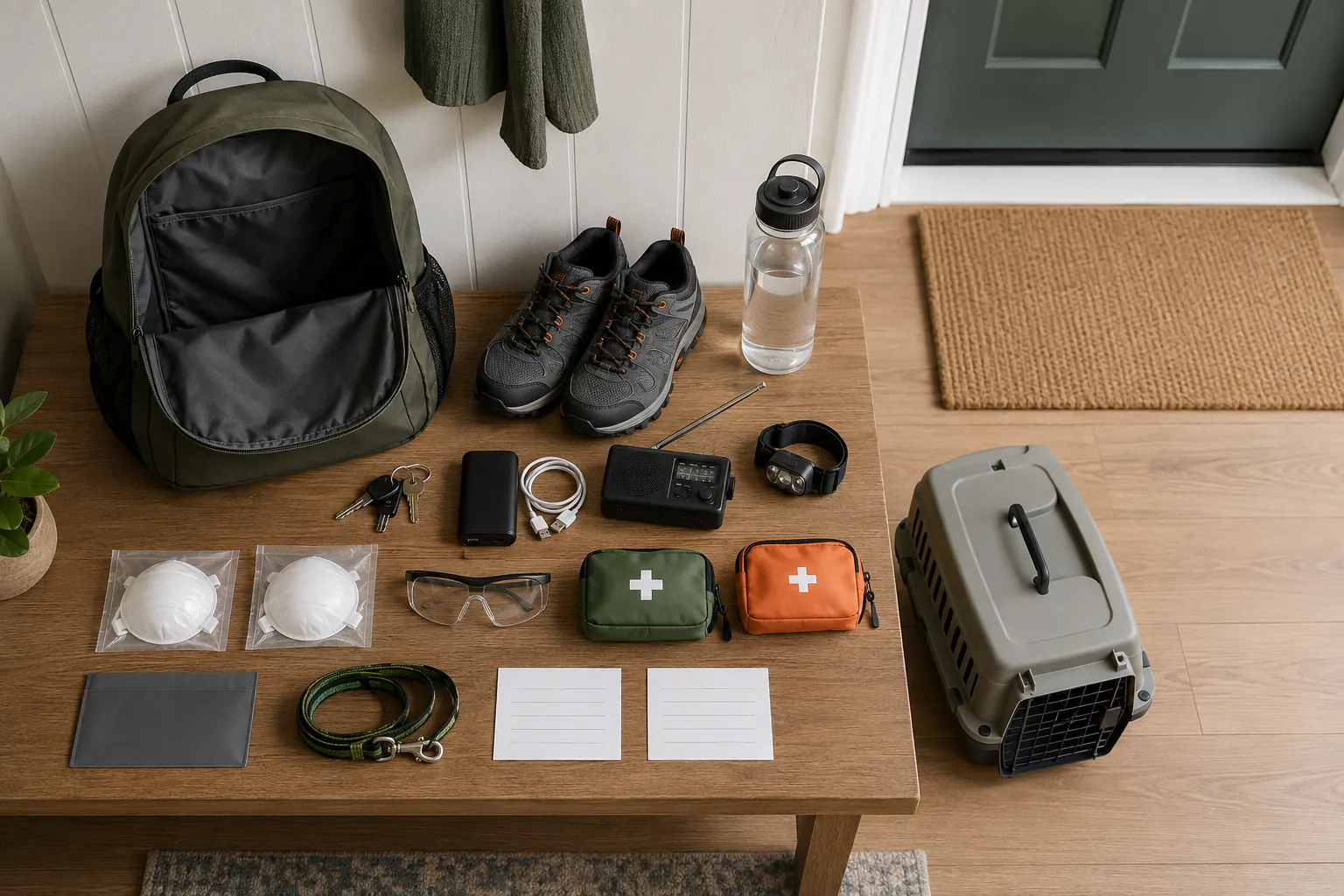
Leave when ordered and earlier when necessary
Go promptly when officials order evacuation. U.S. Fire Administration guidance also tells residents not to wait for an order if they feel unsafe. Earlier departure can be especially important for:
- people who need mobility or medical assistance;
- households with infants, older adults, or multiple children;
- people without a reliable vehicle;
- pets, livestock, trailers, or specialized transport;
- narrow, steep, gated, wooded, or single-access roads;
- limited fuel, charging, visibility, or communication;
- destinations that require advance confirmation.
Do not delay to take photographs, water a roof, deploy equipment, pack optional property, watch flames, or wait for every household member to return home. Use the separate reunion plan.
If trapped, call 911, give the precise location and conditions, and follow dispatcher instructions. Do not drive through flame, heavy ember exposure, downed lines, blocked roads, or an unofficial “shortcut” because a generic article suggests movement.
Identify the local decision system
Before fire season, record:
- the evacuation zone name or number for home, work, school, and care locations;
- official alert registration and notification methods;
- fire, law-enforcement, emergency-management, and transportation sources;
- local terms for prepare, warning, and order;
- shelters, cleaner-air spaces, animal shelters, and accessibility contacts;
- emergency transportation or paratransit enrollment;
- re-entry authority and credential requirements.
Enable Wireless Emergency Alerts and local opt-in notifications. Keep a battery radio and paper list because internet, towers, and power can fail.
The family communication plan provides out-of-area contacts, meeting points, and check-in messages.
Build two routes to two destinations
Map at least two ways out of the neighborhood and community. Drive them in ordinary conditions and note gates, bridges, one-way sections, low-clearance roads, seasonal closures, construction, schools, fuel stations, and places likely to congest.
Routes are candidates, not promises. Wind, fire, smoke, debris, traffic control, and responder access can close the preferred road. Follow official routing during the incident.
Choose destinations in different directions and outside the likely hazard area:
- family or friends who have agreed to receive the household;
- hotels with confirmed pet and accessibility policies;
- official shelters or reception centers;
- cleaner-air and cooling spaces for smoke-sensitive people;
- livestock facilities arranged in advance.
Record street address, coordinates, phone, alternate contact, check-in time, animal rules, power/medical capability, and a backup if the destination closes.
Plan every person’s movement
Assign roles without making one person indispensable:
| Need | Primary plan | Backup |
|---|---|---|
| Children | Named pickup authority and destination | School/care emergency procedure |
| Older adult or disability | Accessible vehicle and assistance contact | Local emergency transportation program |
| Medication/device | Grab location, battery, supplier and care plan | Alternate treatment destination |
| Person without car | Named ride with departure trigger | Transit, paratransit, or official assistance |
| Pet | Carrier/leash, records, destination | Backup handler and animal shelter |
| Livestock | Trailer, trained handler, facility | Prearranged local animal response contact |
Do not assume family members can cross an evacuation zone to reunite. The plan should allow people to leave from work, school, or care locations and meet outside the threat area.
Make the vehicle ready without creating another hazard
USFA advises keeping the fuel tank at least half full and, where appropriate, parking facing the direction of escape. Adapt this to local fire guidance, parking rules, theft risk, charging needs, garage configuration, and accessibility.
Before the season:
- maintain tires, brakes, fluids, lights, wipers, cabin filter, and cooling system;
- keep keys consistently accessible to authorized drivers;
- know how a garage door or gate operates during power loss;
- avoid storing fuel or loose heavy objects in the passenger compartment;
- keep paper maps and a vehicle charging cable;
- practice fitting people, mobility equipment, carriers, and the go-bag;
- identify fuel or charging options outside the evacuation zone.
Do not drain fuel by idling for device charging. Never run a vehicle in a garage, carport, or near openings. Electric-vehicle households should set an ordinary minimum charge and know multiple reachable chargers beyond the hazard area without depending on one network.
USFA cautions against using trailers or large vehicles during evacuation when the driver is not comfortable operating them. A stalled trailer, RV, or unfamiliar combination can block residents and responders. Move large animals earlier under the local plan.
Pack one carryable evacuation set
Keep the load realistic for the vehicle and people who may carry it. Include:
- identification and protected copies of critical records;
- medication, prescriptions, medical information, and device supplies;
- phone, battery bank, charging cables, radio, and paper contacts;
- NIOSH Approved respirators that fit intended wearers;
- water and compact food appropriate for the route;
- flashlight or headlamp and spare batteries;
- season-appropriate clothing, sturdy footwear, and eye protection;
- first-aid supplies and hygiene items;
- keys, payment methods, and a small amount of cash;
- child, disability, communication, and comfort needs;
- pet carriers, leashes, food, water, medication, records, and sanitation supplies.
A respirator can reduce inhalation of particles when it fits and is worn correctly. It does not protect against fire, carbon monoxide, oxygen deficiency, every gas, or dangerous heat.
Keep irreplaceable data backed up outside the home before fire season. The bag should not become too heavy or disorganized to move.
Use staged departure triggers
Write household actions for changing conditions without pretending they replace official levels:
Normal elevated risk
- monitor official fire weather and local restrictions;
- keep vehicles, devices, medication, and bags ready;
- confirm destinations and animal transport;
- postpone work that blocks access or creates ignition risk.
Nearby incident or local preparation notice
- bring people and pets together when safe;
- charge devices and load the vehicle without blocking the road;
- move livestock and mobility-dependent people under their earlier plan;
- stop nonessential projects and monitor continuously;
- leave early if the household’s written conditions are met.
Evacuation order or immediate threat
- take people, animals, medication, devices, bags, and keys;
- use the route directed by officials;
- close doors and windows if doing so does not delay departure;
- leave immediately and do not return for property.
Do not stay to perform last-minute landscaping, roof work, generator setup, or structure defense unless you are specifically trained, equipped, authorized, and operating within an official program.
Communicate with short messages
Send one message to the out-of-area contact:
EVACUATING | 4 people + 1 dog | Route directed by officials | Destination B | Next check-in 45 minutes
Do not post real-time empty-home status, route details, valuables, gate codes, or destination publicly. Use text rather than repeated voice calls when networks are congested.
If someone misses a check-in, follow the predetermined escalation. Do not drive back into the zone to search without responder direction.
Drive for visibility and responder access
Follow traffic control and official routes. Keep windows closed and vehicle ventilation on recirculate when the system instructions and conditions allow. Use headlights when visibility is reduced and avoid unnecessary stops.
Watch for:
- rapidly changing smoke and visibility;
- emergency vehicles and people evacuating on foot;
- fallen trees, rocks, ash, and debris;
- downed lines and anything touching them;
- animals and trailers;
- stalled or abandoned vehicles;
- fire equipment using the road in the opposite direction.
Do not photograph while driving, overtake evacuation traffic dangerously, stop on dry vegetation, or follow a navigation app onto a closed or unsuitable road. Preserve fuel and keep listening for rerouting.
If the vehicle fails, move only as officials direct, call 911 for immediate danger, give the location, and make the vehicle visible without entering a more hazardous area.
Evacuating without a private car
Register early for local accessible transportation, paratransit, evacuation assistance, or neighbor programs where offered. Ask exactly when service stops and how pets, mobility equipment, oxygen, and caregivers are handled.
Choose a named ride and backup. Do not rely on a last-minute rideshare operating inside an evacuation zone. Keep the bag carryable and stage mobility equipment by the exit without blocking it.
Apartment and high-rise residents should know stairs, areas of refuge if the building plan uses them, fire-alarm procedures, and management communication. Follow fire-department instructions; do not use an elevator during a fire evacuation unless authorities direct it.
After reaching the destination
Account for everyone, seek help for injury or illness, and send the planned status message. Register with the shelter or local system if requested. Keep monitoring incident instructions because the destination or route can change.
Do not return until the responsible authority allows re-entry for the exact zone. A map showing less smoke is not re-entry clearance. Expect power, water, roads, communications, and medical services to remain disrupted.
The wildfire smoke power-outage guide covers filtration and communication continuity while the hurricane evacuation guide offers additional transport and household-role planning that can be adapted without copying hazard-specific timing.
Practice the plan
Property mitigation is a separate, ordinary-day task. Before the season, use wildfire home risk assessment questions for local professionals to find the appropriate local assessment route. Never postpone departure for an assessment, vegetation work, or a home-hardening project.
- Receive a test alert and identify the zone.
- Account for every person and animal.
- Load the actual vehicle or carry the bag to the pickup point.
- Review the exact garage or gate outage instructions with the authorized user or qualified provider; do not disconnect power, defeat a lock or alter equipment for a drill.
- Drive both candidate routes in ordinary conditions.
- Confirm two destinations and their animal/accessibility rules.
- Send the status message and complete the next check-in.
- Record delays, missing items, blocked paths, and unclear roles.
- Correct the plan and repeat with the slower household member setting the pace.
Wildfire evacuation is not a packing contest. It is a rehearsed movement decision that protects time, routes, people, animals, and responder access.
Sources reviewed
- U.S. Fire Administration: Wildfire Evacuation
- U.S. Fire Administration: Wildfire Evacuation Checklist
- U.S. Fire Administration: During a Wildland-Urban Interface Fire
- Ready.gov: Be Prepared for a Wildfire
- CDC: Safety Guidelines for Wildfires and Wildfire Smoke
Sources reviewed July 14, 2026. Local fire, emergency-management, law-enforcement, traffic, shelter, animal, medical, and re-entry instructions control the incident.