
In calm conditions, ask your local fire or wildfire-mitigation program what assessment route applies to your address and who may authorize the work. During a warning or evacuation, follow current official instructions instead of inspecting the property. An assessment can inform a site-specific plan; it cannot fireproof the home or replace departure readiness.
This guide helps a household prepare for that conversation. It belongs in the early-warning diagnostics hub, beside the wildfire smoke preparedness hub and the evacuation-or-shelter decision guide, not in place of any of them. It never overrides an evacuation order or suggests a resident stay to defend property.
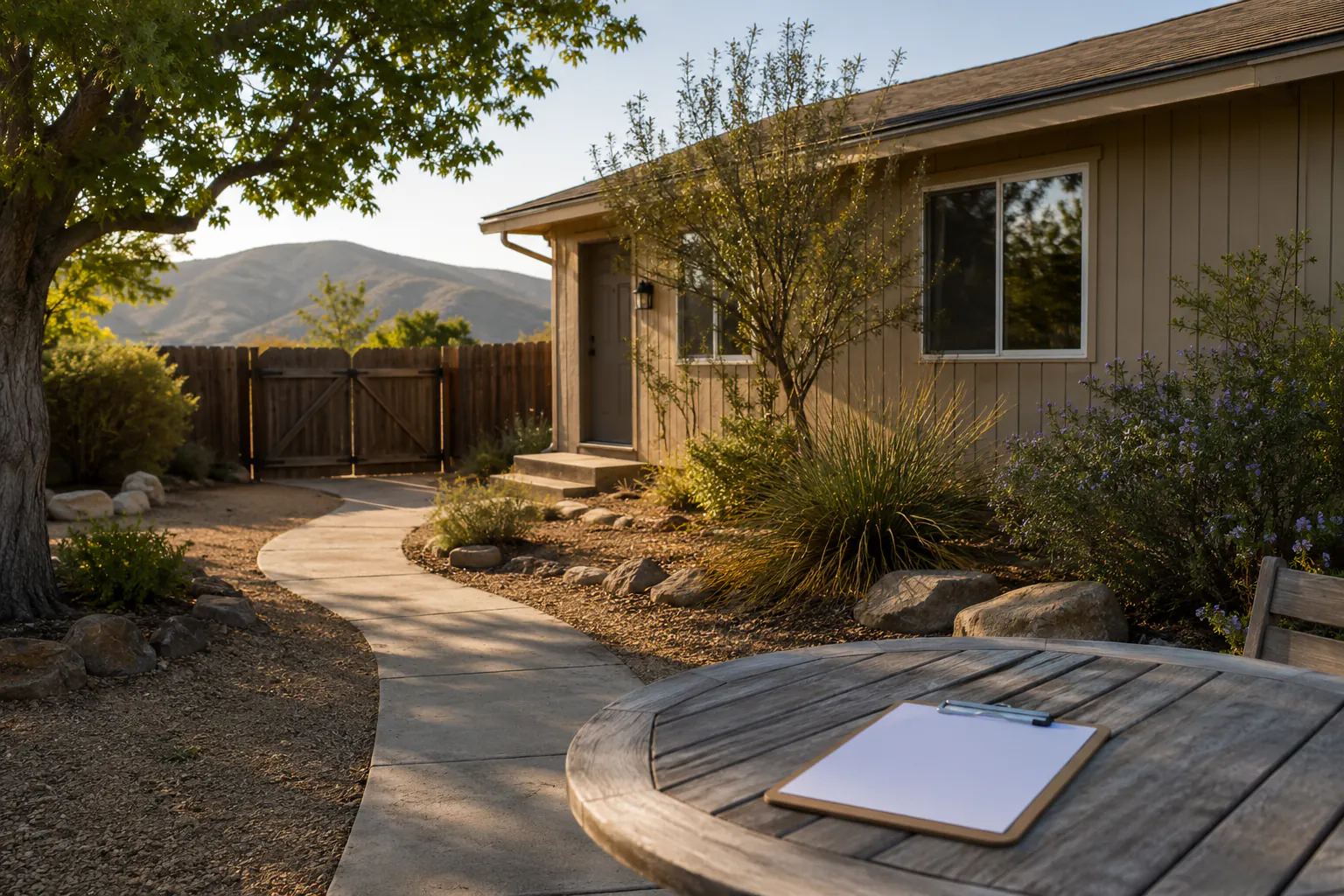
Start with the local risk picture
FEMA and the U.S. Fire Administration both emphasize that wildfire mitigation is local work. The first call may be a fire department, local forestry or emergency-management office, building department, utility, insurer, homeowners association, or a local wildfire-mitigation program. Ask which of these applies to your address before paying for an assessment.
Record only the facts needed for the conversation:
- address, property type, and whether the home is rented, owned, or part of a shared community;
- known local wildfire, evacuation, burn-restriction, and access information;
- prior fire, ember, smoke, wind, tree, drainage, roof, or exterior-maintenance records;
- dates and documents for material or roof work already completed; and
- questions about authority, permits, neighbors, shared access, and maintenance responsibility.
Do not enter a hazard area, climb a roof, clear vegetation during unsafe conditions, or inspect exterior openings with tools simply to improve the record. A site assessment is valuable precisely because it considers things a household cannot safely or reliably evaluate by itself.
Ask what the assessor will and will not examine
Before accepting a quote or visit, ask for the scope in writing.
- Is this a fire-department, community, insurer, consultant, landscape, roofing, or building-envelope assessment?
- Which parts of the property and exterior are included, and what is excluded?
- Does the assessor use a local code, program, community wildfire plan, or written standard? Can they name it?
- Will the report distinguish observed conditions from recommendations and from work the assessor also sells?
- Are access, drone, roof, vegetation, neighbor-property, or destructive-inspection limits stated clearly?
- Who is qualified to address any structural, electrical, roofing, tree, or code question that appears?
An assessment should produce observations and priorities, not a vague fear-based sales pitch. It also should not imply that one product, coating, plant change, or vent treatment makes a home immune to wildfire.
Ask for a phased, site-specific plan
FEMA materials describe both structural hardening and management of combustible material around a home as parts of wildfire mitigation. The exact work, sequence, and legal authority vary by location. Ask the assessor to separate recommendations into:
- immediate maintenance or documentation items the appropriate authority says are relevant;
- work that needs a licensed trade, permit, design review, or shared-property approval;
- items dependent on a neighbor, association, utility, or public program; and
- long-term rebuild or renovation decisions.
For each item, ask what problem it addresses, what evidence supported the priority, who owns the decision, and what maintenance it assumes. A household should be able to compare a written scope without being pressured into the largest project first.
Pair mitigation with evacuation readiness
Mitigation work is not an alternative to leaving when officials direct it. Keep current alerts, household communication, pets, medications, documents, and a departure route in the Evacuation Planning and Bug-Out Bags hub and the more specific wildfire evacuation plan. Store assessment reports with the home’s normal maintenance file, then revisit them through the seasonal home inspection calendar rather than treating one visit as permanent certification.
Renters should ask the owner or manager which exterior or shared-system decisions they control. Never undertake building changes or vegetation work on another person’s property without clear authority.
Keep the assessment separate from the sales offer
Ask whether the assessor also sells the proposed work, which local rules or program support each recommendation, and what remains outside its scope. A paid referral, product offer, or report cannot promise insurance savings, permit approval, fire clearance, or home survival.
For now, the reader’s win is simpler: a local authority, a written scope, an evacuation plan, and a record of what actually changed.
Review the assessment after the season
An assessment should leave a household with a dated report, named assumptions, authorized next steps, and a list of items to revisit after wind, rain, heat, maintenance, or construction changes. Keep that report with roof, exterior, contractor, and permit records. If the assessor also sells the recommended work, obtain enough detail to compare the proposed scope with another qualified local perspective when time and safety allow.
No report is a permanent pass. Conditions around a property, local rules, building materials, occupancy, and hazard patterns change. The useful habit is an honest maintenance record and an evacuation-ready household, not a certificate that implies the next wildfire has been solved.
Make permissions part of the scope
Before anyone proposes exterior, vegetation, roof, vent, utility, fence, driveway, or shared-access work, ask who owns the affected area and what local permit, association, rental, environmental, utility, or neighbor coordination may apply. A wildfire concern does not erase property boundaries or local requirements. It is better to have one clearly authorized small step than a large unapproved project that creates another risk.
For renters, the useful action is documentation and a written question to the owner or manager. For communities, a local fire or emergency-management program may be able to explain the community plan, but it cannot promise resources or prioritize one address through a general article. Keep all local claims local: the assessor, authority, and current program materials must own them.
Evaluate a proposal without treating it as a guarantee
If a provider proposes work, ask which observation supports it, what maintenance it will require, what condition it does not address, and what the provider will document at completion. Ask whether a separate roofer, building official, arborist, utility, or landscape authority needs to be involved. A clear answer can still be “outside our scope”; that is safer than a provider who turns every condition into its own service sale.