
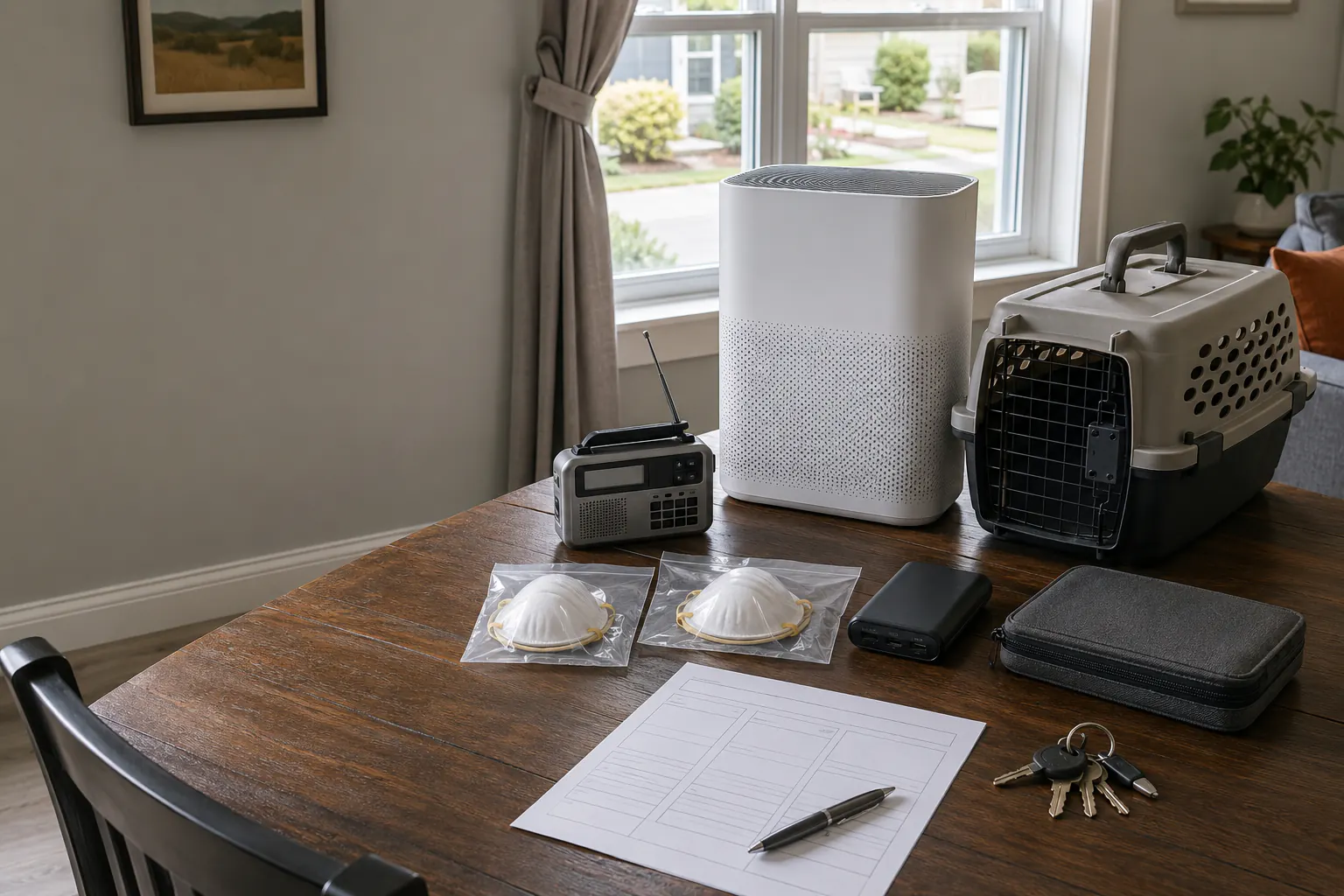
Check local fire and evacuation instructions first. If it is safe to stay, choose one room where the household can filter the air and stay cool. Before smoke season, confirm an open, reachable alternative and who can help with transport if that room stops meeting the plan.
The central rule is simple: sheltering from smoke never overrides an evacuation order or an approaching fire. Prepare for both cleaner indoor air and rapid movement before the sky changes color.
Decide whether this is a fire emergency or a smoke event
Leave immediately when authorities order evacuation. Monitor local emergency management, fire agencies, the Emergency Alert System, Wireless Emergency Alerts, and NOAA Weather Radio where available. Do not use a generic website or a distant air sensor to reinterpret a local evacuation zone.
Call 911 if fire, entrapment, or another immediate threat prevents safe movement. Give the location and follow dispatcher instructions. Do not wait for a photograph, return for property, or drive toward a fire to inspect conditions.
For a smoke event without a local fire threat, follow the current public-health and air-quality recommendations for the location. Smoke can shift quickly; keep the evacuation plan active even while improving indoor air.
The wildfire evacuation guide separates zone status, routes, go-bags, pets, fuel, transportation, and departure timing.
Monitor air quality without trusting one signal
Use AirNow, the AirNow Fire and Smoke Map, and the state or local air-quality agency for current particle-pollution information. The map combines regulatory monitors, temporary monitors, lower-cost sensors, fire locations, smoke plumes, and forecasts; these inputs do not all have the same precision or update schedule.
The Air Quality Index translates pollution into health categories:
| AQI | AirNow category | Planning meaning |
|---|---|---|
| 0-50 | Good | Air quality is generally satisfactory. Keep monitoring when smoke is nearby. |
| 51-100 | Moderate | Some unusually sensitive people may need precautions. |
| 101-150 | Unhealthy for Sensitive Groups | Follow current guidance for at-risk household members. |
| 151-200 | Unhealthy | Health effects become possible for the general public and more serious for sensitive groups. |
| 201-300 | Very Unhealthy | Health alert; risk increases for everyone. |
| 301+ | Hazardous | Emergency conditions; everyone is more likely to be affected. |
These categories do not create a personal medical threshold or an evacuation order. A clinician’s plan, symptoms, outdoor work, indoor conditions, heat, pregnancy, age, and underlying disease can change the appropriate action.
Low-cost indoor sensors can help show trends and whether filtration appears to improve a room, but placement, calibration, humidity, particle type, and device correction affect readings. A consumer sensor does not measure every gas or toxic compound in smoke and cannot clear a building after structural fire contamination.
Prepare before smoke season
Do the work while products and services are available:
- Enable local emergency and air-quality alerts on at least two devices.
- Map the evacuation zone and two routes to destinations outside the threat area.
- Choose a room that can hold the household comfortably with doors and windows closed.
- Measure that room and select adequate particle filtration for its size.
- Use existing records or safely accessible user instructions to identify HVAC filter requirements; ask management or a qualified technician about compatibility and fresh-air controls.
- If the equipment plan calls for a spare, store the exact replacement filter without blocking exits or damaging it.
- Review heat, medication, pregnancy, respiratory, cardiovascular, disability, and medical-device plans with qualified care teams.
- Plan for pets, service animals, livestock, and shelters that may not accept every animal.
- Review communication, charging, transportation, and the outage plan in normal conditions; do not cut power or interrupt care to rehearse it.
- Identify public cleaner-air and cooling locations and confirm their current hours and access rules during an event.
Do not wait for smoke to discover that a filter does not fit, an air cleaner is too small, an apartment system cannot be adjusted by the tenant, or the only evacuation route crosses the likely hazard area.
Build one cleaner-air room
EPA recommends a cleaner-air room when it remains safe to stay at home. Choose a room large enough for the people and pets who will use it, with relatively few windows and doors and access to cooling if heat is possible. An attached bathroom can reduce door openings, but it is not required.
During smoke:
- close windows and exterior doors;
- limit trips in and out;
- run a correctly sized portable air cleaner continuously at the highest fan setting, following EPA’s How to Create a Cleaner Air Room at Home and the device instructions;
- use a compatible high-efficiency HVAC filter when the system supports it;
- set suitable systems to recirculate and reduce outdoor-air intake under manufacturer, building, and professional guidance;
- keep air-cleaner inlets and outlets unobstructed;
- monitor temperature as well as particle conditions;
- keep the evacuation bag, alerts, medication, water, and pet supplies accessible.
Weather stripping can reduce selected leaks but must not block a required combustion-air opening, dryer vent, bathroom exhaust, fire egress, or building ventilation system. Renters should not modify shared HVAC, dampers, doors, alarms, or windows without authorization.
EPA also advises airing out the room when outdoor air improves, even temporarily. Follow current local fire, air-quality, weather, and building instructions; do not open the room toward an active fire threat or stay in unsafe heat to keep smoke out.
The cleaner-air room guide covers room choice, sealing limits, setup, heat, apartments, and stop rules.
Filter particles with equipment sized for the space
Wildfire smoke contains fine particles that mechanical filters can capture. A portable air cleaner should be sized for the actual room and have a meaningful smoke Clean Air Delivery Rate or equivalent verified particle-performance information. Higher speed can deliver more clean air but may increase noise and power use; a unit people switch off because it is intolerably loud may underperform the plan.
EPA’s 2026 wildfire guidance emphasizes mechanical filtration and warns against intentional ozone generators. Ionizers, electrostatic devices, hydroxyl generators, ultraviolet components, and broad chemical-removal claims should not be treated as substitutes for demonstrated smoke-particle removal; some technologies can produce ozone or other byproducts.
A central forced-air system may accept MERV 13 or the highest efficiency the fan and filter slot can accommodate. A filter that does not fit, is installed backward, bypasses around the edges, or creates excessive system restriction is not an upgrade. Ask a qualified HVAC professional when compatibility is uncertain.
DIY box-fan filters can provide a temporary lower-cost option when a commercial unit of known performance is unavailable or unaffordable, but construction, electrical, child, pet, tip-over, fan-age, filter, airflow, and fire-safety details matter. Use current EPA instructions rather than an improvised social-media design.
The wildfire air purifier and HVAC filter guide explains CADR, room sizing, MERV, HEPA, ozone, noise, replacement filters, and evidence standards without inventing product-test results.
Stop creating particles indoors
Reducing infiltration helps only if the household also controls indoor sources. During a smoke event, EPA advises avoiding activities that add particles, including:
- smoking or vaping;
- candles, incense, fireplaces, and unvented combustion;
- frying, broiling, and other smoky cooking;
- aerosol sprays;
- dry sweeping and ordinary vacuuming that resuspends fine material.
Never operate a grill, camp stove, generator, pressure washer, or fuel-burning heater inside a home, garage, porch, carport, basement, or partially enclosed area. Carbon monoxide has no useful warning smell. Read generator carbon monoxide safety before planning backup power.
Resolve the smoke-versus-heat conflict early
Closing windows can reduce smoke entry but allow dangerous indoor heat to build. A cleaner-air room is not protective if occupants overheat. Monitor the room temperature, recognize heat illness, and follow clinician and public-health plans.
Use safe cooling and shading that do not pull smoky outdoor air inside. Some single-hose portable air conditioners can depressurize a room and draw air through leaks; evaporative coolers normally bring outdoor air in. Equipment configuration matters.
If the home cannot remain both cool enough and acceptably smoke-protected, move early to a confirmed cleaner-air and cooling location outside any evacuation zone. The extreme heat preparedness guide provides the broader heat decision framework.
Plan for a power outage
Filtration, air conditioning, communications, elevators, garage doors, medical equipment, and fuel pumps can fail together. Use documented watts or existing normal-operation records for the selected ordinary loads. Unknowns remain questions for the equipment provider; do not move equipment, open cabinets, induce an outage, or interrupt operation to obtain a reading. Prescribed equipment and its reserve stay under the clinician, supplier, and manufacturer plan, not a household runtime estimate. Keep care details private.
Battery backup can support selected low-wattage filtration and communication loads, but capacity, inverter limits, heat, recharge, and battery availability constrain runtime. Do not assume a portable power station can operate central HVAC or a room air conditioner.
The wildfire-smoke power outage guide connects indoor-air priorities to the power outage preparedness hub and measured runtime planning.
Use respirators within their limits
A well-fitting NIOSH Approved N95 or P100 respirator can reduce inhalation of smoke particles when it fits and is worn correctly. It does not supply oxygen and does not make fire zones, carbon monoxide, toxic gases, or every vapor safe.
Fit is personal. Facial hair, gaps, damage, moisture, reuse, comfort, exertion, and medical conditions affect use. NIOSH Approved respirators are not available in sizes suitable for very young children, and a child must be able to wear the selected protection correctly without impaired vision or breathing.
Follow current CDC/NIOSH and clinician guidance. A loose face covering is not equivalent to a fitted respirator, and a respirator is not permission to remain outdoors unnecessarily.
Protect people at higher risk
Wildfire smoke can affect anyone. EPA and CDC identify greater concern for children, older adults, pregnant people, people with asthma or COPD, cardiovascular disease, diabetes, chronic kidney disease, and others whose health or exposure increases risk.
Before the event, ask the relevant clinician:
- which symptoms change the plan;
- where to go if home air cannot be controlled;
- how medications and equipment remain available during evacuation or outage;
- whether respirator use is appropriate;
- when urgent or emergency care is required.
Do not change medication because of a general article. Call 911 for severe trouble breathing, chest pain, confusion, fainting, blue or gray lips, or another emergency sign. Follow the personal action plan for worsening asthma or other disease.
Include pets and large animals
Smoke also affects animals. Bring pets indoors when advised and safe, reduce strenuous activity, provide confirmed-safe water, and keep carriers, leashes, medication, records, and current identification ready. Monitor official and veterinary guidance for coughing, breathing difficulty, eye irritation, weakness, reduced appetite, or behavior changes.
Do not place an animal in a sealed vehicle or leave it in dangerous heat. Evacuation centers and hotels may have animal restrictions; confirm multiple destinations before the event.
Large-animal movement takes more time, vehicles, handlers, and destination coordination. Plan with veterinarians, agricultural extension, emergency management, and animal-control resources before smoke or flame closes routes. The wildfire smoke pet plan separates household pets from livestock logistics.
Return and clean only after authorities allow it
Smoke odor alone does not reveal the contamination type or cleanup scope. Ash from burned structures can contain more hazardous material than ash from vegetation. Do not enter a closed fire area, disturb debris, dry sweep ash, use an ordinary vacuum on fine ash, or let children and at-risk people perform cleanup.
After official clearance, use current EPA/public-health guidance for PPE, damp methods, HEPA-type vacuuming where appropriate, contaminated clothing, HVAC inspection, filter changes, and professional remediation. Fire damage, asbestos, lead, chemicals, structural instability, utilities, and extensive ash exceed a routine household-cleaning article.
The post-smoke and ash cleanup guide begins with those stop rules.
Talk through the plan before smoke season
Before the season:
- Receive a test alert and name the trusted local sources.
- Find the current AirNow reading and explain what it can and cannot decide.
- Name the selected room, its cooling plan, and the conditions that require leaving.
- Review filter instructions and safely accessible user controls; ask the responsible technician or building manager about unknown fit or airflow. Do not approach damaged, wet, hot, or sparking equipment.
- Estimate ordinary battery loads from documented watts, without a forced outage, smoke trial, or interruption of prescribed equipment.
- Pack people and pet essentials without blocking exits.
- Review two evacuation routes, assistance, and suitable destinations on paper; do not drive toward a warning area to check them.
- Send one concise family status message and name the next check-in.
- Record replacement-filter sizes, reorder points, and inspection dates.
- Write the conditions that mean the household leaves rather than continuing to shelter.
The family communication plan provides a reusable message and check-in structure.
Leave this discussion with one room, one confirmed suitable destination, and the person arranging transport. During an event, help and departure come before completing the notes or collecting equipment.
Sources reviewed
- U.S. EPA: Wildfire Smoke: A Guide for Public Health Officials, 2026
- U.S. EPA: Wildfires and Indoor Air Quality
- U.S. EPA: Create a Clean Room to Protect Indoor Air Quality During a Wildfire
- U.S. EPA: How to Create a Cleaner Air Room at Home
- AirNow: Fire and Smoke Map, Version 4
- AirNow: AQI Basics
- Ready.gov: Wildfires
- CDC: Safety Guidelines for Wildfires and Wildfire Smoke
Sources reviewed July 14, 2026. Event-specific emergency, fire, public-health, air-quality, clinician, veterinary, utility, and building instructions control actual decisions.
October 3, 2026 update: checked EPA’s cleaner-air-room guidance for operating setting, ventilation, and movement limits, and AirNow’s AQI categories. Other sources retain their historical review date.