
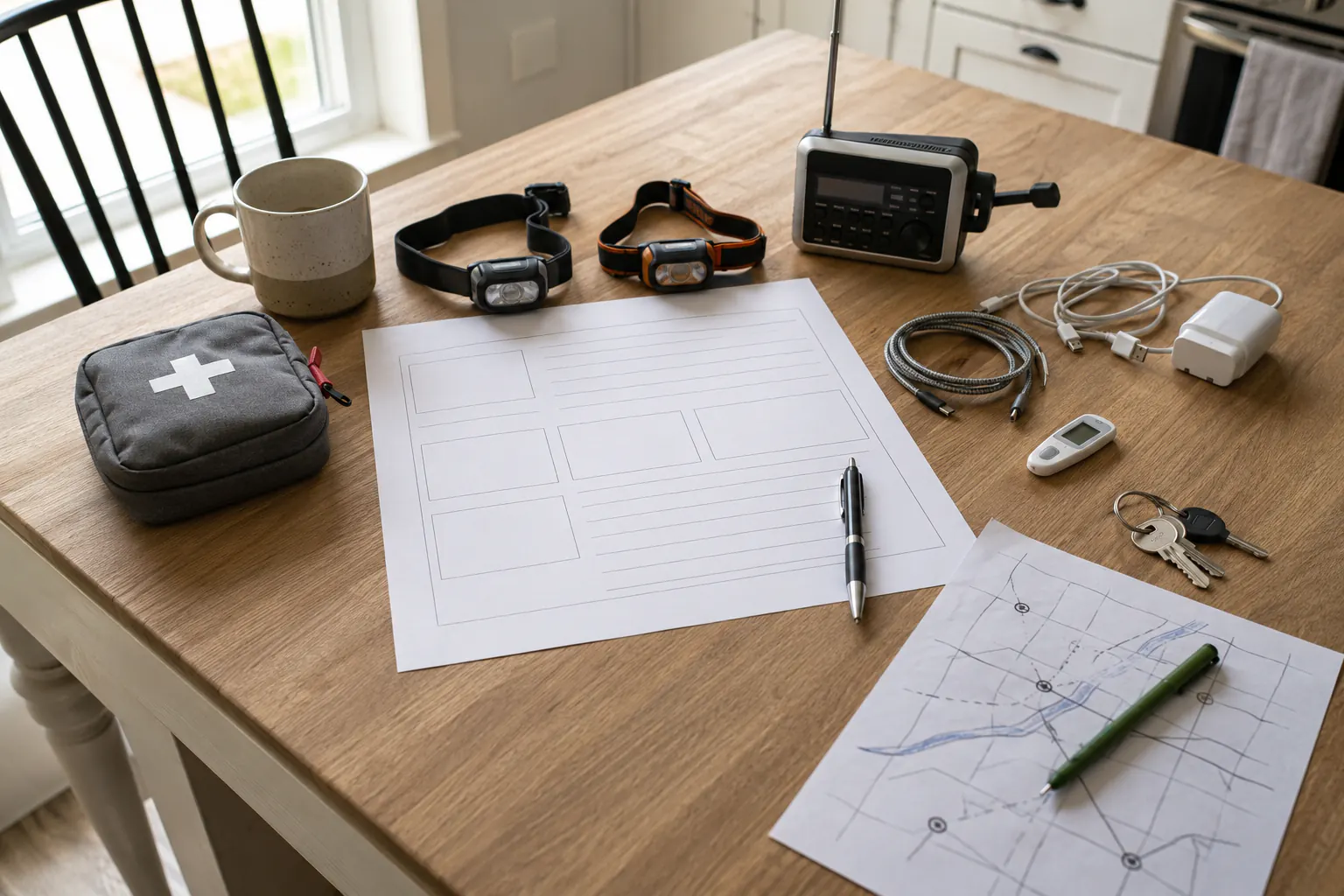
Start with the first light: where would each person find it if the power went out tonight? Then answer four questions: what could put us in danger, what must keep working, how will we communicate, and when would we need to leave? Build around the people and home you have, before buying equipment.
For a calm route through the 4-, 12-, and 24-hour decisions, use Power Continuity for 4, 12, and 24 Hours at Home. It organizes the existing specialist guides by the next household function instead of treating a battery as the whole plan.
If the power is out now
- Check for immediate danger: fire, smoke, a gas odor, downed lines, flooding, or someone dependent on powered medical equipment.
- Use flashlights or battery lanterns. Avoid candles when possible.
- Confirm whether the outage is limited to your home. Look outside without approaching damaged electrical equipment, then check your utility’s outage map.
- Keep the refrigerator and freezer closed.
- Unplug or switch off sensitive electronics and heat-producing appliances that could restart unattended.
- Send a short text to your household contact and preserve phone battery.
Use the full first-actions checklist if you are dealing with an outage now.
Leave and call for help if you smell gas, see fire or arcing, hear a carbon monoxide alarm, or anyone develops sudden headache, dizziness, nausea, weakness, chest pain, or confusion around combustion equipment.
The three blackout time horizons
The first 10 minutes: control hazards
Find people, light the safest path through the home, and account for medical needs. Do not enter a flooded electrical area. Treat every downed power line as energized and keep people and pets away.
If you operate a portable generator, it belongs outside, at least 20 feet from the home, with exhaust pointed away from openings. A garage, porch, shed, carport, or open doorway is not a safe substitute. Read the generator carbon monoxide guide before startup.
The first 4 hours: protect food and communication
An unopened refrigerator keeps food cold for about four hours. A full freezer holds temperature for about 48 hours; a half-full freezer for about 24 hours. These are planning windows, not permission to trust appearance or smell. See the power outage food safety guide for the discard rules.
Send concise text updates rather than making repeated calls. Decide who will report the outage, who checks nearby relatives, and where everyone meets if the home becomes unsafe. Put the details in a family communication plan.
Beyond one day: ration systems, not essentials
Estimate stored water, refrigeration time, medication needs, battery capacity, fuel, indoor temperature, and sanitation. Do not improvise indoor combustion for heat or cooking. If the home cannot remain safe, decide early where you can go and what will make you leave.
Build the plan around household loads
List loads in three groups:
| Priority | Examples | Planning question |
|---|---|---|
| Critical | prescribed medical equipment, sump pump, safe heat controls | What is the medically or structurally approved backup? |
| Essential | refrigerator, communication, task lighting, water pump | How many watts and hours are actually needed? |
| Deferrable | laundry, entertainment, most cooking appliances | Can this wait until grid power returns? |
Do not size backup power from marketing labels alone. Measure or verify watts, account for startup surge, and decide whether the device can cycle rather than run continuously. The backup power hub explains the decision, while the runtime calculator turns watt-hours and load into a first estimate.
The minimum useful blackout kit
- One flashlight or battery lantern per person, plus headlamps for hands-free tasks.
- Working carbon monoxide alarms on every level and outside sleeping areas.
- Drinking water stored in food-grade containers.
- A battery radio and two ways to charge phones.
- A refrigerator/freezer thermometer and an appliance thermometer.
- Paper contact details, utility numbers, medications, and an evacuation destination.
- Weather-appropriate bedding, clothing, and a plan for unsafe indoor temperatures.
- A small amount of cash and copies of essential records.
The kit must match the household. Apartment residents need a different power plan than detached-home owners. Pets, infants, pregnancy, disability, medication, well pumps, electric-only cooking, and extreme heat or cold all change priorities.
Use the emergency water storage guide to calculate a reserve instead of guessing, and build a room-by-room emergency lighting plan so nobody must cross a dark stairway to find the first flashlight.
Plan by outage duration
An outage plan becomes easier to use when it is divided into decision windows. The utility estimate is useful, but it is not a guarantee; make each decision from the conditions in the home as well as the estimated restoration time.
| Planning window | Main decisions | What to verify |
|---|---|---|
| 0–4 hours | Immediate hazards, medical continuity, lighting, communication, refrigerator discipline | People accounted for, alarms operating, outage reported, one safe illuminated route |
| 4–24 hours | Food transfer or discard decisions, battery allocation, indoor temperature, water and sanitation | Appliance temperatures, usable battery energy, official alerts, safe place to relocate |
| 24–72 hours | Fuel and recharge logistics, hygiene, medication, neighbors, work and school continuity | Resupply route, cooling/heating limits, departure triggers, cash and transportation |
| More than 72 hours | Sustainable shelter or relocation, waste, resupply, property checks and recovery | Whether the home remains safer than the destination and route |
Do not let a predicted short outage delay a safety decision. A damaged building, carbon monoxide alarm, medical problem, evacuation order, or dangerous indoor temperature can require action even when restoration is expected soon.
Adapt the plan to the home
Apartment or condominium
Assume elevators, electronic entry, garage gates, water pumps, hallway lighting, package rooms, and shared alarms may behave differently without power. Learn the building’s emergency plan and locate every exit stair. Never run a generator on a balcony, corridor, roof access, parking garage, or near another unit’s opening. Battery systems usually fit apartment constraints better, but capacity and building charging rules still matter.
Keep supplies movable enough to carry down stairs. A two-week water target can be heavy and space-intensive, so combine manageable containers, commercially bottled water, staged storage, and a realistic resupply or relocation plan.
Use the Apartment Emergency Preparedness hub to map floor, elevator, water, access, storage, mobility, pet, and building-management dependencies without duplicating each specialist plan.
Detached home
Map the main electrical panel, water shutoff, gas emergency procedure, sump pump, well pump, garage release, heating controls, and outdoor generator position. Do not perform panel work during an outage merely because the cover is accessible. Decide in advance which systems require a qualified electrician, plumber, HVAC technician, or utility response.
Rural home
A private well, septic system, longer restoration time, limited cellular service, and greater distance to fuel or medical care can turn a grid outage into several simultaneous service failures. Store more communication and water redundancy, maintain paper directions and contact numbers, and test radio reception before severe weather.
All-electric home
Induction cooking, heat pumps, electric water heating, well pumps, and vehicle charging can create a load list far larger than a portable battery can support. Prioritize life safety, communication, refrigeration, and one safe thermal strategy. A backup system does not need to reproduce normal whole-home consumption to be useful.
Account for people who cannot simply “wait it out”
Write a separate continuity line for every medication, refrigerated drug, powered mobility device, CPAP, oxygen system, feeding pump, home dialysis process, or temperature-sensitive condition. The CDC notes that refrigerated medications need product-specific handling and replacement guidance during extended outages; contact the pharmacist, prescribing clinician, and device manufacturer before an emergency rather than relying on a generic battery estimate. (Source: CDC, What to Do to Protect Yourself During a Power Outage.)
Also plan for:
- a person who cannot hear an alarm or see a dark exit;
- someone who cannot lift water or operate a manual garage release;
- an infant who needs safely prepared formula;
- an older adult vulnerable to heat or cold;
- a service animal or pet whose food, medication, restraint, and water must travel too;
- a caregiver who may be outside the home when the outage begins.
Give the out-of-area contact enough information to help without publishing sensitive medical details broadly. The family communication plan should record who checks on whom and at what time.
Set departure triggers before the outage
“We will leave if it gets bad” is not a trigger. Use observable conditions:
- an official evacuation order or building closure;
- a CO or smoke alarm, gas odor, active fire, structural damage, or floodwater near electrical equipment;
- inability to maintain an approved medical-device or medication plan;
- indoor temperature outside the safe range established for a vulnerable household member;
- loss of safe water or sanitation beyond the household reserve;
- a route and destination that are currently safer than remaining.
Choose at least two destinations because the same storm can affect relatives, hotels, shelters, roads, and fuel stations. Keep the vehicle above the household’s chosen fuel threshold when severe weather is forecast, but never run it in a garage for charging or warmth.
Try the plan while everything is working
- Choose a safe evening and tell everyone it is a drill.
- Keep normal lighting and utilities on. Do not interrupt care, alarms, building systems, or essential equipment to simulate an outage.
- Start from the places people are normally found and retrieve the first lights.
- Send the agreed check-in message and find the paper contact plan.
- Read the refrigerator and freezer thermometers without holding doors open.
- If an ordinary non-medical load is already approved for your battery setup, check it under its normal instructions and record watts. Otherwise, record what still needs verification.
- Check the bedroom-to-exit route in normal safe lighting, using each person’s usual support. Do not create a dark walk or operate the electrical panel; review a route from a seated position if walking it is not appropriate.
- Locate water, medications, shoes, keys, cash, and the go bag.
- End the drill and record every delay, missing item, dead battery, confusing instruction, and blocked path.
The goal is not to perform dramatically. It is to discover friction while the lights and stores are still available.
Common plans that fail
- One oversized shopping list: supplies exist, but nobody knows which problem each item solves.
- One flashlight for the house: the light is not where the person is when the outage begins.
- A generator without an operating site: rain, cord length, exhaust direction, neighbors, and theft are considered only after startup.
- A battery sized from appliance labels alone: cycling, surge, inverter limits, and usable capacity were never tested.
- Water without a dispensing plan: the container is too heavy or becomes contaminated through repeated handling.
- Contacts stored only in phones: the battery dies, the device is locked, or a child does not know whom to call.
- Security that blocks escape: improvised barriers slow the household and responders during fire or medical evacuation.
- No recovery checklist: food, chargers, alarms, fuel, and damaged systems are not restored deliberately.
Security without escalation
A dark house changes visibility and routines; it does not automatically create a confrontation. Lock normal entry points, keep one controlled route usable, close visual gaps where practical, and avoid broadcasting equipment or fuel. Coordinate with trusted neighbors and follow local emergency instructions. The blackout home security guide focuses on deterrence, communication, and safe withdrawal.
Recovery is part of the plan
When power returns, verify the home before restoring every load. Look for water intrusion, unusual smells, overheated cords, and appliances left switched on. Reconnect essential devices in stages. Record what ran out too early, what was never used, and which assumption failed. That short after-action note is how a generic kit becomes your household system.
Sources reviewed
- Ready.gov power outage hazard information sheet
- CPSC Carbon Monoxide Information Center
- FoodSafety.gov temporary power outage guidance
- CDC emergency water supply guidance
Sources reviewed July 13, 2026. Local authorities, utilities, product manuals, and medical providers may give more specific instructions.