
A blackout reduces visibility and may disable familiar alarms, gates, cameras, elevators, or access controls. The useful response is layered and calm: account for people, control normal entry points, preserve communication, avoid drawing attention, and keep a safe way out.
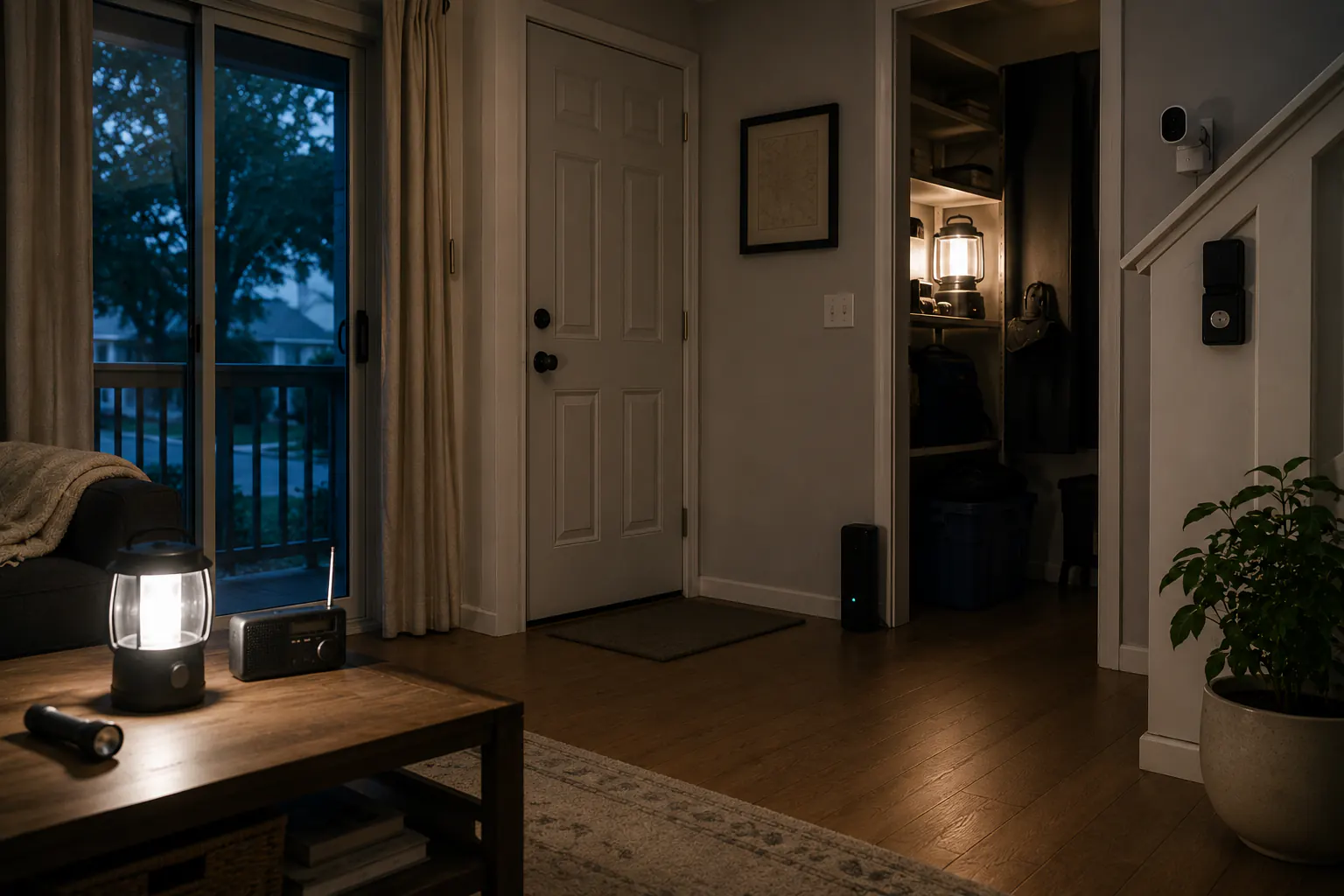
First secure people, then doors
Confirm who is home and who is expected. Children and vulnerable household members should know which room to use and whom to contact. Keep keys, shoes, a flashlight, and essential medication accessible if the home must be left quickly.
Lock doors and reachable windows using their normal hardware. Do not create improvised barriers that trap occupants, block firefighters, or make an exit unusable.
Check the systems that lost power
Determine which equipment still works and for how long:
- alarm panel and cellular backup;
- electronic locks, garage doors, gates, and intercoms;
- cameras, router, and local recording;
- exterior lights and motion sensors;
- smoke and carbon monoxide alarms;
- building entry and elevator systems in multifamily housing.
Learn manual releases before an outage. Keep physical keys available for every lock that may fail without power. Never test a garage release by standing under an unsupported or damaged door.
Record the result in a simple dependency table:
| System | What happens without grid power? | Backup duration | Manual method | Who can operate it? |
|---|---|---|---|---|
| Main entry lock | Mechanical, battery, or fail state | Verify | Physical key | Every responsible adult |
| Alarm panel | Battery/cellular dependency | Test and document | Provider procedure | Named household contact |
| Cameras/router | Usually stop without local backup | Measure | Local observation | Household |
| Garage/gate | Motor and release dependency | Verify | Manufacturer procedure | Person physically able to operate it |
| Elevator/building entry | Building-managed | Unknown | Building plan | Management/responders |
Do not publish access codes, key locations, alarm details, or camera blind spots in a shared online document. Keep the operational copy where the household can reach it during an outage. The alarm, camera, and router continuity guide maps the full sensor-to-person dependency chain without asking a household to defeat or bypass its own system.
Use five security layers
1. Information
Know the outage scope, official restoration estimate, weather, road conditions, and whether authorities have issued shelter or evacuation instructions. Avoid driving toward a reported disturbance merely to verify it.
2. People
Account for household members and assign roles: communication, children or dependents, property check from inside, and departure preparation. One person should not investigate while everyone else assumes someone is watching the exits.
3. Delay and deterrence
Use normal locks, closed accessible windows, ordinary exterior lighting where it can operate safely, and visible signs of occupancy without displaying supplies. Physical reinforcement must preserve fire egress and comply with rental, building, and local requirements.
4. Detection
Battery alarms, dogs, neighbors, and cameras can provide information, but every system has false alarms and power/network dependencies. Decide how a detection event is verified from safety and when it triggers a 911 call rather than confrontation.
5. Withdrawal
Keep two exit options where the home and building allow. Shoes, keys, light, medication, phone, and the go bag should be reachable without crossing the likely problem area. A security plan that makes evacuation impossible is not resilient.
For ordinary-season door, window, egress, and privacy decisions, begin with Home Security and Hardening Without Blocking Safe Exit. A blackout does not make a new hardware system appropriate; it changes how the existing, safe system is used.
Use light deliberately
Provide safe interior path lighting without displaying every person, supply, or piece of backup equipment through uncovered windows. Close blinds or curtains where appropriate, while preserving visibility needed for safe exits.
Exterior lighting can deter casual approach, but walking outside to reposition a light during an uncertain situation may create more risk. Make placement decisions in advance and keep generator location compliant with carbon monoxide rules regardless of visibility or theft concerns. The deterrence without escalation guide covers looking occupied and unappealing to trouble without ever confronting anyone.
The emergency lighting guide separates path, task, and area lighting. The security-lighting guide keeps the separate visitor-identification, glare, and privacy boundary. Keep at least one interior route visible enough for safe movement and avoid shining a bright light from a dark room directly into household members’ eyes.
Coordinate without broadcasting
Contact trusted neighbors through an established group and exchange concise facts: outage scope, official updates, vulnerable residents who need a check, and observed hazards. Avoid posting household absence, fuel, equipment, or exact supply information publicly.
Rumors travel faster during outages and civil unrest. Verify instructions through local emergency management, law enforcement, utilities, and weather services before moving toward a reported event. The privacy-respecting neighborhood check-in guide keeps voluntary contact information separate from home-security details.
If someone approaches
Use a locked barrier, distance, and a clear voice. You are not required to open a door to identify a stranger or investigate a noise. Move household members away from the entrance, maintain an exit option, and call 911 for an immediate threat.
Avoid threats, challenges, pursuit, or going outside to protect replaceable property. Laws governing weapons, force, surveillance, and defensive devices vary by jurisdiction; generic internet advice cannot determine what is lawful or necessary in a specific encounter.
Use a prepared sentence that does not require opening the door: “I cannot open the door. Tell me what you need and I will contact the appropriate service.” Verify utility workers, building staff, deliveries, or officials through a known number rather than one supplied by the person at the door when circumstances allow. The disaster fraud and price-pressure warning guide covers the separate verification and pressure tactics that can follow a disruption.
Call 911 for an immediate threat. Give location, description, direction of movement, injuries, and whether household members are safely separated. Do not pursue someone who leaves.
Prepare for shelter-in-place and civil unrest
These are distinct scenarios, but the home-security basics overlap: official alerts, a low-information public profile, controlled access, medication and water, an internal safe area, and explicit triggers to stay or leave. Shelter-in-place can be the official instruction for a hazard outside; it does not mean sealing a home indiscriminately without knowing the hazard.
For disturbances, avoid gathering areas, demonstrations, damaged commercial zones, and unknown roadblocks. Leave early only when the route and destination are safer than remaining; otherwise stay away from windows and follow official guidance. The Civil Unrest household-safety hub owns avoidance, movement, and calm decision sequencing, and the personal safety awareness guide covers the individual who is out in a public space when conditions shift.
Shelter-in-place is hazard-specific
An instruction to remain indoors may relate to severe weather, smoke, a chemical release, police activity, or another outside hazard. Closing and sealing openings may be appropriate for some airborne hazards and wrong for others, especially if indoor combustion or fire is present. Follow the exact local instruction and keep monitoring official updates.
Choose an interior coordination area with communication, light, water, medication, and access to an exit plan. It is not automatically a “safe room” against every threat.
Civil unrest does not make rumor reliable
Separate confirmed facts from messages that only repeat a location or video. Events can move, footage can be old, and normal routes may change. Use local emergency management, law enforcement, transportation agencies, and credible local reporting. The goal is to stay away from the disturbance, not document it.
If leaving is necessary, choose a destination and more than one route, tell the out-of-area contact, and avoid visible political or tactical signaling that can attract attention. Do not attempt to pass a barricade or crowd because a navigation app still shows the road open.
Preserve escape while improving hardware
Patrick’s locksmithing and renovation experience supports inspection of alignment, loose fasteners, damaged frames, worn cylinders, and missing keys. It does not replace fire-code, accessibility, landlord, or licensed professional review.
The U.S. Fire Administration recommends two ways out of each room where possible, unobstructed doors and windows, known exit stairs in high-rise buildings, and practiced escape plans. (Source: U.S. Fire Administration, Home Fire Escape Plans.)
Before reinforcing an opening:
- confirm it is not a required emergency exit;
- confirm everyone can release it quickly from inside;
- account for children, older adults, disability, and low visibility;
- avoid loose braces or furniture that become trip hazards;
- obtain landlord or building approval where required;
- use a qualified professional for doors, frames, glazing, alarms, or access control beyond your actual competence.
Security bars and secondary locks need interior emergency-release arrangements. A stronger lock on a severely damaged or misaligned frame may create a false sense of security while making daily escape harder.
Protect information and power equipment
Do not post real-time absence, generator location, fuel storage, battery inventory, or hotel destination publicly. Disable automatic geotag sharing where appropriate and keep insurance photos in a private account.
Position batteries, radios, and chargers where they remain ventilated according to instructions and are not visible from the street. Generator theft prevention must never create an enclosure, exhaust obstruction, refueling hazard, or cord trap. See generator carbon monoxide safety.
Renters and apartment residents must also preserve building rules and shared egress. The renter-friendly security guide and apartment package, mail, and privacy routine keep reversible hardware, building approval, package, and information-sharing decisions in their proper scope.
When power returns
Do not let restored lights end the security check automatically. Confirm gates, electronic locks, alarms, cameras, garage controls, and routers returned to their intended state. Some devices reboot unlocked, lose time, exhaust their backup battery, or require manual acknowledgment.
Recharge batteries, inspect temporary measures, remove anything blocking an exit, and document any suspicious event for police, management, or insurance without embellishment. Update the family communication plan and return to the power outage preparedness hub for the broader after-action review.
A 15-minute pre-outage audit
- Operate every mechanical key and manual release.
- Check exterior doors for alignment, loose strike hardware, and damaged frames.
- Confirm exits open from inside without searching for a key.
- Test alarm backup and update contact lists.
- Walk the dark route from bedrooms to the planned safe area and exit.
- Decide which official event or household condition triggers departure.
Patrick’s locksmithing and renovation experience informs the physical audit. It does not replace local fire-code, accessibility, landlord, building, security, or legal guidance for a particular property or situation.
Sources reviewed
- Ready.gov family communication planning
- Ready.gov power outage hazard information sheet
Sources reviewed July 13, 2026. For a real threat, fire-egress concern, building-access issue, or legal question, use current local instructions and the responsible authority; call 911 when there is an immediate threat.