
Check one normal exit path and the battery light already available for it before adding exterior fixtures. Useful lighting helps people see and move; it does not guarantee deterrence or justify going outside to investigate. Permission, electrical safety, glare, privacy, and outage dependencies still need their own checks.
More light is not automatically more security. Glare, shadow, power loss, and equipment condition can reduce useful visibility. The home security hardening plan connects lighting with other functions; a lighting checklist does not guarantee that any of them remains available.
Plan lighting by task, direction, control, and power dependency.
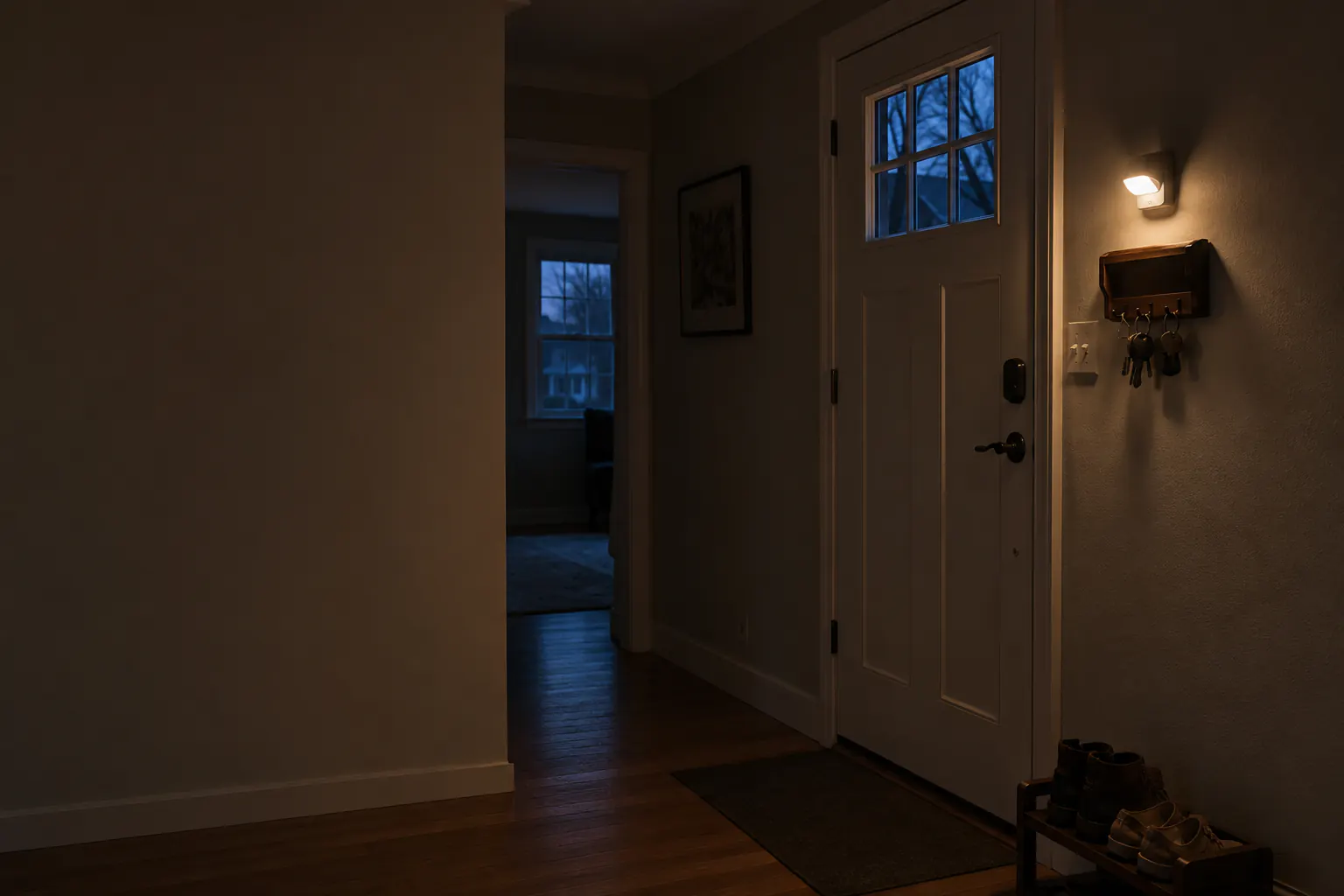
If the lights fail during a concerning event
- Account for everyone and move away from the suspected entry or exterior disturbance.
- Call 911 for an immediate threat; do not go outside to identify a person or noise.
- Use a flashlight or battery path light from cover without standing silhouetted in a window.
- Close curtains or shades where that preserves privacy and does not block an exit.
- Check official outage and safety information.
- Do not connect exterior fixtures through improvised cords, wet equipment, or a generator in an unsafe location.
- Preserve battery for paths, communication, medication, and essential tasks.
The blackout security guide adds access control, neighbor communication, and departure triggers.
Define four lighting jobs
Identification light
This light helps an occupant see a face, uniform, package, or credential from inside before opening. It should illuminate the visitor area without forcing the occupant to stand directly in front of glass.
Use a peephole, intercom, camera, or side view only as the home and privacy plan allows. Do not open the door merely because a uniform is visible; verify unexpected workers through a known number.
Approach light
This covers the normal route from public way, parking, gate, or driveway to the entrance. It should reveal steps, address numbers, surface changes, and obstacles without spilling into unrelated property.
Path and exit light
This lets occupants move between bedrooms, stairs, exits, keys, and the meeting place. The existing emergency lighting guide separates path, task, and area lighting inside the home.
Observation light
This supports a camera or safe view of a defined exterior zone. It should not be treated as an invitation to patrol the property. Camera sensors, exposure, infrared mode, reflective surfaces, rain, fog, snow, and insects can all change the image.
Make a simple lighting map
At dusk in normal conditions, record:
| Zone | Task | Existing control | Power source | Outage fallback |
|---|---|---|---|---|
| Main door | identify visitor and key area | wall switch/motion | branch circuit | battery light from inside |
| Walkway | see steps and surface | timer/photocell | branch circuit | portable path marker |
| Side access | observe gate or service route | motion | branch circuit | no exterior inspection during outage |
| Interior exit | reach door and stairs | switch | branch circuit | headlamp/lantern |
| Address | help responders locate home | dusk control | branch circuit | visible reflective number where permitted |
Do not include camera blind spots, travel plans, or exact backup locations in a public map.
Control glare before adding brightness
Stand in the normal interior viewing position, on the walkway, and at property boundaries where lawful. Look for a bare lamp visible to the eye, blown-out camera image, deep shadow beside the lit area, reflection from glass, or light entering a neighbor’s home.
Prefer a fixture that aims light only where needed and shields the source. Use the lowest output that performs the task. Color, mounting height, optics, surface reflectance, weather, and adaptation all affect visibility; wattage alone does not describe useful light.
DarkSky International notes that overlighting and glare can reduce visibility and that evidence does not support a simple claim that more outdoor light prevents crime. Treat lighting as orientation and observation, not a guarantee.
Do not aim a flashlight or fixture directly at a public road, aircraft path, neighbor, or household member. Check local nuisance, wildlife, historic, and association rules.
Choose controls that fail predictably
Manual switch
Simple and understandable, but only useful if occupants can reach it safely and know which zone it controls. Label switches without revealing sensitive details.
Photocell or astronomical schedule
Can provide routine dusk operation. Check time, location, daylight changes, and what happens after a power interruption.
Motion sensor
Can reduce operating time and draw attention to movement, but animals, branches, rain, vehicles, heat sources, and neighbors can create activations. A motion event is information, not proof of a person or threat.
Smart control
Adds schedules and remote access but may depend on Wi-Fi, a hub, cloud service, phone, account, and update support. Confirm local manual operation and the state after internet or power returns.
The alarm, camera, and router continuity guide uses the same dependency method.
Build an outage layer without unsafe wiring
An outage plan can combine:
- headlamps for hands-free movement;
- flashlights for identification from a protected position;
- stable battery lanterns for interior paths;
- listed battery path or step lights compatible with the location;
- integrated fixtures with documented battery backup;
- solar fixtures only after verifying seasonal charging, shade, battery condition, and actual runtime.
Solar garden lights often provide low or inconsistent output after short winter days, shade, snow, dirt, or battery aging. Test the real fixture through the expected night; do not treat the box estimate as guaranteed.
Keep portable lights dry, stable, and out of walkways. Avoid candles. Do not run extension cords through doors, windows, wet areas, or paths.
For a whole fixture or circuit, use the backup-power guide and qualified installation. CDC says generators belong outdoors more than 20 feet from doors, windows, and vents, with exhaust directed away; neighboring occupied spaces matter too. Lighting does not justify unsafe placement or a cord trap.
Coordinate lighting with cameras
Test the actual recorded image, not only the live view. Check:
- face and clothing detail at the intended identification area;
- overexposure from nearby fixtures;
- reflections from glass, siding, vehicles, rain, or snow;
- infrared reflection and mode switching;
- motion blur and frame rate;
- timestamp after power interruption;
- local recording when internet is unavailable;
- whether a bright interior screen reveals occupant location.
Do not publish test footage showing neighbors, license plates, children, keys, access codes, or private interiors. Delete recordings according to the household retention policy.
Preserve interior privacy
At night, a bright room behind uncovered glass can expose routines and supplies. Use shades, curtains, and task lighting to reduce unnecessary visibility while maintaining safe egress and supervision.
Do not black out every opening if that prevents seeing fire, smoke, floodwater, or emergency responders. Hazard-specific shelter instructions may require different actions.
Arrange lamps so a person can answer an intercom or view a camera without standing directly in the doorway. Keep keys, shoes, phone, and light reachable along the exit route.
Renter and apartment options
Renters can use approved plug-in or battery lighting, portable lights, curtains, and account controls. Exterior fixtures, common corridors, address lighting, stairwells, emergency lighting, penetrations, and line-voltage circuits belong to management and qualified service.
Report failed common-area lights in writing. Do not install a fixture in a corridor, aim a camera-light combination at neighbors, or attach equipment to the facade without permission.
The renter security guide organizes reversible measures and lease questions.
Test monthly and after change
Use a non-emergency test:
- Check each fixture, switch, sensor, timer, and photocell.
- View the path and identification area from normal positions.
- Review camera exposure without recording private areas.
- Simulate loss of one power layer using the manufacturer test procedure, not by opening electrical equipment.
- Measure battery runtime under safe conditions.
- Verify that portable lights are charged and reachable.
- Clear vegetation and obstructions only from stable ground and within authority.
- Record failed batteries, drifted aim, false triggers, and dark steps.
Use an electrician for damaged wiring, water entry, repeated trips, hot fixtures, exposed conductors, or changes to exterior circuits.
Product evaluation without a fake winner
A useful future comparison should measure beam pattern, glare, color rendering, sensor range and false triggers, weather rating, cold/heat behavior, battery runtime, charging, manual control, camera interaction, app security, update support, mounting, and replacement parts.
Until products are tested, ReadyLience will describe selection criteria and verified specifications without claiming a “best security light.”
Sources reviewed
- NYPD: Security Surveys and Safeguard Your House
- Ready.gov: Power Outage Hazard Information
- U.S. Fire Administration: Home Fire Escape Plans
- DarkSky International: Outdoor Lighting, Glare, Crime, and Safety Evidence
Sources reviewed July 14, 2026.
October 9 clarification: CDC’s generator-placement guidance was checked for the separation wording above. This is not a site-specific installation approval or a lighting-runtime test.
Streamlight’s MicroStream documentation and the exact non-USB 66318 Amazon listing were checked October 11, 2026 in the ordinary-lighting research lane. The example is now confined here to an indoor handheld fallback; no security-light, camera, weather, glare or household-runtime test was performed. Broader historical safety-source dates are unchanged.