
Start with one ordinary access or exit issue you can report to management or address within the lease. A renter-friendly label does not establish permission, compatibility, fire safety, or a refund at move-out. Keep household routines, permitted reversible devices, and building work separate.
The safest plan separates three categories: ordinary household practices, reversible devices allowed by the lease, and building changes that require written approval or professional work. A product advertised as renter-friendly is not automatically permitted, fire-safe, accessible, or compatible with the actual door and window. The underlying priorities — layers, exits, and honest assessment — come from the home security hardening and safe exit plan.
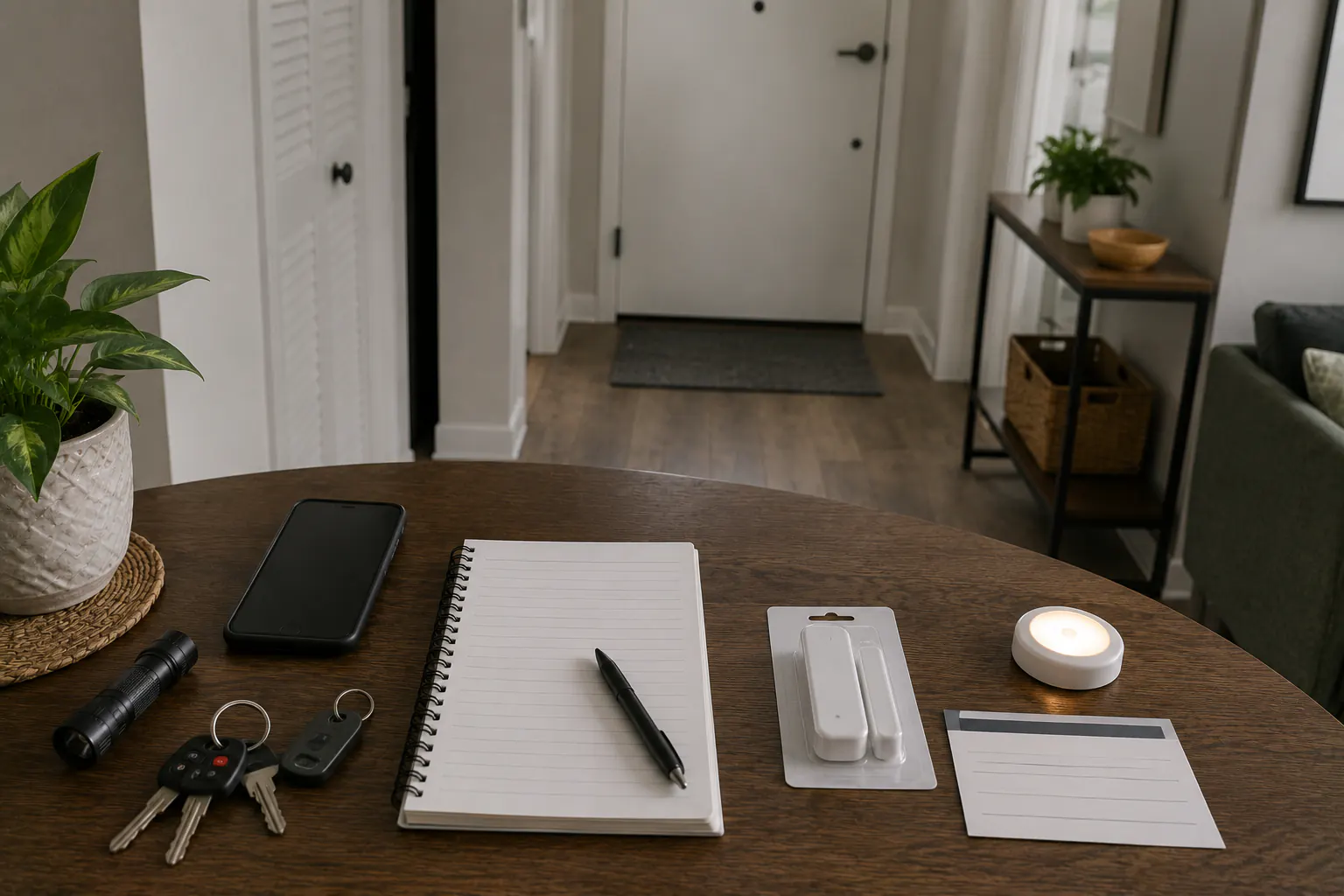
This guide does not teach lock bypass, forced entry, confrontation, weapons, traps, or improvised barricades.
If there is an immediate concern
Call 911 from a safe location for a suspected break-in in progress, fire, violence, or another immediate threat. Do not search a hallway, stairwell, shared basement, parking area, or apartment after signs of unauthorized entry.
For a damaged lock, door, window, intercom, garage gate, or building entrance:
- Photograph the condition from a safe position after emergency services clear the scene.
- Notify property management through the emergency channel and preserve the written record.
- Ask who will secure the opening, when, and with what temporary access arrangement.
- Notify the insurer when theft or covered damage may be involved.
- Do not make a permanent repair or discard damaged parts before authority and insurance questions are resolved.
If management does not respond, use the tenant, housing, fire, or building resource for the actual jurisdiction. Rules and remedies vary; this page is not legal advice.
Read the lease and map responsibility
Record who controls each part of the access system:
| Item | Usually needs clarification | What to record |
|---|---|---|
| Apartment entry lock | keying, replacement, added hardware | authorized keys, management contact, written permission |
| Corridor or stair door | fire rating, closer, latch, common access | defect report and work-order number |
| Window or balcony door | fall protection, egress, glazing, exterior appearance | opening type, child risk, approved limits |
| Intercom or access app | account owner, guest access, outage behavior | support number and manual fallback |
| Camera or doorbell | mounting, field of view, recording law, common area | written approval and privacy settings |
| Exterior light | common-area maintenance and electrical responsibility | fixture location and outage report |
| Package room or locker | carrier access, notifications, retention | normal and outage procedure |
Do not assume that a previous tenant’s device or an online installation video establishes permission. Fire doors, shared entrances, sprinklers, alarms, access-control wiring, and exterior appearance may be regulated even when a change looks small.
Keep access methods separate from their apps
A renter needs to know how an authorized person enters and exits if one part of the building’s technology is unavailable. A connected access feature can be useful, but it should not replace a clear local and emergency-release plan.
| Access method | What may remain available during a home-internet outage | What still needs a real check |
|---|---|---|
| Physical key and ordinary mechanical lock | The key path may remain local | Key control, door alignment, lease permission, and whether every occupant can use it safely |
| Battery-powered connected lock | Some local lock or keypad behavior may remain available | Exact manual behavior, battery warnings, physical override, account access, and interior emergency release |
| Building app, fob, intercom, or common entry | The building may have its own backup or local procedure | Management’s actual outage plan, accessibility, visitor process, and who can authorize recovery |
| Removable temporary device | It may be independent of a phone or subscription | Lease approval, door compatibility, fire rating, and release by every occupant in smoke or darkness |
“No subscription,” “no cloud,” “no Wi-Fi,” and “has a battery” are not interchangeable claims. They describe different parts of a system. Record the actual local function, remote function, and exit method before relying on a device during an outage. The alarm, camera, and router continuity guide has the wider dependency map for permitted security systems.
Start with measures that do not alter the building
The Safety Net Project advises prioritizing personal safety before changing account access. If shared accounts or monitoring may involve stalking or abuse, seek confidential safety planning from a safe device before revoking access or making visible changes. The routine account steps below are not a substitute for that plan.
High-value improvements often begin with behavior:
- account for every issued key, fob, garage remote, and access code;
- remove former occupants, contractors, or guests from apps and shared accounts;
- use a unique password and multi-factor authentication where available;
- verify visitors and service workers before opening the door;
- avoid hiding a key in a predictable shared location;
- keep travel plans, deliveries, valuables, and exact security weaknesses off public posts;
- close and lock doors and windows during ordinary use;
- report a door that does not self-close or latch instead of propping it open;
- keep the apartment number and emergency address available to every occupant;
- agree on what children, guests, caregivers, and roommates should do when an alarm sounds.
Some routines are independent of subscriptions or power, while connected-account and alert tasks still depend on their actual systems. Review the specific fallback rather than assuming every habit remains available in an outage.
Improve privacy without creating a blind exit
Use curtains, shades, or other permitted coverings to limit casual views of valuables, occupancy patterns, work screens, medications, and stored supplies. At night, check from normal outdoor public areas whether interior lighting reveals more than expected. Stay on public or authorized property and do not inspect neighbors’ windows.
Privacy film, adhesive products, glazing changes, and coverings on a fire or egress opening require more care than a removable curtain. Heat absorption, glass type, residue, lease restrictions, and emergency identification can matter. Ask management or a qualified glazing professional before applying a product to unfamiliar glass.
Keep the release, handle, floor path, and escape instructions visible and usable. A privacy measure should not make a child, guest, or responder unable to identify an exit.
Add detection only where it has a defined job
A removable contact sensor, local alarm, or approved camera can reveal an event, but first define what the alert means and who acts on it.
For each device, record:
- the opening or area it observes;
- whether it makes a local sound, sends a phone alert, records locally, or uses cloud service;
- battery type and low-battery behavior;
- Wi-Fi, router, internet, cellular, account, subscription, and phone dependencies;
- who receives alerts and who can view recordings;
- how to cancel a false alarm;
- how it can be removed without damaging the surface;
- whether management and local law permit the location and recording mode.
Do not place a camera where residents, guests, children, caregivers, or neighbors reasonably expect privacy. Audio recording can have separate legal restrictions. The alarm, camera, and router continuity guide provides a system-level audit.
If a current or former partner may monitor accounts or devices, changing settings can create risk. Seek confidential domestic-violence or victim-advocacy support from a safe device before altering shared technology.
For delivery handoffs, mail, sensitive labels, and account privacy, use Package, Mail, and Privacy Routines for Apartment Residents. It covers approved retrieval, missing-item records, carrier-message verification, and low-exposure household routines without turning a delivery problem into a confrontation.
Keep security usable during an outage
An apartment may lose corridor lighting, elevators, intercoms, electronic locks, cameras, internet, garage access, water pumps, or cellular reliability during a wider outage. Ask management what has backup power, how long it is expected to operate, and how residents receive instructions.
Inside the apartment:
- keep a flashlight or hands-free light where it can be found in darkness;
- light the route to the exit without using candles;
- maintain a charged phone and a documented communication fallback;
- learn the building’s stair and alternate-exit plan;
- test permitted sensors according to their instructions;
- keep spare batteries by type without mixing old and new cells;
- maintain a paper copy of management and emergency contacts;
- know how authorized manual operation works before the outage.
Never force, prop, bypass, or dismantle a building access system. Report an unsafe failure. Use the blackout security guide for the wider household plan and the security lighting guide for visibility layers.
Treat portable door devices cautiously
Temporary door devices can interfere with the normal latch, damage trim, prevent authorized entry, delay firefighters or medical responders, and become difficult to release in smoke or darkness. A device that seems simple to one adult may be unusable for a child, guest, older adult, person with limited grip, or caregiver carrying someone.
Before using any permitted device, verify all of the following:
- The lease and management allow it.
- The door is not a fire-rated, self-closing, shared, or access-controlled opening affected by the device.
- Every occupant can release it from inside without a hidden key, app, tool, tight grasp, or several unfamiliar actions.
- It does not obstruct the floor path, damage the frame, defeat the closer, or prevent the door from latching normally.
- It can be identified and removed under safe practice conditions.
Do not wedge, brace, tie, or furnish an occupied exit as an improvised barricade. Review the fire-egress security warning before adding any secondary device.
Make a written request that can be acted on
When a building repair is needed, send a short factual report:
- exact opening and unit or common-area location;
- observable symptom, such as failure to close, latch, lock, illuminate, or send an alert;
- date and time observed;
- photo or video that does not expose keys, codes, neighbors, or private interiors;
- immediate safety impact, including fire escape or accessibility;
- request for inspection, temporary measure, and repair timeline;
- request for written confirmation and work-order number.
Avoid diagnosing hidden construction or prescribing a specific product unless a qualified person has inspected it. “The corridor door does not close and latch” is more useful than an unsupported claim about the closer or frame.
Use a move-in and move-out security record
At move-in, document issued credentials, existing damage, window operation, smoke and CO alarms, exit routes, intercom behavior, exterior lighting, package procedure, and emergency contacts. Keep sensitive access details private.
At move-out:
- return every key, fob, remote, and parking credential through a documented process;
- remove personal devices and approved adhesive residue without damaging surfaces;
- delete the address from device accounts and automations;
- transfer or close permitted utility and monitoring accounts;
- remove shared users and revoke temporary access;
- erase recordings according to the retention plan;
- photograph the restored condition.
A practical renter security review
Use the layered home security inspection and mark each item as household action, management request, or professional review. Give every open issue an owner and due date.
The goal is not to turn an apartment into a sealed space. It is to reduce routine mistakes, notice failures early, maintain privacy and communication, and preserve a fast, understandable way out.
Sources reviewed
- U.S. Fire Administration: Home Fire Escape Plans
- U.S. Consumer Product Safety Commission: Childproofing Your Home
- Federal Trade Commission: Shopping for Home Security Systems and Securing Cameras
- NYPD: Residential Security Surveys and Safeguard Your House
Sources reviewed July 14, 2026. Lease terms, building policy, local fire and housing codes, recording law, and site-specific professional guidance control actual decisions.
Streamlight’s current MicroStream information and exact Amazon black 66318 variant were checked October 12, 2026 for ordinary indoor reading only. No exact-product test or new security-system assessment was performed; Patrick’s earlier practical experience is not a test of this lamp.