
Start with one authorized opening and its normal access and exit functions in calm daylight. Record an actual symptom and the person responsible for the next action before considering a purchase. Do not inspect during a threat, expose private weaknesses, attack-test equipment, or treat a checklist as certification.
Use this checklist in daylight and only on a home you are authorized to inspect. Do not pick, pry, kick, ram, climb, cut, drill, defeat, or otherwise attack-test a lock, door, window, alarm, camera, network, gate, or access system. Do not publish the completed checklist or store sensitive details in a shared cloud document.
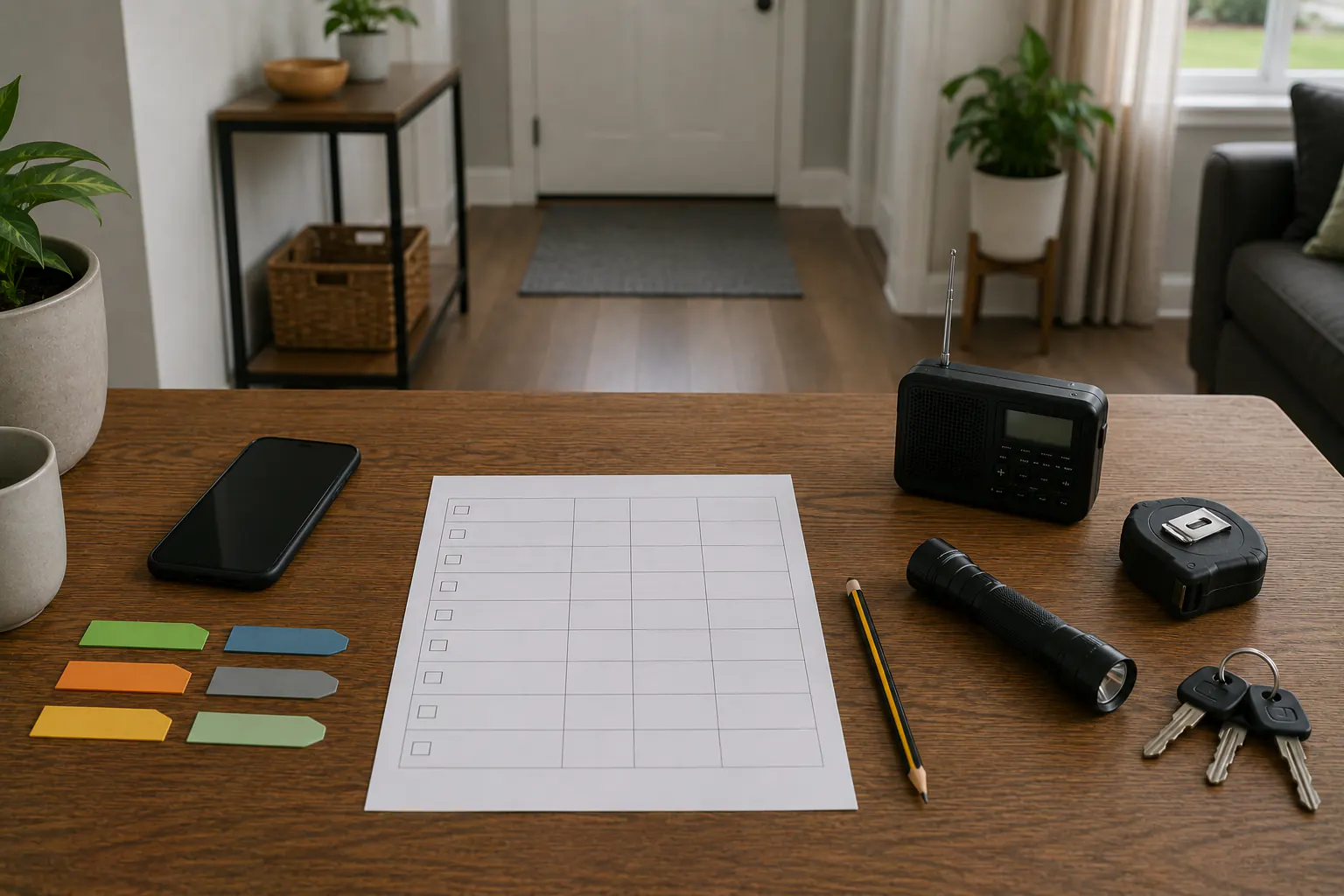
Close the security-inspection loop
Keep the working sheet private. The goal is an accountable next action, not a public map of the household's vulnerabilities.
Set a private baseline
Record ordinary access, detection, exit, power, and authority arrangements without storing sensitive credentials.
Review after a change
Revisit the plan after a move, outage, resident or caregiver change, service work, or a relevant incident.
Resolve the specific finding
Assign maintenance, a work request, or qualified review; verify ordinary operation and update the record.
Stop before inspecting when conditions are unsafe
Call 911 from a safe location for an immediate threat, suspected break-in, fire, or evidence that an unknown person may be inside. Do not enter or disturb the scene.
Stop and contact the responsible service for:
- broken or unstable glass;
- a split, burned, flooded, rotten, or displaced opening;
- exposed wiring, wet electrical equipment, gas odor, smoke, or carbon monoxide alarm;
- a damaged fire door, stair door, garage system, gate, or access-control component;
- a door that traps an occupant or cannot serve as a necessary exit;
- roof, ladder, tree, utility-line, or unsafe exterior-height work;
- a threat involving stalking, domestic violence, or account monitoring that needs confidential specialist planning.
The inspection is a calm review of ordinary operation. It is not a substitute for police, fire, code, accessibility, locksmith, glazing, electrical, alarm, structural, or legal expertise.
Prepare one private working sheet
Create columns for:
| Field | What belongs there |
|---|---|
| Area or opening | neutral identifier such as front entry or kitchen window |
| Expected function | access, detection, delay, lighting, communication, escape |
| Observed condition | factual symptom, not an unsupported diagnosis |
| Outage behavior | what happens without power, Wi-Fi, internet, cellular, or cloud |
| Affected people | children, guests, caregivers, mobility or sensory needs |
| Authority | household, landlord, association, building, utility, public authority |
| Next action | maintain, test normally, request repair, or obtain expert review |
| Owner and due date | one responsible person and a realistic date |
| Verification | work order, receipt, photo, test record, or professional sign-off |
Do not write exact codes, key locations, camera blind spots, alarm disarm steps, travel dates, or a list of exploitable weaknesses on the main sheet. Keep credentials in an appropriate password manager and sensitive operational details in a more restricted record.
1. People, routines, and legitimate access
Record who needs regular or emergency access: residents, children, relatives, caregivers, cleaners, pet care, maintenance, property management, and responders.
Check:
- every issued key, fob, remote, code, app user, and temporary credential has an accountable owner;
- former residents, vendors, or guests no longer have digital access;
- household members know how to verify a visitor without opening the door;
- deliveries and service visits do not create predictable unlocked periods;
- emergency contacts and the exact 911 address are available on paper;
- residents know when to call 911 rather than investigate;
- no one is assigned to confront, pursue, or protect replaceable property;
- travel and occupancy information is not posted publicly in real time;
- confidential risks are handled through an appropriate individualized plan.
Result: list credentials to recover or revoke, routine changes to discuss, and contacts to update.
2. Exterior doors and connected openings
Observe each authorized exterior door during normal use from both sides. Do not remove trim or hardware.
Check:
- the door opens through a clear path and closes without scraping or obstruction;
- the latch enters the strike consistently under ordinary closing;
- authorized keys and interior releases operate without binding;
- hinges, frame, strike, closer, threshold, weather seals, and visible fasteners are not obviously loose or damaged;
- glazing, sidelights, mail slots, pet doors, vents, and nearby openings are included in the assessment;
- a self-closing or fire-rated door still closes and latches;
- secondary devices do not create a trip hazard or complicated release sequence;
- every legitimate occupant can release the door from inside;
- the opening remains usable during an outage under its approved manual procedure.
Do not infer hidden framing from a screw length or product claim. The door, frame, and strike guide explains how to record condition without prescribing one reinforcement for every assembly.
Result: classify each issue as maintenance, qualified inspection, landlord request, or authority review.
3. Windows, balcony doors, and other openings
Inspect from safe floor or ground level. Do not lean outside, climb, or access a fire escape except as the building plan permits.
Check:
- normal latches and locks operate and the frame is not visibly damaged;
- opening type, floor level, exterior access, glazing, and ventilation role are recorded;
- curtains or shades limit unnecessary views without hiding the release;
- screens are not treated as child fall barriers;
- guards, stops, sensors, air conditioners, and secondary devices are documented;
- at least the required escape and rescue openings remain usable under the actual plan;
- furniture and storage do not block approach;
- child fall prevention and fire escape have been reviewed together;
- renter or association approval is documented before alteration.
Do not test resistance by pushing hard on glass or attempting entry. Use the window security guide for the decision sequence.
Result: separate privacy, ordinary maintenance, fall-protection, egress, glazing, and security issues instead of assigning one product to all of them.
4. Lighting and visibility
Walk normal indoor and authorized outdoor paths at dusk without creating a blackout or entering unsafe areas.
Check:
- steps, thresholds, address numbers, paths, doors, and control points can be identified;
- fixtures do not create disabling glare or conceal a person beyond the bright area;
- exterior light is aimed away from neighbors’ private spaces and traffic;
- motion zones and timers match the defined purpose;
- cameras can form a usable image without relying on excessive brightness;
- indoor curtains do not reveal private activity after dark;
- safe battery lighting covers the exit route when line power fails;
- bulbs, batteries, and fixtures can be maintained without unsafe height or electrical work.
Lighting supports observation and movement; it does not guarantee deterrence. The security lighting guide covers glare, controls, backup, and outage testing.
Result: record each dark path, glare source, outage gap, privacy conflict, and professional maintenance need.
5. Alarms, cameras, and connected accounts
List each sensor, alarm, camera, doorbell, hub, monitoring service, app, and account by function. Do not include passwords on the sheet.
Check:
- the system’s purpose and limitations are understood;
- manufacturer maintenance and permitted test instructions are available;
- monitoring contacts, address, permits, and false-alarm procedure are current;
- unique passwords and multi-factor authentication are enabled where supported;
- former users and unnecessary sharing are removed;
- software and firmware support remain available;
- camera fields of view avoid private neighboring areas and sensitive household rooms;
- audio, retention, export, and deletion choices have been reviewed;
- alerts reach more than one appropriate person without exposing data broadly;
- local sound or recording behavior is distinguished from cloud and monitoring behavior;
- account recovery does not depend on one inaccessible phone or email account.
If a partner or former partner may have surveillance access, do not make a visible account change without confidential safety planning. The alarm, camera, and router guide provides a dependency table.
Result: assign account cleanup, privacy decisions, provider questions, and approved testing.
6. Power, network, and communication continuity
Trace the full chain from the device to the person expected to receive the alert.
Check each dependency:
- line power and power adapter;
- internal or external battery and realistic replacement date;
- local hub or recorder;
- router, modem, Wi-Fi access point, or building network;
- internet and cellular path;
- cloud service and subscription;
- phone, app, notification permission, and account session;
- monitoring center and emergency contact list.
Record what continues locally when each dependency fails. A battery-backed camera does not provide a remote alert if the router, internet connection, cloud service, or phone path is unavailable.
Use provider-approved test mode and tell monitoring or affected household members before a planned test. Do not disable life-safety systems, cut building power, unplug unknown shared equipment, or trigger a police response. Coordinate any backup-power sizing with the power station runtime calculator.
Result: identify single points of failure and decide which need battery backup, a manual routine, a paper contact, or provider confirmation.
7. Fire escape and accessibility
This is a pass/fail gate for every proposed security change.
Check:
- primary and alternate routes are identified from occupied rooms;
- hallways, stairs, doors, and assigned windows are clear;
- smoke and CO alarms are maintained under their instructions;
- doors and windows assigned to escape can be released without a hidden key, app, tool, or complex sequence;
- children and people needing assistance have an assigned adult and realistic plan;
- guests and caregivers can understand the route;
- mobility, grip, reach, hearing, vision, and cognitive needs are represented;
- the outdoor meeting place and 911 procedure are known;
- no security device interferes with a closer, latch, rated opening, or responder access.
Do not simulate smoke, trap a participant, disconnect alarms, or practice a hazardous climb. Use the fire-egress security warning when any secondary device affects release.
Result: remove ordinary clutter immediately and escalate hardware, access, or building conflicts before relying on the setup.
8. Renter, association, and code authority
For every physical change, identify who can approve it. Renters should use the renter-friendly security guide to distinguish household practices from reversible devices and building alterations.
Check for written authorization before changing:
- keys or lock cylinders;
- doors, frames, strikes, hinges, or closers;
- windows, guards, stops, bars, glazing, or film;
- exterior fixtures, cameras, doorbells, wiring, or penetrations;
- common areas, gates, garages, intercoms, or access control;
- fire-rated or required-egress components.
Ownership does not remove permit, association, insurance, accessibility, utility, or code obligations.
Result: attach the relevant written approval, permit, or professional scope to the action item.
Rank findings by consequence, not excitement
Use four action levels:
| Priority | Meaning | Example response |
|---|---|---|
| Immediate | active threat, fire, trapped occupant, suspected entry | move to safety and call 911 |
| Urgent | required exit unusable, broken glazing, door cannot secure, life-safety conflict | restrict exposure and contact responsible authority/professional |
| Scheduled | maintenance, account cleanup, lighting gap, battery replacement | assign owner and date |
| Monitor | acceptable condition with a future review trigger | record review interval and trigger |
Do not let a cosmetic upgrade outrank an exit that binds, a former user with account access, or an alarm chain that silently fails during an outage.
Close the loop
An inspection is complete only when findings are tracked.
- Remove immediate clutter and correct simple authorized routine errors.
- Send factual work requests with location, symptom, safety impact, and photos that reveal no credentials.
- Obtain written scope and approval before physical changes.
- Verify the completed work by ordinary operation and documentation.
- Update contacts, inventory, device records, and household instructions.
- Revisit the plan after a move, renovation, new resident, caregiver change, attempted entry, outage, device replacement, or service change.
The Home Security and Hardening hub explains how these layers work together. The goal is not an impossible promise of prevention. It is a home that avoids predictable mistakes, detects failures, supports calm withdrawal and communication, and still lets people get out.
Sources reviewed
- NYPD: Security Surveys and Safeguard Your House
- U.S. Fire Administration: Home Fire Escape Plans
- Federal Trade Commission: Securing Home Security Cameras
- NIST: Consumer IoT Cybersecurity Baseline
- ANSI/BHMA: Residential Locksets and Latches
Sources reviewed July 14, 2026. Local authorities, leases, applicable codes, manufacturer instructions, and qualified site-specific review control actual decisions.