
If a fire, smoke, CO alarm, trapped occupant, or immediate threat is occurring, follow the building’s emergency instructions and call 911 from safety; do not spend time auditing security devices. In calm conditions, check whether every assigned exit can be used by the people who depend on it without a hidden key, app, tool, or obstructing device.
Security and escape are not competing goals. A sound plan must support both. This warning helps households identify conflicts; it is not a code approval, installation guide, or universal declaration that a device is legal or illegal. It is the safety boundary that every measure in the home security hardening plan must clear before installation.
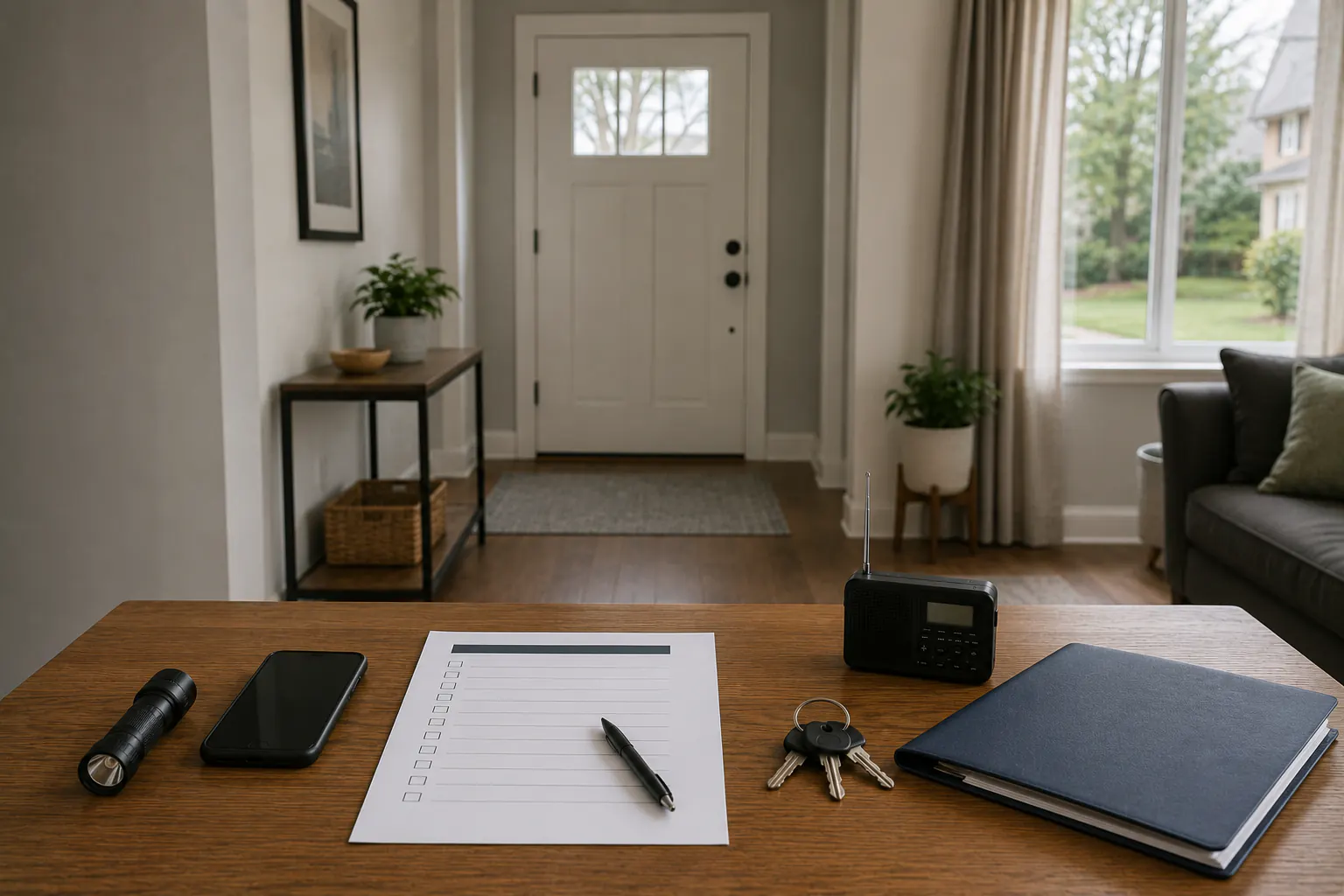
During a fire or smoke alarm
Follow the actual building’s fire plan and current responder instructions. Do not enter a route blocked by smoke, heat, or flames; if escape is unsafe or someone is trapped, call 911 and follow dispatcher instructions rather than forcing an improvised route.
- Leave immediately by the safest available route.
- Stay low when smoke is present and close doors behind you when possible.
- Do not spend time collecting property, operating optional security equipment, or investigating the source.
- Use stairs, not elevators, unless the building’s emergency plan and responders direct otherwise.
- Go to the household meeting place, call 911, and account for everyone.
- Never re-enter until the fire department says it is safe.
If a primary route is blocked, use the alternate route in the household escape plan and signal for help. Do not improvise a jump or climb without emergency-dispatch or firefighter direction.
USFA recommends planning two ways out of every room where possible, keeping exits clear, and practicing the plan with everyone in the home.
Why ordinary operation is not enough
An exit may be easy for a healthy adult who installed the device and still fail the household. Review it under realistic human conditions without creating darkness, smoke, panic, or an attack test.
Ask whether the opening remains usable by:
- a child who is expected to act in the plan;
- an older adult or person with limited grip, reach, balance, vision, hearing, or cognition;
- a resident using mobility equipment;
- a guest, sitter, caregiver, or roommate unfamiliar with the device;
- someone carrying an infant or assisting another person;
- an occupant awakened at night;
- a person without a phone, glasses, hearing aid, or usual dominant-hand function;
- a responder who may need authorized access.
Accessibility and fire-code requirements are site-specific. A household simulation cannot replace inspection by the authority having jurisdiction or a qualified professional.
Red flags that need prompt review
Stop treating the setup as complete when any exit:
- requires an interior key that is hidden, removable, or not carried by every user;
- depends on a phone, internet connection, cloud service, voice assistant, or charged battery as the only release method;
- needs a tool, code, several unfamiliar motions, tight pinching, or strong lifting;
- is blocked by a bar, furniture, storage, exercise equipment, seasonal decoration, or package;
- has a floor-mounted device that creates a trip hazard;
- does not close, latch, or release consistently;
- has a closer, fire label, alarm contact, electric lock, or shared-building function affected by an added device;
- uses window bars or guards without a verified emergency-release and fire-escape plan;
- is too small, high, damaged, painted shut, or obstructed for its assigned escape role;
- relies on a garage door opener without an understood, authorized manual plan;
- creates a conflict between child fall protection and emergency escape;
- cannot be operated by someone represented in the household plan.
Do not wait for the next drill if the only practical exit is affected. Contact the responsible authority, landlord, or qualified professional.
Secondary locks and door jammers
Added deadbolts, surface devices, portable jammers, braces, chains, guards, wedges, and improvised restraints can change how a door releases and how responders enter. Some may also damage a frame, interfere with normal latching, or violate a lease or fire requirement.
A device is not proven suitable because it can be removed quickly by the purchaser in daylight. Check written manufacturer instructions, certification, the exact opening, building rules, and every legitimate occupant’s ability. Do not add multiple devices until a release sequence becomes a puzzle.
Never use furniture, rope, wire, lumber, or another improvised object to barricade an occupied home’s required exit. This site does not publish barricade construction or defeat testing.
The door, frame, and strike assessment focuses on normal operation and condition before any product decision.
Double-cylinder and keyed-interior locks
Any setup that requires a key from inside creates an obvious question: where is the key during a fire, and can every occupant find and use it under emergency conditions? Leaving a key in place may introduce other risks, while removing it may delay escape.
Do not resolve that conflict through a generic online recommendation. Codes, glazing, occupancy, historic conditions, multifamily rules, and local approvals vary. Ask the fire/building authority and a licensed locksmith or qualified door professional to assess the exact opening.
Window bars, guards, stops, and fall protection
Windows may serve security, ventilation, child fall prevention, rescue, and escape functions at the same time. CPSC distinguishes screens from fall protection and advises that window-guard planning preserve fire escape as applicable.
Potential conflicts include:
- bars or guards without a readily usable emergency release;
- stops that restrict an assigned escape opening;
- keyed locks whose keys are unavailable;
- an air conditioner blocking the only planned window route;
- furniture or storage preventing approach;
- a child-safety device adults forget to release;
- a basement or upper-floor window assigned as an exit without a safe exterior continuation.
Do not remove a required guard or enlarge, cut, drill, or alter glazing based on this page. Use the window security guide and obtain site-specific fire, building, glazing, and child-safety guidance.
Smart locks and electronic access control
Electronic locks can support convenient access, but the complete release path may include local electronics, batteries, a keypad, credential, hub, router, internet, cloud service, phone, app, account, building controller, and electric power.
Document:
- normal interior release;
- behavior during loss of line power, network, cellular service, or cloud access;
- low-battery alerts and replacement responsibility;
- authorized mechanical or local fallback, if provided;
- behavior after software update, account lockout, or phone loss;
- effect on the latch, closer, fire door, alarm, and shared access system;
- management, monitoring, and responder procedure.
Do not deliberately defeat building access control or create a dangerous outage to test it. Coordinate with management or the provider, use approved test mode, and preserve emergency access. The alarm and network continuity guide maps these dependencies.
Garage doors and attached garages
An automatic garage door is not a substitute for a household fire exit unless the actual approved building plan says otherwise. During an outage, the opener, lighting, vehicle, manual release, door weight, spring system, and interior passage may behave differently.
Do not pull, adjust, or repair springs, cables, tracks, or an unfamiliar release. Garage door systems can store dangerous mechanical energy. Use the manufacturer’s authorized procedure and a qualified service provider. Keep the door between an attached garage and living space closed and operating as designed; do not wedge it open or alter a self-closing feature.
Fire doors, closers, and shared corridors
Apartment corridor doors, stair doors, garage separation doors, and other rated openings may limit smoke and fire spread. Security additions can interfere with closing, latching, clearances, seals, labels, hinges, or access control even when the added part is small.
Report rather than modify:
- a stair or corridor door propped open;
- a closer that does not close and latch the door;
- damaged glazing, seals, frame, hinges, or latch;
- an added device contacting the frame or floor;
- storage in an exit corridor or stair;
- a lockout condition on an expected escape route.
Shared egress components belong to building management and the relevant authority, not a resident’s DIY experiment.
Child safety and escape planning
Child-safety devices should reduce access to hazards without creating an impossible escape role. Adults remain responsible for young children who cannot independently execute the plan.
Assign who assists each child, older adult, person with a disability, and animal. Teach children to respond to a smoke alarm, avoid hiding, go to the meeting place, and never return inside. Keep matches, lighters, medications, firearms where lawfully present, and other hazards secured through methods that do not obstruct the exit route.
Do not ask a child to practice climbing from a window or upper level. Fire-escape ladders and exterior escape routes require product instructions, age-appropriate planning, and site-specific professional or fire-department guidance.
Conduct a safe release review
Perform this in normal daylight with no simulated smoke and no disabled life-safety equipment.
- Identify the primary and alternate route from each occupied room.
- Remove ordinary clutter from the path.
- Confirm smoke and CO alarms are maintained according to their instructions.
- Have each appropriate occupant demonstrate ordinary interior release without timing or pressure.
- Record any need for a key, phone, code, tool, strong grip, multiple hands, or help.
- Check that doors close and latch after the review.
- Verify the outdoor meeting place and 911 address.
- Assign each defect to management, an authority, or a qualified professional.
Do not lock someone in, disconnect an alarm, cut power, blindfold participants, fill a room with theatrical smoke, or rehearse a jump. A household drill should build recognition and calm movement, not create a new emergency.
The layered home security inspection combines this escape review with doors, windows, lighting, accounts, and outage dependencies.
Sources reviewed
- U.S. Fire Administration: Home Fire Escape Plans and Smoke Alarms
- U.S. Consumer Product Safety Commission: Childproofing Your Home
- UL Code Authority: Locking Configurations, Access, and Egress Control
- National Fire Protection Association: Home Fire Escape Planning
Sources reviewed July 14, 2026. The authority having jurisdiction, applicable code, building plan, manufacturer instructions, lease, and qualified site assessment control actual decisions.