
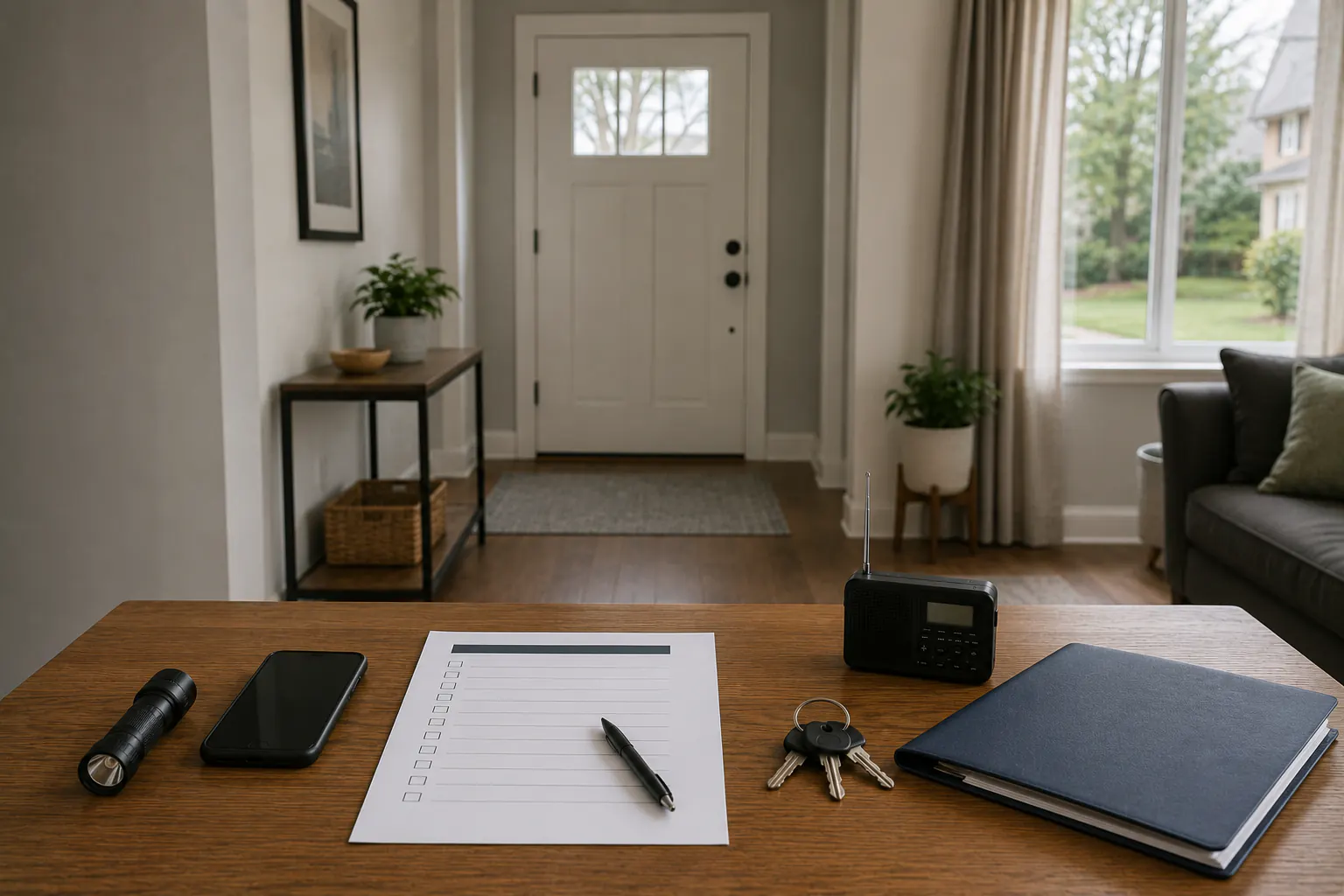
Start with a clear, usable exit and one ordinary access problem that needs attention before buying security hardware. If a break-in, fire, or immediate threat may be occurring, move to a safe location and call 911 instead of inspecting. Security measures must support privacy, communication, and safe withdrawal without promising prevention.
The weak point may be a damaged frame, an unlocked side window, a garage door, an expired alarm battery, a camera account with a reused password, a dark step, or a secondary lock that a child or older adult cannot release. Adding hardware without inspecting the whole opening can shift risk rather than reduce it.
This guide does not teach lock bypass, forced entry, traps, confrontation, weapons, or the use of force. Laws, lease terms, fire codes, accessibility needs, insurance conditions, and building construction vary across the United States.
If someone may be entering now
- Move away from the suspected entry point and account for everyone.
- Call 911 from a safe location for an immediate threat or suspected break-in in progress.
- Do not go outside, search the building, confront the person, or try to protect replaceable property.
- Use distance, a locked barrier, and an exit route that does not cross the threat when available.
- Give dispatch the address, description, direction, injuries, known hazards, and location of household members.
- Follow police instructions and do not re-enter or disturb the scene until cleared.
If returning home and something looks wrong, stay outside at a safe distance and call police. An open door, broken window, unfamiliar vehicle, damaged frame, or alarm notification is not an invitation to inspect alone.
The existing blackout security guide adds power-failure, civil-unrest, and temporary evacuation decisions.
Use five layers with different jobs
| Layer | Purpose | Common failure to avoid |
|---|---|---|
| People and routines | reduce predictable mistakes and control normal access | sharing codes, hiding keys, opening the door without verification |
| Detection | reveal a door, window, motion, glass, smoke, water, or network event | assuming every alert is real or that the system works offline |
| Delay | make ordinary unauthorized entry more difficult | strengthening hardware on a damaged door, frame, or wall |
| Communication | reach household members, monitoring, neighbors, or 911 | internet-only alerts, expired contacts, uncharged phones |
| Safe withdrawal | let occupants leave or move to safety | keyed interior locks, bars, furniture, or devices blocking escape |
No layer guarantees prevention, warning time, or a safe delay. Plan withdrawal and communication without assuming equipment will give occupants enough time to investigate or protect property.
Start with a household threat and access map
List legitimate users, doors, windows, garage connections, shared entrances, gates, balconies, basement access, exterior stairs, fire escapes, and service openings. Include normal visitors, deliveries, caregivers, cleaners, contractors, pet care, and emergency responders.
Then record conditions that change the plan:
- single-family, apartment, high-rise, mobile home, or shared house;
- owner, renter, condominium association, or managed building;
- children, older adults, disability, limited grip, cognitive impairment, or hearing/vision needs;
- required fire exits, self-closing doors, sprinklers, and smoke/CO alarms;
- pets and service animals;
- frequent deliveries, home business, or public-facing address;
- domestic-violence or stalking concerns requiring confidential specialist planning;
- power, Wi-Fi, cellular, cloud, and battery dependencies;
- local police, fire, building, alarm-registration, and permit rules.
Do not store codes, key locations, camera blind spots, travel dates, or exact security weaknesses in a shared online document. Keep an operational copy private.
If firearms are present in the household, their unauthorized-access, escape-path, and evacuation questions belong to a separate plan with stricter boundaries: the firearm household emergency planning guide owns them without covering handling, acquisition, or tactics.
NYPD crime-prevention officers provide residential security surveys in New York City; many local police or sheriff departments offer similar programs. Use the service available in the actual jurisdiction rather than treating one city’s hardware guidance as national law.
Inspect the whole door opening
A lock works with the door, frame, strike, hinges, fasteners, wall connection, glazing, threshold, closer, and daily alignment. A certified lock cannot compensate for rotten wood, a split jamb, loose hinges, a damaged fire door, or a door that does not latch.
From the safe side, look for:
- smooth closing and consistent latch engagement;
- movement at hinges, frame, strike, and trim;
- cracks, rot, corrosion, impact damage, and loose hardware;
- exposed or removable hinge components on an outward-swinging opening;
- glass or panels close enough to affect the lock plan;
- weather swelling or settlement that changes alignment;
- a self-closing door that no longer closes and latches;
- an interior release that every occupant can operate quickly.
Do not disassemble a fire-rated door, access-control system, shared entrance, or unfamiliar lock. The exterior door assessment guide explains what can be observed without publishing bypass methods or prescribing one fastener for every wall.
Patrick’s practical locksmithing and renovation experience informs the inspection sequence. It does not establish a license, certification, code approval, or a claim that a specific reader’s assembly has been tested.
Treat windows as security, fall, and escape openings
Window type, height, glass, frame, air conditioner, child fall risk, and fire-escape role change the safe options. A device that limits opening may reduce one risk while blocking emergency escape or rescue.
Check normal locks and latches, damaged frames, accessible openings, screens, stops, guards, air conditioners, and vegetation from safe ground. A screen is not a child fall barrier. CPSC advises that where window guards are used, at least one window in each room should remain readily usable for fire escape, subject to the actual building plan and local rules.
Do not install bars, security film, pins, stops, keyed locks, or glazing products without verifying egress, fall protection, lease authority, and compatibility. The window security guide separates detection, delay, privacy, child safety, and escape.
Use lighting for orientation and observation
Lighting should let occupants see steps, paths, doors, visitors, and hazards without creating glare, shining into neighbors’ homes, revealing private interior activity, or encouraging someone to go outside and investigate.
Security claims for lighting are often overstated. Treat exterior light as one visibility layer, not proof that crime will be deterred. Place and aim fixtures based on the site, local code, wildlife or nuisance rules, camera exposure, and safe maintenance access.
The security lighting guide connects normal line-powered lighting with battery path lights and outage operation. The existing emergency lighting guide covers indoor path, task, and area light.
Line-voltage wiring, exterior circuits, wet locations, penetrations, and elevated work belong to qualified installation.
Audit alarms and cameras as service chains
An alarm or camera may depend on a sensor, local hub, transformer, battery, router, internet service, cellular path, cloud account, phone, app, monitoring center, current contact list, and police registration. “Battery backup” at one component does not prove the whole chain survives an outage.
For each system, document:
- what it detects and what it cannot detect;
- local sound, local recording, cloud recording, and monitoring behavior;
- backup duration measured under normal conditions;
- what happens when Wi-Fi, internet, cellular service, or cloud access fails;
- who receives alerts and in what order;
- false-alarm cancellation and emergency procedure;
- update, account, encryption, password, and multi-factor settings;
- video retention, sharing, field of view, microphone, and privacy choices;
- manual operation after phone loss or account lockout.
The alarm and camera continuity guide turns this into a testable table without claiming that a camera prevents entry.
Protect privacy while adding observation
Cameras can expose sensitive household activity if accounts, networks, vendors, or sharing settings fail. The FTC recommends researching encryption, securing the home network, updating software, using unique passwords and two-factor authentication, and limiting remote access and sharing.
Do not point cameras into neighbors’ private areas or record audio without checking applicable law. Avoid cameras in bedrooms, bathrooms, and spaces where residents, children, caregivers, or guests reasonably expect privacy. Use the minimum view and retention needed for the defined purpose.
If a current or former partner may have account access, device access, or monitoring capability, do not make changes that could increase danger without a confidential safety plan. Use a qualified domestic-violence service or victim advocate from a safe device.
Preserve fire escape and accessibility
USFA advises mapping all doors and windows, finding two ways out of every room where possible, keeping exits unblocked, and practicing with everyone in the home.
Security changes can undermine that plan when they require a hidden key, two hands, tight grasping, several unfamiliar motions, lifting a heavy bar, moving furniture, or using an app. Smoke, darkness, panic, injury, and loss of power make ordinary tasks harder.
The fire-egress security warning addresses double-cylinder locks, window bars, door jammers, improvised braces, self-closing doors, garage releases, smart locks, and child or accessibility conflicts without declaring one device legal everywhere.
Separate renter and owner authority
Renters can improve routines, key control, privacy, portable lighting, contact sensors, camera account security, package handling, and documentation. Drilling, replacing locks, changing a fire door, installing bars, modifying common areas, or altering access control generally requires written authority and may require permits or licensed work.
The renter-friendly security guide distinguishes reversible measures from changes that need management approval. It also avoids products that make it hard for emergency responders or occupants to open the door.
Owners still need permits, code compliance, utility marking, association approval, and qualified trades where applicable. Ownership is not technical competence.
Choose products by verified function
Avoid a single “best lock” or “best alarm” claim. Door construction, use, egress, climate, accessibility, monitoring, and installation determine performance.
For mechanical hardware, look for the current applicable standard and independent certification, then verify the exact model in the certification directory. ANSI/BHMA residential standards test categories such as security, durability, and finish under laboratory conditions; BHMA explicitly notes that real performance varies with installation, door and frame construction, maintenance, and environment.
For connected products, review support period, update process, unique credentials, data practices, encryption, multi-factor authentication, local operation, account recovery, export/deletion, and what happens when the company or cloud service stops.
ReadyLience will not publish comparative winners until representative products are acquired and tested under the testing methodology.
Run a layered inspection without testing defeat
Use the home security inspection checklist in daylight with every legitimate occupant represented.
- Confirm emergency contacts and the 911 address.
- Walk normal entry, visitor, delivery, and caregiver routines.
- Operate each authorized key and interior release.
- Check doors and windows for ordinary damage and alignment.
- Trace alarm, camera, router, power, cellular, and cloud dependencies.
- Walk the fire escape route in low but safe light.
- Verify that children and vulnerable residents can follow their part of the plan.
- Record each issue with an owner, professional, authority, and due date.
Do not kick, pry, pick, ram, bypass, climb, or otherwise attack-test the home. Product and assembly resistance require controlled standards and qualified testing, not a household demonstration.
Sources reviewed
- U.S. Fire Administration: Home Fire Escape Plans
- NYPD: Security Surveys and Safeguard Your House
- U.S. Consumer Product Safety Commission: Childproofing Your Home
- Federal Trade Commission: Home Security Systems and Camera Security
- NIST: Consumer IoT Cybersecurity Baseline
- ANSI/BHMA: Residential Locksets and Latches
Sources reviewed July 14, 2026. A site-specific security, fire-code, accessibility, legal, or product decision belongs to the applicable authority, lease, manufacturer instructions, and qualified professional rather than a general hardening checklist.