
If firearms are already present in your household, make secure storage and a clear way out part of the ordinary plan before an emergency. Identify the responsible authorized adult and the qualified safety or legal resource for unresolved questions. Never delay a fire escape to check or collect property.
It is not a plan for confronting someone, investigating a disturbance, or making a weapon part of a family response. A blackout, wildfire warning, evacuation, shelter instruction, visitor, argument, or power failure can make ordinary storage and access assumptions fail. The useful preparation is quiet and specific: know who is responsible, keep storage secure, keep exits clear, and decide in advance which official sources control the next step.
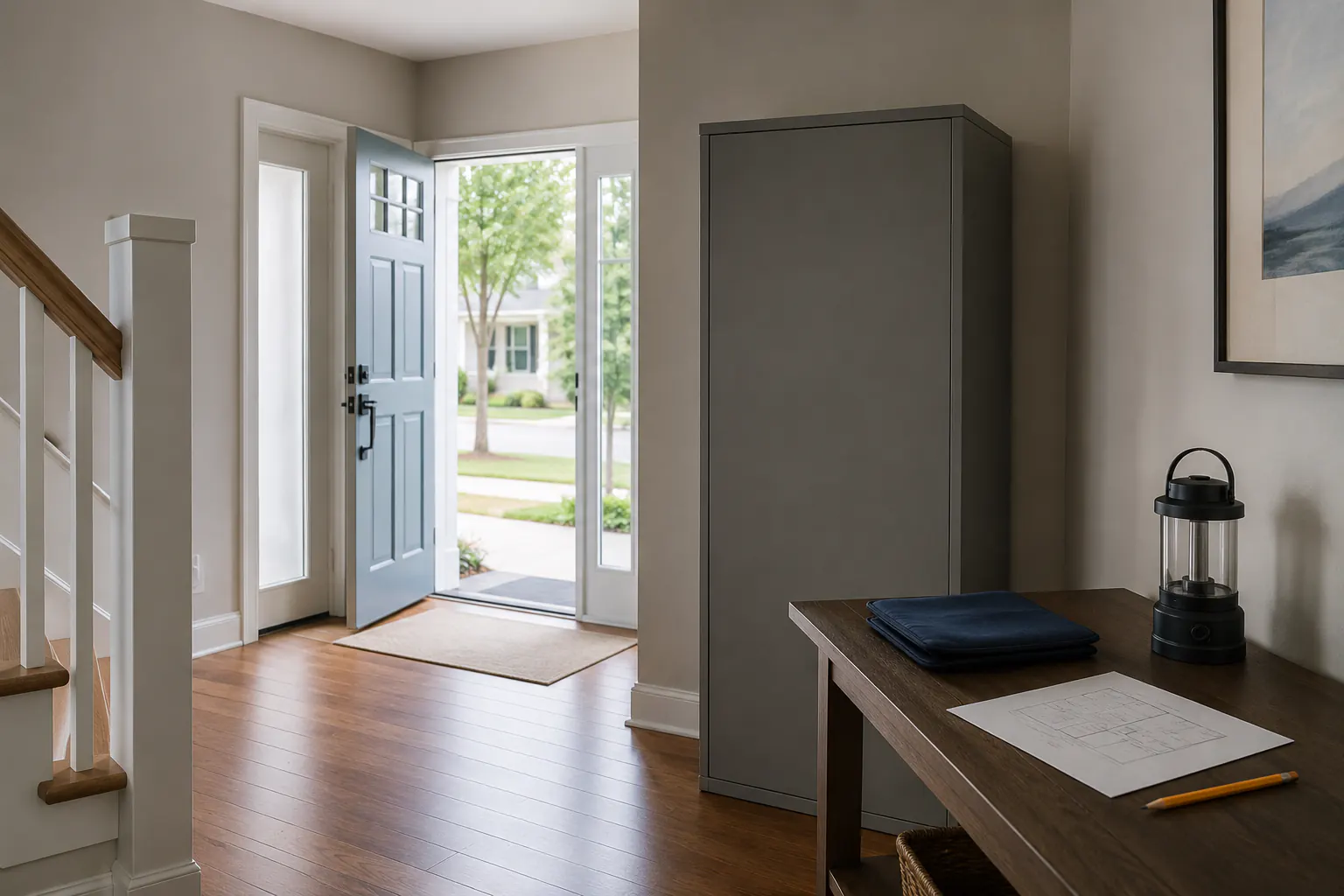
Keep unauthorized access out of the plan
The Centers for Disease Control and Prevention notes that a firearm being out of sight or reach is not enough to prevent access by children or unauthorized adults. The Bureau of Alcohol, Tobacco, Firearms and Explosives also advises secure storage inaccessible to children and separate secure storage for ammunition.
For a household plan, write the rule in plain language: firearms are stored securely when not in use, access is limited to the responsible adults authorized by law, and no child, guest, caregiver, contractor, neighbor, or visitor is asked to manage them during an emergency.
Do not leave an item unsecured because a situation feels temporary. A rushed departure, a disrupted routine, a guest, a tired caregiver, a lost key, a power failure, or an open garage changes who may encounter it. A locked vehicle, closet, nightstand, or out-of-sight shelf is not automatically secure storage.
This page deliberately does not recommend a particular product, lock type, storage location, or access method. The correct option depends on the household, the item, the people who may be present, legal requirements, fire and egress constraints, and the manufacturer instructions. A high-stakes decision needs current local and qualified advice, not a generic ranking. For the widely accepted storage principles — secured, unloaded, ammunition separate, keys controlled — especially in homes with children, see safe firearm storage principles.
Assign responsibility without sharing access
Name the responsible adult or adults in the private household plan. They should know the current legal, storage, and safety responsibilities that apply to them. Everyone else needs a simpler rule: do not touch, move, show, transport, photograph, or discuss the storage arrangement.
Keep that role separate from a family communication plan. An out-of-area contact, school pickup contact, neighborhood coordinator, contractor, pet sitter, or caregiver does not automatically need access to the household’s storage information. The family communication plan keeps contact and reunion roles useful without turning them into security permissions.
Do not put a storage location, access method, identifying number, photo, inventory, or live absence notice into a group chat, shared calendar, evacuation checklist, household whiteboard, or social-media post. The neighborhood check-in guide explains the same privacy principle for disruptions: share only the minimum information that solves the immediate coordination problem.
If a household needs a controlled record for lawful recovery after theft or loss, keep that record away from the item and within the protected record system. The home inventory guide and the household record map provide the separate documentation boundary. They do not grant physical or account access.
Protect the fire escape before property
In a fire, the priority is to leave. U.S. Fire Administration guidance calls for two ways out of rooms where possible, unobstructed doors and windows, an outside meeting place, and practice with everyone in the home. No storage plan may block a doorway, window, corridor, stair, or the normal path to the meeting place.
Do not delay a fire escape to collect property, retrieve a storage item, or verify a cabinet. Leave, meet at the agreed location, and call emergency services. The fire-egress security guide and home hardening guide help a household review doors, windows, hardware, and barriers without creating a trap.
For renters and apartment residents, never alter a fire door, common-area exit, building access system, or storage area without written authority and any required professional review. A storage choice that works in a detached home can be incompatible with a lease, fire code, building rule, accessibility need, or shared exit. The owner, manager, and local authority control those conditions.
Plan a departure around people and official instructions
An evacuation order, fire, flood, building instruction, dangerous indoor condition, or other immediate emergency changes the plan. Account for people first: children, guests, older adults, people with disabilities, pets, medication, communication, and a usable route. The evacuate-or-shelter decision guide owns the decision framework, while the shelter-in-place hub explains why the current hazard-specific instruction matters.
Before a disruption, identify the official sources that can change the plan: local emergency management, fire or law enforcement, building management, the evacuation destination, transportation provider, and the relevant state or local authority. Their current instructions determine whether a route, shelter, property, or transport option is available and what rules apply. Do not assume that a general preparedness article, an old social post, or a prior trip answers a live legal or safety question.
Do not leave a firearm unsecured in a vehicle while making other stops, waiting for help, checking into a shelter, or relocating. ATF safety material emphasizes secure vehicle storage, limiting unattended time, and returning an item to secure home storage when possible. Exact possession, transport, destination, and storage requirements vary by jurisdiction and location, so verify them through current official resources before a planned trip and follow on-scene directions during an emergency.
The blackout home-security guide covers the adjacent outage rule: do not investigate a disturbance, protect replaceable property, or turn a household plan into a confrontation. When an immediate threat exists, get people to safety and call 911 when it is safe to do so.
Review who might gain access when routine changes
Review the plan after a move, household change, new child or teen routine, new caregiver, separation, renovation, lost key or device, change in health or safety circumstances, or a prolonged period away from home. Ask only questions that reduce risk:
- Can every resident leave quickly without passing a blocked exit?
- Is the secure-storage responsibility still clear and lawful?
- Could a child, visitor, worker, or unauthorized adult encounter an unsecured item?
- Are private records kept separate from the item and from general household messages?
- Does the emergency contact plan avoid publishing a household absence or storage detail?
- Does the household know which official sources control an evacuation or building instruction?
Do not test access controls by defeating them, stage a realistic emergency with an item present, or ask children or visitors to demonstrate the plan. A review can be done with a paper checklist and a normal fire-escape walk. When a storage, legal, relationship, health, or safety situation feels uncertain, pause and use qualified help rather than improvising.
Keep the post-incident response factual
After a theft, loss, damage event, or unauthorized-access concern, keep people safe first and contact the authority that owns the immediate response. Do not search for a person, pursue anyone, post identifying details, or conduct your own investigation. Record only the factual details requested by law enforcement, the insurer, property manager, or qualified advisor, and protect the record from unnecessary sharing.
The purpose of this guide is not to make firearms central to preparedness. It is to make an existing household responsibility less likely to harm someone when a normal day stops being normal.
Sources reviewed
- Bureau of Alcohol, Tobacco, Firearms and Explosives: Firearms Safety and Security; Firearms Questions and Answers
- Centers for Disease Control and Prevention: Preventing Firearm Injury and Death
- U.S. Fire Administration: Home Fire Escape Plans
Sources reviewed July 16, 2026. Firearm possession, storage, transport, access, use, property rules, and emergency procedures can be jurisdiction- and location-specific. This guide is safety planning only; it does not provide legal advice, product advice, handling instruction, threat assessment, or use-of-force guidance.