
If an authority directs you to shelter in place, check the area, time, action, and next update in the complete message. Account for the people with you and follow the hazard-specific location and steps. Do not seal a room or change ventilation from the label alone; fire, flooding, a medical emergency, or a new order can change the response.
That distinction matters because the household job is not to invent a perfect sealed room. It is to recognize the authority, understand the actual instruction, account for people and animals, preserve the essentials, and stay ready to change course when conditions or officials say so.
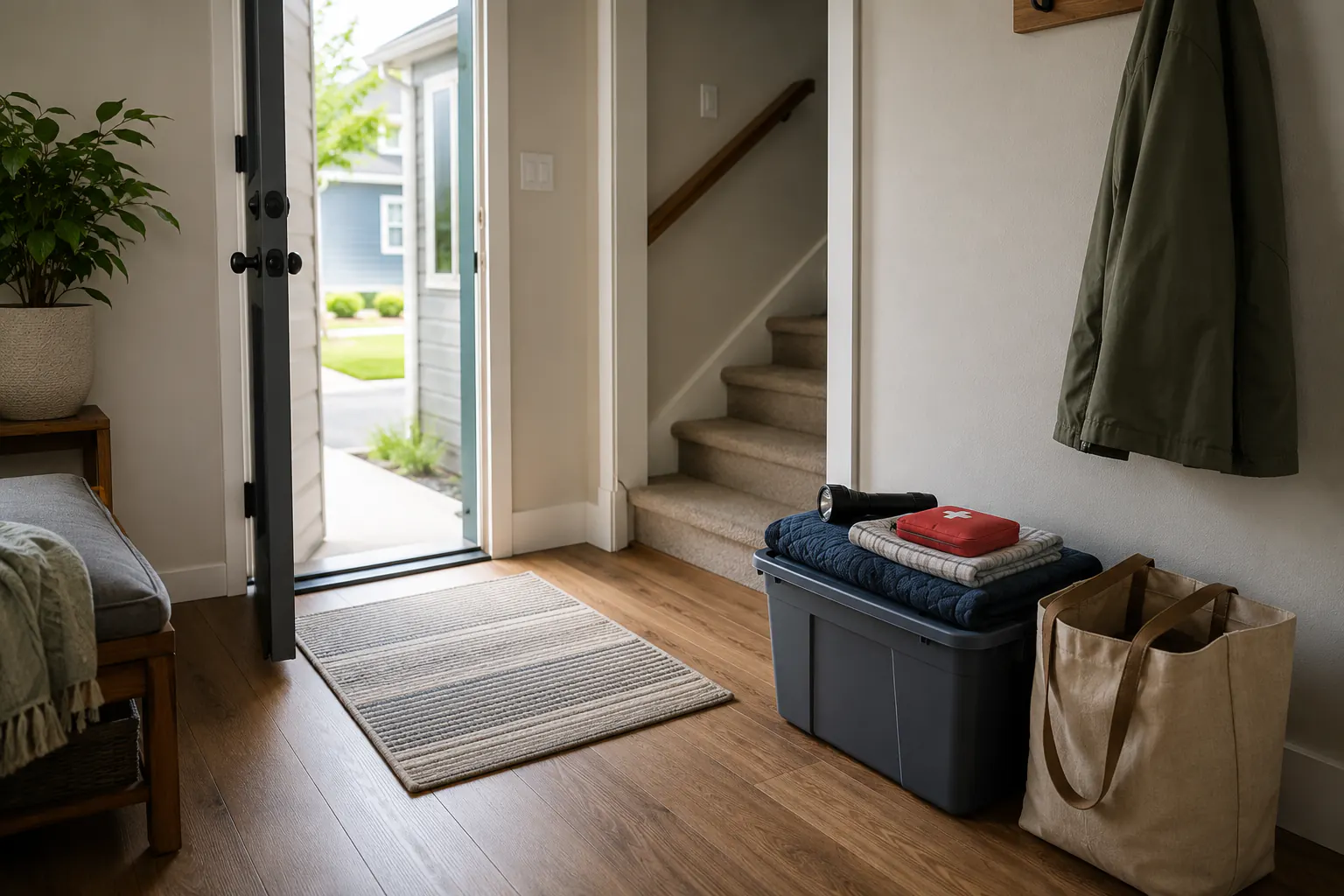
Start with the instruction, not the label
Read the complete official message before acting on a forwarded post, a partial alert, or a neighbor’s summary. Write down or repeat five details:
| Detail | Why it matters |
|---|---|
| Issuing authority | Identifies who owns the incident and the next update |
| Time | Distinguishes a current instruction from an old screenshot |
| Area | Tells you whether the address, building, route, or school is included |
| Action | May mean stay indoors, move to a named area, avoid travel, evacuate, or take hazard-specific steps |
| Next update or all-clear | Prevents a household from leaving because the room feels uncomfortable or a rumor changes |
An order always outranks this hub. So does a direct instruction from police, fire, emergency management, a utility, a school, a transit operator, or building management when that organization controls the place you are in. The local alerts guide helps build the redundant alert paths that make this possible when power, data, or one phone fails.
Do not use the phrase shelter in place to flatten different hazards into one response. CDC guidance distinguishes ordinary indoor sheltering from hazard-specific protective actions. A room appropriate for wind or radiation may not be appropriate for airborne contamination, and a home that is safe at noon may not be safe after a fire, rising water, medical failure, or a building instruction changes. When the hazard-specific direction is unclear, verify it with the responsible authority rather than improving the room from a generic article.
Prepare the household before anyone has to stay put
The practical work happens on an ordinary day. The aim is modest: make it possible to remain where you are for a period of time without searching through a dark house, exposing private details, or treating a delayed reply as a reason to travel through an active incident.
Choose information roles. Name one person who checks official channels and one backup. They do not need to monitor every rumor; they need to capture the source, time, instruction, household status, and next check-in. The family communication plan owns the contact, meeting-place, and out-of-area relay details.
Stage ordinary essentials where they are used. Safe lighting, drinking water, shelf-stable food, sanitation supplies, charging, and a paper contact list are more useful when they are reachable from the rooms people actually occupy. The specialist guides own the details: emergency lighting, water storage, emergency food storage, and sanitation when utilities fail.
Plan for people who cannot wait for a generic answer. Device power, refrigerated medication, oxygen, mobility, caregiving, service animals, infant needs, and personal assistance require a plan developed with the clinician, supplier, pharmacist, caregiver network, or service provider that owns the need. The medical device continuity guide is the household starting point, not a substitute for that care plan. Bring pets into the decision early through the pet preparedness hub; a carrier and records are useful precisely because the instruction may later change to leave.
When the instruction arrives
Use a short sequence. It keeps the household moving without pretending that every event needs the same physical setup.
- Get inside or remain in the designated safe place if the current authority directs it. Bring people and pets in only when that is safe and consistent with the message.
- Account for the household. Confirm who is physically present, who is elsewhere, which institution or caregiver controls their location, and when the next verified update happens.
- Check the immediate condition inside. Fire, gas odor, carbon monoxide alarm, smoke, flooding, structural damage, medical failure, violence, or another threat inside the building changes the situation. Call 911 for immediate danger when safe; do not stay merely because an earlier generic message said to remain indoors.
- Use the hazard-specific instruction. It may tell you to close openings, move to a particular level or room, adjust ventilation, avoid plumbing, avoid windows, or prepare to move. Do not add or omit steps from memory when a current official direction gives the relevant action.
- Preserve attention, batteries, and communication. Keep one reliable update path active and send the household’s short check-in rather than a stream of screenshots.
The evacuate-or-shelter decision framework explains the larger handoff: an official evacuation, an unsafe building condition, or an earlier individualized trigger can end a sheltering plan. The moment to agree on that handoff is before the safe departure window closes.
The room is a function of the hazard
Treat a prepared room as a flexible household location, not a permanent bunker. It should be reachable, have enough space for the people who may need it, allow safe communication, and avoid obvious household hazards. The authority may specify a better location for the incident; follow it.
| Situation | What controls the location | What this hub does not decide |
|---|---|---|
| Severe weather | Current weather warning and the building’s safest available interior area | Structural safety, tornado safe-room design, or when to leave a damaged building |
| Airborne, chemical, or radiological concern | Current public-health and emergency instructions | Whether a particular room is sealed enough, what contamination is present, or when outside air is safe |
| Wildfire smoke | Air-quality and local evacuation or cleaner-air guidance | Air-cleaning performance, HVAC changes, respirator fit, or medical suitability |
| Public-safety disruption | Police, fire, emergency-management, school, employer, or building instruction | A security confrontation, surveillance plan, or a route through an active scene |
| Utility outage | Household condition plus utility and public-safety direction | Generator use, medical-device runtime, food safety, or safe indoor temperature |
For an apartment, add the building’s realities: elevators may stop, common areas may be controlled, stair doors may have procedures, and an exterior route can become unavailable. The apartment outage plan covers floor and building-type constraints. Do not block a unit door, corridor, stair access, or fire exit with supplies, furniture, or improvised security hardware.
Keep separated people where their responsible plan places them
One of the hardest impulses is to drive to school, work, child care, a relative’s home, or a care facility as soon as an alert arrives. That can add a vehicle to the hazard, interfere with an institution’s accounting procedure, and make two locations less safe rather than one.
Before an event, learn the reunification and shelter procedures for each regular location. During an event, use the institution’s verified channel and the household contact plan. CDC guidance for children is direct on this point: wait until school authorities say it is safe to pick a child up. The same discipline applies to a hospital, care facility, workplace, or shelter that has its own emergency plan. A lack of immediate information is a reason to use the next official update path, not a reason to enter a restricted area.
Decide what changes the plan
Sheltering succeeds when it has clear stop conditions. Agree on them in advance and keep them specific: a new official order; an unsafe air, fire, flood, structural, security, or utility condition; an individualized medical or care trigger; loss of a required accessible service; or a direction from the building or institution that controls the location.
The power outage preparedness hub is useful when the disruption is primarily a loss of services. The wildfire smoke hub owns smoke-specific planning. The Civil Unrest household safety hub covers avoidance, verified information, and lawful choices during a public-safety disruption. They are routes into specialists, not alternatives to current authorities.
The honest limit
This page helps a household prepare to follow an instruction. It does not issue one. The current message from the authority managing the event, the actual condition inside the building, and the needs owned by qualified professionals control the decision. Call 911 for an immediate threat to life when safe to do so. Do not re-enter a restricted area, approach an active scene, or leave a safe location to solve a problem that responders or a responsible institution have told you to wait on.
Sources reviewed
ReadyLience reviewed CDC shelter-in-place guidance for chemical and radiation emergencies, CDC guidance for children and disability-inclusive emergency sheltering and evacuation, and Ready.gov household planning guidance. This hub organizes the household sequence and routes each specialist decision to its owner; it does not establish a safe room, a contamination procedure, a ventilation procedure, a medical plan, or a live instruction.