
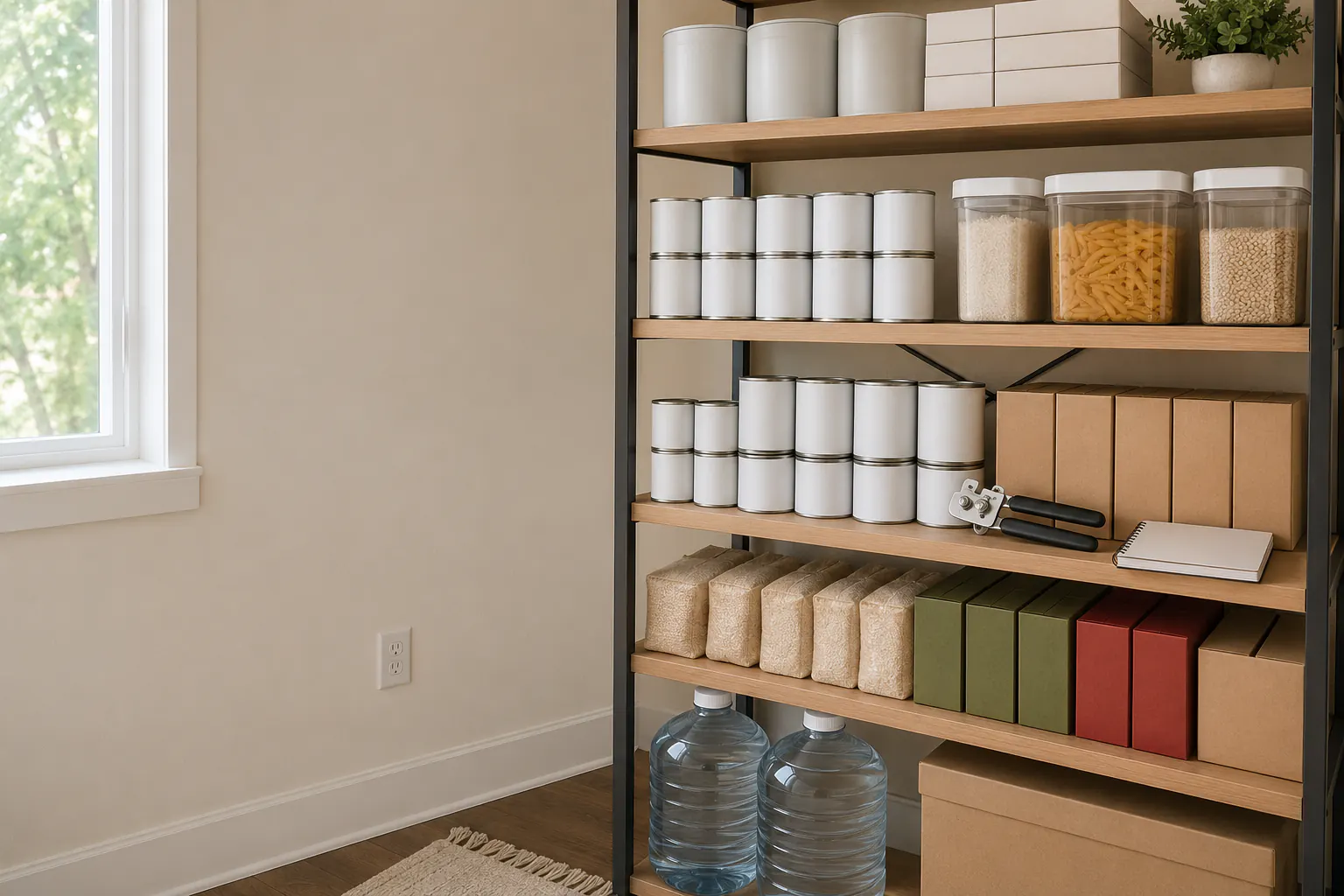
Choose one meal your household already likes and check whether its shelf-stable version works without your normal kitchen routine. Can you open it, follow its label, provide safe water, and handle leftovers? That is a useful starting point for a reserve, even in a small cupboard. This guide helps you add depth, store it where you can reach it, and rotate it through ordinary meals.
Start with a three-day layer, then extend it toward two weeks. Build in normal grocery trips and rotate it. Do not treat a box of unfamiliar rations as a substitute for a workable food system. The disruption most likely to test the pantry is an ordinary blackout, so pair this plan with the power outage preparedness hub.
Keep the three food decisions separate
1. What can the household eat?
This cluster owns the reserve: shelf-stable meals, ingredients, access tools, water demand, normal rotation, dietary compatibility, and storage limits. The three-day and two-week food list turns that into a household inventory.
Each household has a different answer. Age, chewing and swallowing needs, allergies, prescribed diets, pregnancy, infant feeding, cultural needs, disability, appetite changes under stress, and food preferences affect whether a meal is usable. The dietary-needs plan helps collect those facts without offering clinical substitutions — it also owns infant feeding, which follows product-specific and clinical rules rather than any pantry rule.
Plain preference matters too, for a practical reason rather than a soft one: a reserve nobody wants to eat is one that never rotates and eventually gets thrown away. Building a reserve your household will actually eat covers palatability and food fatigue, which quantity planning does not.
2. Is it safe after an outage or flood?
That is a different question. Refrigerated and frozen food, floodwater exposure, thawing, temperature history, appliance thermometers, coolers, and discard decisions belong to Power Outage Food Safety; choosing the cooler itself is the cooler comparison’s job. It owns the time-and-temperature rules and the instruction never to taste food to decide whether it is safe.
Food and medicine are also different systems. A meal reserve cannot replace a medication continuity plan, and food-cooler intuition does not establish refrigerated medicine stability. See Medical Device and Medication Continuity for the correct escalation path.
3. Can it be prepared without creating a new hazard?
An item is not a no-power meal merely because it is shelf stable. Some need safe water, a manual can opener, refrigeration after opening, long simmering, grinding, a heat source, or cleanup capacity. The outage cooking safety guide owns indoor/outdoor boundaries, combustion and carbon-monoxide stop rules, equipment instructions, and alternatives when cooking is unavailable.
Build in layers, not one shopping trip
Start with the food already eaten each week. Add enough extra shelf-stable versions to make familiar breakfasts, lunches, dinners, and snacks for three days. Then add depth one meal at a time until the two-week layer is useful. A reserve that expands gradually is easier to afford, rotate, transport, and inspect. The food quantity calculator turns the household’s own meal choices into a transparent slot count for both layers without prescribing a menu.
For a beginner who needs to connect food to water, light, communication, sanitation, care, and departure planning, begin with the 72-Hour Household Starter Kit. It is a routing checklist, not a second food-storage owner.
For every planned meal, record:
- the number of household servings it provides;
- water needed to drink, prepare, and clean up;
- whether it is ready to eat, needs heat, or needs cooking;
- the manual tool required to open or prepare it;
- whether leftovers need refrigeration after opening;
- the relevant label date and the household’s rotation month;
- allergies, diet limits, texture, and child or caregiver requirements;
- location in the home and the item that substitutes if unavailable.
This record prevents a familiar failure: buying a large quantity of dry staples that need more water, fuel, time, and equipment than are available during the event.
Choose food by job
Use categories, not brand lists.
| Job | Useful planning question |
|---|---|
| Ready-to-eat meal | Can it be eaten safely with no heat, no power, and minimal water? |
| Protein | Is it shelf stable, acceptable to the household, and accessible with the tools available? |
| Energy and comfort | Does it provide familiar calories, warm-drink options when safe, and foods people will actually eat? |
| Produce and fiber | Does the reserve include shelf-stable fruit, vegetables, and diet-compatible options? |
| Hydration support | What drinking and preparation water does the meal require? |
| Access | Can every container be opened manually by the person likely to prepare it? |
| Cleanup | Does it create dishes, food waste, packaging, or sanitation needs the household can handle? |
The low-water and low-fuel meals guide converts these questions into meal patterns. It does not claim that any particular food is nutritionally complete for every person.
Store for quality, access, and inspection
USDA describes shelf-stable food as food that can be stored at room temperature, but labels still control. Some canned products are marked “Keep Refrigerated”; some require refrigeration after opening; all food changes in quality over time. Store food cool, dry, protected from pests and water, and away from temperature extremes. Do not keep cans by a stove, under a sink, or in a damp garage or basement.
Inspect the reserve on an ordinary schedule. Use the FIFO pantry rotation guide to move older acceptable items into normal meals and replace them with new stock. The Pantry Rotation Planner can print a small normal-use and review card without turning a label date into a food-safety conclusion. Do not buy, keep, or use bulging, leaking, deeply dented, badly rusted, punctured, or otherwise damaged cans. Check current recalls by exact product. Manual access matters as much as the food itself; the containers, can openers, and pantry tools comparison covers choosing tools every likely cook can actually operate.
Apartment storage needs a separate plan for heat, moisture, weight, egress, pests, lease restrictions, and the fact that a small kitchen may be the only preparation space. See emergency food storage in a small apartment.
Keep water, sanitation, and food connected
Food quantity is not a complete plan without water. Some foods require more preparation water than they appear to; all households need drinking water. Plan drinking water separately through Emergency Water Storage. Do not assume a building tap, melted snow, or a water source is safe without current authority guidance.
Plan hand hygiene, dishes, trash, and human-waste disruption through Emergency Sanitation and Hygiene. Opening ten cans is not helpful if the family has no safe way to wash hands, manage waste, or prevent cross-contamination.
Keep the cooking boundary unambiguous
Never use a grill, charcoal appliance, generator, camp stove, patio heater, or other outdoor combustion device inside a home, garage, basement, enclosed porch, or partly enclosed area. Never use an oven to heat the home. Carbon monoxide has no reliable odor or visual warning; an alarm is an emergency warning, not permission for unsafe indoor combustion.
The Carbon Monoxide and Combustion Safety guide and the cooking guide explain the boundary. If the household cannot cook within equipment instructions and local or property rules, choose ready-to-eat meals or relocate rather than improvise.
Make a short, durable food record
Keep one accessible page with household count, diet needs, food inventory, water demand, manual opener location, safe cooking options, recall check date, rotation month, food-safety log location, local food-assistance contacts, and evacuation instruction. Update it after a move, a diet change, a new baby, a medical change, a new pet, or a major appliance change.
The goal is not a bunker pantry. It is a calm system that feeds the household while preserving attention for alerts, safety, neighbors, and relocation decisions.
Review the plan after every meaningful change
Revisit the reserve after a move, a new roommate, a change in work schedule, a new child or pet, a diet change, an appliance replacement, or a change in the household’s ability to lift, open, or cook food. A plan that was workable last winter may no longer fit the people or home using it. Update the record through normal meals and ordinary shopping rather than trying to repair it during an outage.
Sources reviewed
ReadyLience reviewed current Ready.gov kit guidance, FDA emergency food and water guidance, USDA FSIS shelf-stable storage guidance, and USDA FNS home-storage resources. Product labels, current food and water advisories, recalls, local emergency orders, property rules, clinicians, pharmacists, and registered dietitians control the individual situation. This hub does not replace the food-safety decision chart for an outage or flood.
OXO’s Soft-Handled Can Opener documentation and the exact manual Amazon listing were checked October 11, 2026 for model identity and the opening mechanism. No product handling, accessibility, cleaning or food-safety test was performed; broader safety-source dates are unchanged.