
There is a failure mode in household food storage that no calculator catches. The shelf is full, the quantities are right, the dates are current — and when the power goes out for three days, nobody wants to eat any of it. The reserve was built for an abstract emergency instead of for the people in the house.
This is the part that quantity planning misses. The emergency food storage hub covers how much to keep and for how long; this covers whether it will get eaten.
Why palatability is a practical concern, not a luxury
It sounds soft next to calories and shelf life. It is not, for three reasons:
- A reserve you dislike does not rotate. Food you avoid sits until it expires, then gets thrown out and replaced with more food you avoid. The pantry rotation guidance only works if the food re-enters normal meals.
- Appetite drops in stressful conditions, and it drops further when the only options are unfamiliar. A household eating less than it should during a cold outage is a real problem, especially for children and older adults.
- Ordinary food is a disproportionate comfort when everything else is disrupted. A familiar meal in a dark kitchen does more for a household’s evening than a technically superior ration.
“Food fatigue” is the shorthand: the point at which repetitive or unappealing food stops being eaten regardless of how sensible it is.
Build from what you already eat
The most reliable method is also the least dramatic — start from the meals your household already has on ordinary weeks and ask which versions survive without power.
- List five or six meals people genuinely like. Not aspirational ones.
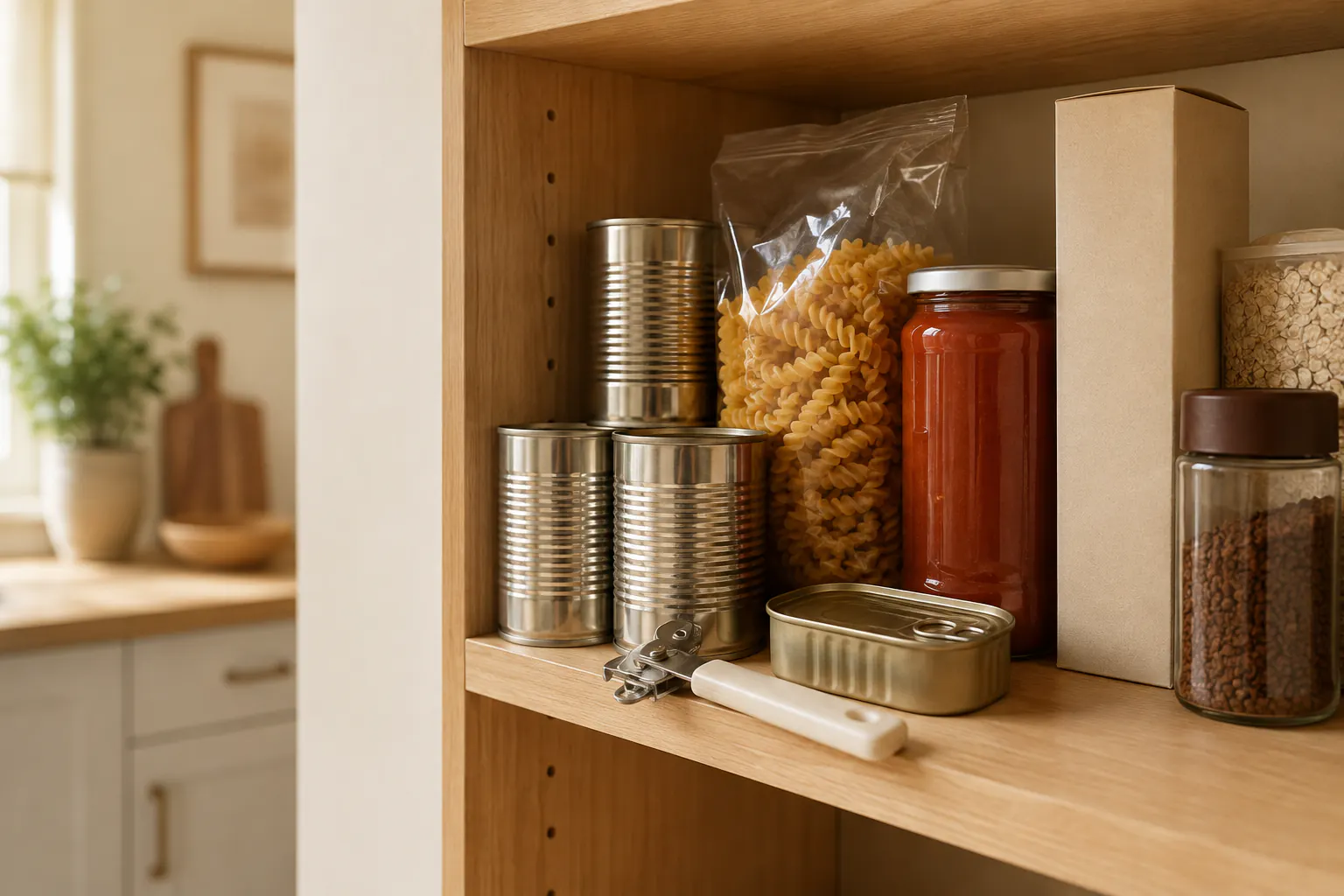
- For each, find the shelf-stable form. Pasta with jarred sauce; rice and tinned beans; tinned fish with crackers; soup; oats with dried fruit; tinned chilli.
- Buy those, in the brands you already buy. A tinned tomato you like is worth more than a survival bucket you do not.
- Eat one every few weeks as a normal meal, then replace it. That is rotation without a spreadsheet.
This is why a supermarket reserve usually outperforms a dedicated emergency kit for the first two weeks: it is made of food that already passes the household’s taste test.
What makes stored food edible over several days
A few practical levers matter more than any single product:
- Variety across texture and temperature, not just flavour. Several days of the same soft, room-temperature food is where fatigue sets in fastest.
- Something warm, if it is safe to make it. Even one hot item resets a day. Cooking safely without power is its own subject — the cooking during an outage guide owns it, including the carbon-monoxide rules that are non-negotiable.
- The small things that carry flavour. Salt, pepper, hot sauce, stock cubes, oil, sugar, coffee, tea. They store almost indefinitely, cost little, and transform bland staples.
- Snacks that need no preparation at all. Nuts, dried fruit, crackers, biscuits, tinned fruit. These matter most on the first disrupted day, when nobody has adjusted yet.
- Familiar options for children. A child who refuses unfamiliar food during a stressful week is not being difficult; plan around it rather than against it.
Meals that need little water or fuel are covered separately in shelf-stable meals that require little water or fuel — that guide handles the resource constraint, this one handles whether the result gets eaten.
Do not let preference override safety or a real dietary need
Two boundaries hold regardless of taste:
- Taste is never a safety test. Food that smells or looks fine can still be unsafe after an outage, and food that seems off should not be sampled to check. Follow the USDA and FDA rules on temperature, time, and discarding — the food safety during an outage guidance covers the thresholds, and “when in doubt, throw it out” is the rule that matters.
- Allergies and medical diets are not preferences. They are planned separately and with a clinician where relevant; emergency food planning for allergies and special diets owns that, and nothing in this guide overrides it.
A reasonable test
Once a season, use the reserve for a normal evening meal with the power on. Not a drill — just dinner. You will learn in an hour what an inventory never tells you: whether the tin opener is where you think it is, whether anyone actually likes the soup, and what you would want on the second day.
Then buy more of what worked and stop buying what did not. If you want the result written down rather than remembered, the pantry rotation planner keeps a normal-use horizon and a next-review date in the browser without storing anything.
A reserve tuned to real preferences is one your household will maintain, rotate, and eat — which is the only kind that helps.
Sources reviewed
- FoodSafety.gov: FoodKeeper storage guidance
- U.S. Food and Drug Administration: Food storage safety
- Ready.gov: Food
- Centers for Disease Control and Prevention: Food safety in emergencies
Sources reviewed August 4, 2026. Current USDA, FDA, and CDC guidance controls real storage-time and food-safety decisions; a clinician or dietitian controls dietary ones.