
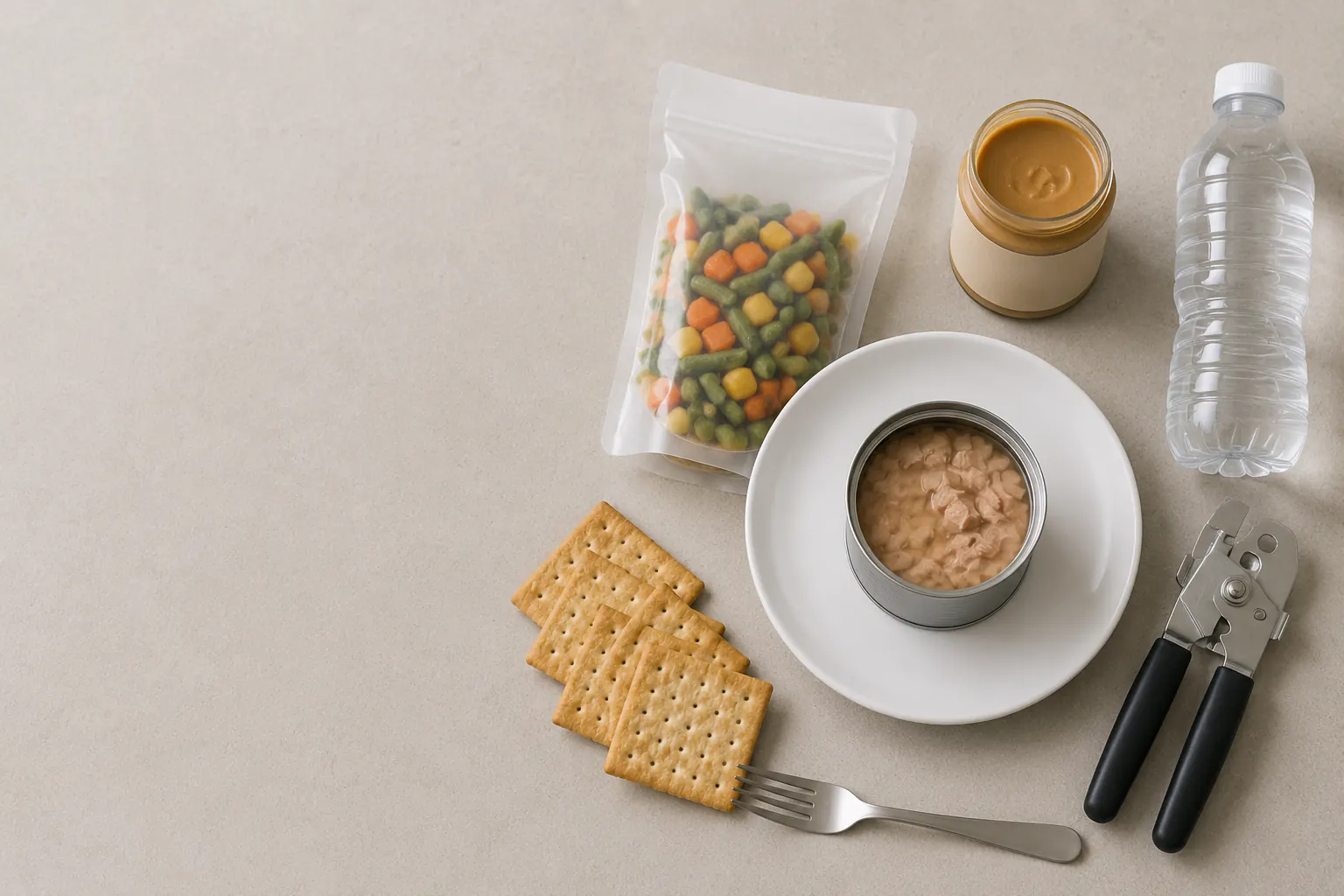
The most useful emergency meal may not be the one with the longest shelf life. It is the one the household can safely eat with the water, tools, time, hygiene, and preparation conditions that still exist. A dry staple that requires a long boil and several dirty pans can be a poor blackout meal even when it stores well. Use this page to pressure-test the menu layer of the household food reserve.
Start with food that can be eaten as packaged or prepared with minimal safe water. Then add low-resource meals only after the household has confirmed how they will be cooked without breaking equipment instructions or combustion-safety boundaries.
Sort food by its resource demand
Use four practical categories instead of a single list.
| Category | Planning question | Typical use |
|---|---|---|
| Ready to eat | Can it be opened manually and eaten now? | First meals, uncertain duration, evacuation-ready food. |
| Add water only | How much safe water is required, and can the water be heated if needed? | A secondary layer when water and preparation are available. |
| Short heat | Does the household have a manufacturer-approved, permitted way to heat it? | A planned option, never an excuse for indoor combustion. |
| Long cook or complex cleanup | What water, fuel, time, cookware, and ventilation would it need? | Ordinary pantry food unless the system has been tested safely. |
This sorting method is more honest than promising that a food is “no-power” simply because it is shelf stable. Read the package label: some products need refrigeration after opening, a specific cooking method, or food-safety handling the household cannot provide during an outage.
Build meals from familiar components
Plan by meal patterns, not by impressive product names. Examples of patterns to adapt to the household include a ready-to-eat protein plus crackers or another compatible staple plus fruit; a shelf-stable meal that can be eaten cold if its label permits; or a simple pantry meal with a safe, already-planned heat source. Exact foods depend on allergies, dietary needs, culture, age, texture, and household preference.
For each pattern, write:
- what can be eaten with no cooking;
- the amount of drinking and preparation water it uses;
- the manual opener, utensils, and clean surface needed;
- the leftovers rule from the product label;
- the diet-compatible alternative;
- the location of every component in the home;
- a simpler fallback if cooking or water is unavailable.
The emergency food quantity planner can turn those chosen meals into serving slots. It deliberately does not calculate nutrition or tell a reader what a person should eat.
Reserve water for the meal that works now
Water is often the hidden cost of a pantry. Dry grains, noodles, instant foods, beverages, washing, and dishes can compete with drinking water and medical needs. Treat water for ingestion and food preparation as a separate system, not a free ingredient. Emergency Water Storage explains the household baseline and storage limits.
When water or sanitation is constrained, favor meals with less preparation and fewer dirty tools. Do not sacrifice hand hygiene or use questionable water to make a meal feel more normal. Emergency Sanitation and Hygiene provides the parallel hygiene plan.
Keep cooking safety out of the pantry bargain
Never burn charcoal, use a grill, camp stove, generator, patio heater, or another outdoor combustion device inside a home, garage, basement, shed, tent, enclosed porch, or partly enclosed space. A cracked door, open window, or fan does not make it safe. If an outdoor device cannot be used exactly as its manual, weather, local orders, and property rules require, it is not available for the meal plan.
Choose ready-to-eat food instead. How to Cook During a Power Outage Without Creating a New Emergency contains the stop rules and links to the broader carbon-monoxide plan.
Make opened packages part of the plan
Small packages can create more waste, but they may be more usable when refrigeration after opening is unavailable. Large packages can be economical during normal life but may leave food the household cannot safely store once opened. Compare package size with the likely number of people eating, label directions, and the no-refrigeration fallback before stocking depth.
Keep a manual opener and a way to handle sharp lids. Store utensils, napkins, a trash plan, and cleaning supplies nearby without blocking exits. Include foods children, older adults, and people with reduced grip strength or low vision can access with available tools.
Do not confuse the reserve with refrigerated food
Shelf-stable meals are a way to avoid opening appliances, not a reason to ignore food inside them. Refrigerator and freezer food remains a separate food-safety problem. Use Power Outage Food Safety for temperature, cooler, floodwater, and discard decisions. Never taste food to decide whether it is safe.
Test gently during normal life
Use one planned meal during a routine weekend. Without turning off utilities or using unsafe equipment, see whether the household can find every component, open it manually, serve it with the available utensils, and clean up. Record what was awkward. That small rehearsal usually reveals more than buying a further case of food.
For ready-to-eat food served in pieces, a suitable pair of kitchen tongs you already own may handle the transfer from an opened package to a plate. Compare a new pair only if that particular serving job is awkward with your existing utensils. Tongs are not a way to grip sharp can lids, bypass cleaning, or make questionable food safe.
Match the utensil to the meal rather than buying both tong sizes: a short pair may suit a small opened container, while a solid serving spoon keeps a ready-to-eat mixture and its liquid together. Use a clean fork or spoon you own if it already works. These are room-temperature serving choices here, not permission to cook or ignore the food label.
Plan for comfort without turning it into a dependency
Familiar beverages, snacks, and small comfort foods can reduce friction during a long outage, especially for children or people under stress. They are useful only when they do not consume the water, fuel, or preparation capacity reserved for essential needs. Keep them as part of a varied plan, not as the only food a person can tolerate.
When a comfort item needs hot water, refrigeration, or a specialty appliance, make the alternate plain option explicit. A hot drink may be welcome; it should never create pressure to use fuel indoors or bypass a safe-water limit.
Rebuild after use
After the event or normal-life test, replace what was consumed with the same or a confirmed equivalent item. Record why a meal worked or failed: package access, water, cleanup, taste, allergies, appetite, or preparation. This small feedback loop makes the next reserve more personal and less wasteful than a static “survival food” list.
Keep a short first-meal list
Put two or three ready-to-eat first meals at the front of the reserve and name them on the inventory. This makes the first hours of an outage quieter: the household can preserve water, leave appliances closed, and focus on alerts or safe exit decisions before considering anything that needs heat or more cleanup.
Rotate these meals most often. Their job is immediate usability, so they should be the foods the household already knows it will eat.
Keep labels with the food
Do not decant a food into an unlabeled container merely to save space. The original package carries ingredients, storage instructions, dates, preparation directions, and allergy information. If food is moved into an appropriate container, retain the original information in a clear, reliable way and do not obscure food-safety instructions. In doubt, keep the original package and organize around it.
This is especially important when more than one household member buys groceries or may prepare a meal during a disruption.
Before the monthly pantry check ends, read one label from each first-meal group. Confirm the package is intact, the manual tool still works, and the meal remains acceptable to the people expected to eat it. That turns “low resource” from a marketing phrase into a tested household decision.
Sources reviewed
ReadyLience reviewed Ready.gov kit guidance, FDA storm food and water guidance, and USDA FSIS shelf-stable-food guidance. Labels, local orders, food and water advisories, and the relevant clinician or dietitian control the individual plan.
OXO’s Soft-Handled Can Opener documentation and the exact manual Amazon listing were checked October 11, 2026 for identity and the opening mechanism only. This was not a product or food-safety test; the broader safety-source review is unchanged.
OXO’s Kitchen and Herb Scissors documentation and the exact single-item 1072121 listing were checked October 12, 2026 for identity and separable-blade design only. The example serves ordinary package access, not a sanitation or food-safety result.
UCO’s Classic Sand Stone Switch Spork documentation and exact two-piece set were checked October 12, 2026. Maker SKU F-SP-SWITCH-SANDSTONE and retailer model 27008 share barcode 054269003333. The joined layout and tether are documented organization features, not tested joint strength, cleaning or a protected food-storage system.
OXO’s 28481 tongs documentation, applicable materials-disclosure entry, and exact single-pair Amazon listing were checked October 12, 2026. The maker documents stainless-steel heads, a pull-tab closure and dishwasher-safe care. The retailer lists MPN 28481V4; the nominal 9-inch name and maker’s 11-inch overall dimension are not measured storage-fit evidence. The listing’s California warning mentions DEHP, cancer and reproductive harm. This research is not chemical-safety clearance, a supplied-package inspection, or a grip, locking or food-safety test.
OXO’s current 11305500 Mini Tongs and 11281400 Silicone Spoon documentation and exact single-item US listings were reviewed October 13, 2026. The compact pair and solid spoon are different serving formats, not tested improvements or a set to buy together. Dishwasher-safe care is documented. The Mini Tongs materials-disclosure row is not chemical-safety clearance; no exact silicone-spoon row was established. Nominal dimensions and retailer marketing are not measured fit, heat, grip, cleaning or food-safety results. No product or supplied package was physically inspected.