
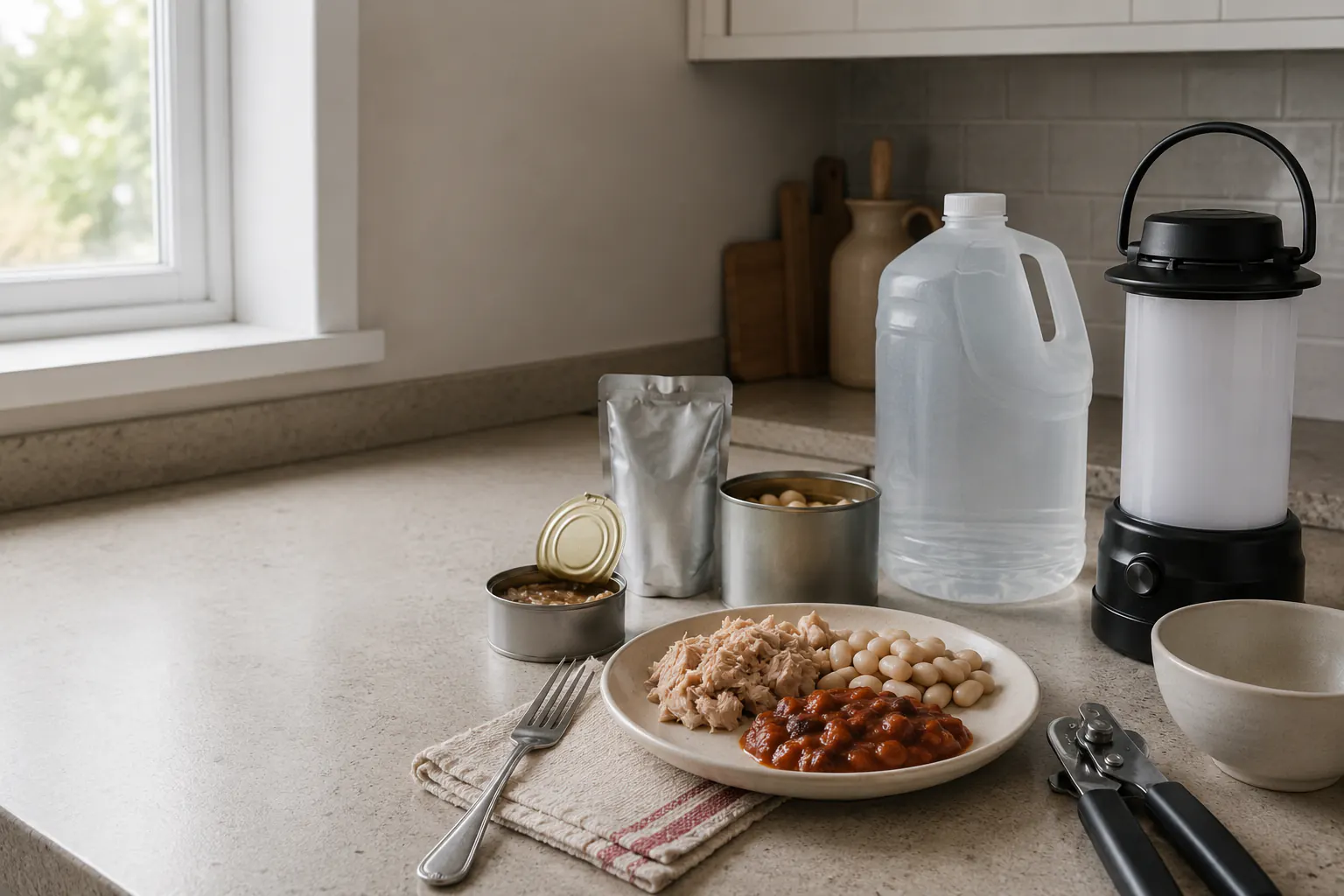
When power is out, the safest meal is often one that needs no flame, no indoor combustion, no improvised wiring, and little cleanup. A power outage is already a stressful event; cooking must not add carbon monoxide, fire, fuel, burn, electrical, or food-safety hazards. This guide bounds the cooking step of the wider emergency food storage plan.
Start with ready-to-eat shelf-stable food. If the household cannot use a cooking device exactly as its manufacturer directs, in a permitted location, with the required clearances and supervision, do not improvise. Choose a different meal, wait, relocate, or use a community resource when it is safe to do so.
The rule that does not have an exception
Never use charcoal, a grill, camp stove, generator, patio heater, fuel-burning heater, or any other combustion device inside a home, garage, basement, shed, tent, enclosed porch, or partly enclosed space. Do not treat an open window, cracked garage door, range hood, or fan as a safe substitute for an approved outdoor location.
The Consumer Product Safety Commission warns that charcoal used in enclosed spaces can produce deadly carbon monoxide. Carbon monoxide has no dependable odor or visual warning. A working alarm is an emergency warning device, not permission to operate a combustion appliance indoors.
Never use an oven to heat a home. Do not bring a hot grill, charcoal, or appliance indoors to cool or store it. Keep children, pets, loose clothing, paper goods, and fuel away from a cooking area.
For the wider household boundary, read Carbon Monoxide and Combustion Safety, what to do after a carbon-monoxide alarm, and fuel-burning heater limits. Those pages own emergency response, alarm, and heater guidance.
Choose the meal before choosing the heat
Use this order of preference:
- Ready-to-eat food that can be opened manually.
- Food that needs only safe water and a low-risk preparation method already planned by the household.
- Food that can be heated with equipment used exactly as its manual, local orders, weather, and property rules allow.
- A meal outside the home, with a trusted neighbor or community resource, only when travel and local conditions are safe.
Do not let the desire for a hot meal push the household toward an unsafe indoor workaround. The three-day and two-week food list and low-water, low-fuel meal guide are designed to make the first option realistic.
Before the outage: make cooking a written system
For each planned meal, record whether it is ready to eat, needs heat, needs boiling water, requires refrigeration after opening, and requires dishes. Record the manual tool that opens it. Keep the product manual for every cooking device and understand the manufacturer’s location, fuel, weather, clearance, surface, and supervision instructions before relying on it.
Also record:
- where the household’s working carbon-monoxide and smoke alarms are located and how they are tested;
- which meals can be eaten if cooking is unavailable;
- water needed for drinking, preparation, hand hygiene, and cleanup;
- extinguisher location and the family’s safe exit route;
- the rule that anyone may stop the plan when the setup feels wrong.
This is more useful than owning a device that has never been inspected, fueled, read about, or used under its instructions. A cooking plan must fit the actual apartment, yard, weather, building rules, and people present.
During the outage: protect the space and the food
Keep the cooking decision separate from food stored in appliances. Refrigerator, freezer, cooler, floodwater, and discard decisions belong to Power Outage Food Safety. Do not open refrigeration repeatedly to assemble an ambitious meal. Do not use snow, a porch, or outdoor temperature as a refrigerator.
Use clean hands, safe water, clean food-contact surfaces, and packaging directions. If safe water or hygiene is limited, choose meals that create less preparation and cleanup. Emergency Water Storage and Emergency Sanitation and Hygiene cover those parallel systems.
Keep a clear exit. Do not cook in a location that blocks the route out, crowds a stairwell or balcony, places a flame near stored fuel, or forces someone to carry hot food through a dark, cluttered home. Use battery lighting rather than candles around cooking tasks whenever possible.
Stop rules
Stop and move to the next safest option when any one of these is true:
| Stop condition | Safer next step |
|---|---|
| The device would be inside, near an opening, or in a partly enclosed area | Do not use it; choose ready-to-eat food. |
| The manual, fuel, or approved location is unavailable | Do not guess; choose a different meal. |
| Weather, wildfire smoke, wind, local orders, or property rules make the outside location unsuitable | Do not force an outdoor setup; use shelf-stable food. |
| A CO alarm sounds, a person has symptoms, you smell gas, or there is a fire concern | Leave the area and follow emergency guidance. |
| The household cannot supervise the device or keep children and pets clear | Do not use it. |
| Food preparation would compromise a safe exit, water, or hygiene plan | Simplify the meal or stop. |
An outage is not a test of self-reliance. Choosing a cold meal is often the correct operational decision.
Plan for neighbors and shared buildings
In apartments, condos, duplexes, and dense neighborhoods, one household’s cooking decision can affect people nearby. Do not put flames, hot equipment, fuel, cords, or smoke where they affect shared exits, balconies, breezeways, building ventilation, or another resident’s ability to leave. A device that might be acceptable in a different setting may be prohibited or unsafe in the present one.
Ask the building manager or local authority about restrictions before an emergency, not while the power is out. If a neighbor is using combustion equipment unsafely, do not confront a potentially dangerous setup alone. Move to fresh air if needed and contact emergency services, property management, or the relevant authority.
Treat battery power as equipment, not a promise
Some cooking appliances may be compatible with a battery system, but compatibility depends on the actual appliance, measured load, startup behavior, battery capacity, output limits, cables, manufacturer directions, and the priority loads the household has already assigned. Do not connect a high-draw appliance because its label seems to fit a rough watt estimate. The backup power hub and power-station calculator explain the limits of a planning estimate.
Before using any electrical appliance on backup power, inspect cords and plugs, keep them dry, and stop if equipment is damaged or has been exposed to water. Do not create a cord run across a doorway or an escape path just to heat a meal.
After cooking
Follow the appliance manual for shutdown, cooling, fuel handling, and storage. Do not bring warm charcoal or a warm grill into an enclosed area. Clean food-contact items with available safe water and manage waste without blocking exits or attracting pests. Record what the household actually used so the food reserve can be rebuilt during normal shopping.
This guide offers no conversion, ventilation workaround, or indoor-use method for outdoor equipment. Current equipment instructions, local fire restrictions, property rules, and emergency authorities control actual use.
Sources reviewed
ReadyLience reviewed CPSC carbon-monoxide and post-storm safety guidance, FDA storm food guidance, and Ready.gov power-outage guidance. Equipment manuals, local fire restrictions, weather, property rules, emergency orders, and emergency services control the situation.