
If a carbon monoxide alarm is sounding right now, stop reading and act:
- Get every person and pet outside into fresh air immediately.
- Call 911 from outside, not from inside the building.
- Do not go back in — for a phone, a pet, a bag, or to look for the cause — until responders say the building is safe.
Everything below assumes you have already done that, or that you are reading this before an alarm ever sounds, which is the right time.
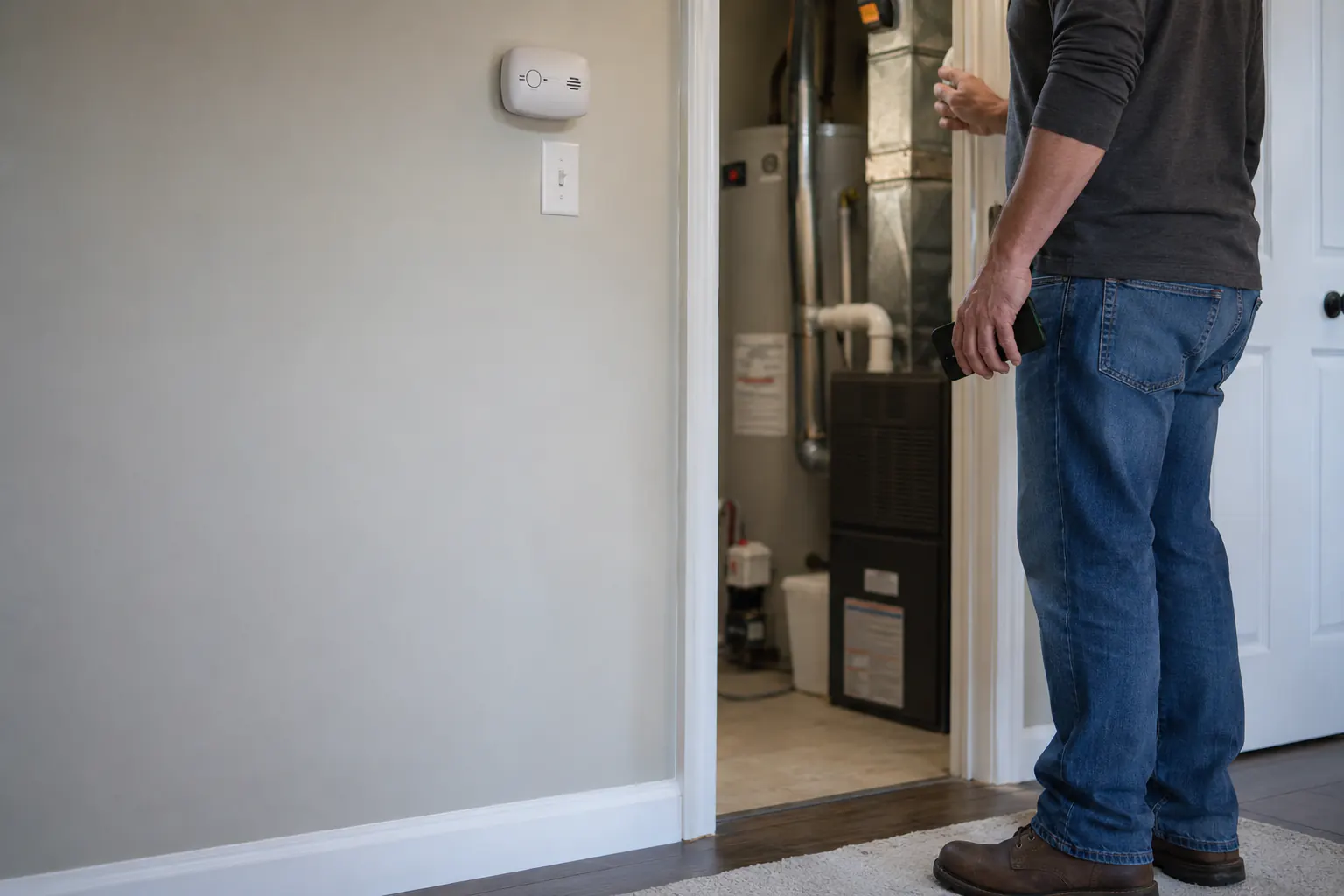
Why the instruction is “leave,” not “investigate”
CO is invisible and odorless, so your senses cannot tell you whether the concentration is falling or rising. Symptoms are unreliable in the other direction too: CDC describes them as flu-like — headache, dizziness, weakness, upset stomach, vomiting, chest pain, and confusion. (Source: CDC, Carbon Monoxide Poisoning Basics.)
Confusion can make it harder to recognize danger or act. Do not wait for symptoms or try to decide whether the alarm is correct while remaining inside.
A sounding CO alarm requires immediate action, not an investigation by the household. Leave first and let responders assess the building.
The response, step by step
1. Move to fresh air. Outside is best. Everyone: children, older adults, anyone who sleeps deeply, anyone with mobility limits, and pets. Assign responsibility for people who cannot self-evacuate before the event, not during it.
2. Account for everyone. From outside. If someone is missing, tell responders — do not re-enter to search.
3. Call 911 from outside. Report a sounding CO alarm and whether anyone has symptoms. Guidance across CPSC and fire services is consistent: move to fresh air and call emergency services. (Source: CPSC, Carbon Monoxide Information Center.)
4. Do not delay departure to operate equipment. Leave the suspected source for responders to assess. Do not go deeper into the building or return to reach a switch.
5. Do not silence the alarm and stay. Silencing removes the warning without removing the gas.
6. Wait outside. Let responders measure the air with instruments and tell you what is safe.
Symptoms do not have to affect everyone
Possible exposure needs urgent attention even if only one person feels ill. Tell responders about the circumstances:
- Multiple people or pets feeling ill at the same time is a major warning sign.
- Symptoms associated with time in the building are important to report. Never re-enter to see whether symptoms return.
- An animal becoming ill is also information for responders; do not wait for a pet or another person to show symptoms before leaving.
Some people are affected sooner or more severely, including infants and young children, older adults, pregnant people, and anyone with heart or lung conditions. (Source: CDC clinical guidance on CO poisoning.) Anyone with symptoms needs medical evaluation — tell the clinician you suspect carbon monoxide, because that changes what they look for.
Never use “we feel fine” to decide the air is safe. Absence of symptoms is not a measurement.
Who is allowed to say the building is safe
Only the fire department, emergency responders, or the utility. Not you, not a neighbor, not a landlord over the phone, and not a consumer CO alarm that has stopped sounding.
A quiet alarm does not establish safe air or explain why it stopped. It cannot tell you that the source is off or the venting is fixed. Responders determine re-entry; do not open windows or reset equipment as a household clearance procedure.
The same applies after the event. Do not resume using the suspected appliance until a qualified professional has inspected it. The fuel-burning heater limits warning explains why “it seemed fine before” is not evidence.
Before you go back to normal
Once responders have cleared the building:
- Find and fix the source. A CO alarm is not a nuisance to be reset. Fuel appliance service, venting, chimney, and flue work belong to qualified professionals.
- Keep suspected equipment out of service until it has been assessed. Follow responders’ instructions and have a qualified professional address the cause before reuse. The generator CO warning covers prevention, not permission to restart after an incident.
- Check the alarm itself. If it activated correctly, it did its job. If it is past its service life, replace it — see the testing and replacement schedule.
- Re-check warning and assistance needs. If the alarm could not be heard from the bedrooms, address that before returning to normal. The placement guide explains the questions to resolve with the model instructions and property authority.
- Write down what happened. Date, time, which alarm, who had symptoms, what equipment was running, what responders found, and what the professional did. That record matters for medical follow-up, for the landlord, and for insurance.
Practice the response before you need it
The confusion symptom is exactly why this must be rehearsed rather than reasoned out in the moment.
Decide in advance: who wakes whom, who takes the children, who takes pets, who calls 911, where everyone meets outside, and who cannot self-evacuate. Households that plan around a fire escape route already have most of this — use the same plan. The family communication plan covers accounting for people when phones are unreliable.
Walk through the plan in normal, safe conditions alongside the household fire-escape plan. Do not create smoke or exhaust, disable an alarm, or rehearse by exposing anyone to CO.
Alarm-response quick card
| Situation | Action |
|---|---|
| Alarm sounds, nobody has symptoms | Everyone out, call 911 from outside, wait for responders |
| Alarm sounds, someone has symptoms | Everyone out, call 911 immediately, report symptoms, seek medical evaluation |
| Suspected poisoning but no alarm | Leave, get fresh air and call 911; tell responders about symptoms. No alarm is not evidence of safe air |
| Alarm stops after you open windows | Still leave; a quiet alarm is not a cleared building |
| A signal you cannot identify | If it may be a CO alarm or anyone has symptoms, leave and call 911. Only treat it as maintenance when the exact manual identifies that signal and there is no suspected exposure |
Print it, keep it with the household emergency records, and make sure the person most likely to be alone at home has read it.
What this page will never say
It will not tell you a safe concentration to tolerate, because a consumer alarm is not an instrument for making that judgment. It will not give you a threshold at which to stay. It will not tell you a portable detector clears a room. And it does not replace 911, a clinician, or the responders standing in your driveway with a meter.
Return to the carbon monoxide and combustion boundary for prevention, and the extreme cold and emergency heating hub to plan heat and a heated destination before an outage.
Sources reviewed
The source basis is CPSC carbon-monoxide information and alarm guidance, CDC poisoning basics and clinical guidance, and U.S. Fire Administration heating-safety guidance. Symptoms are warning signs, never a household diagnostic test. This page states no safe exposure level or self-clearance procedure. Responders determine re-entry; clinicians control medical evaluation; qualified professionals control source repair. CPSC’s immediate exit/911 guidance and CDC’s poisoning basics were checked October 2, 2026; this narrow check is not a new complete clinical review.