
Start with where people sleep and which levels they use. Check the alarms already installed, then get the instructions for each exact model before choosing or changing a location. Carbon monoxide is odorless and colorless; household senses cannot establish safe air. (Source: CDC, Carbon Monoxide Poisoning Basics.)
This guide covers where alarms go and why. What to do when one sounds is a separate, urgent question owned by the CO alarm response guide.
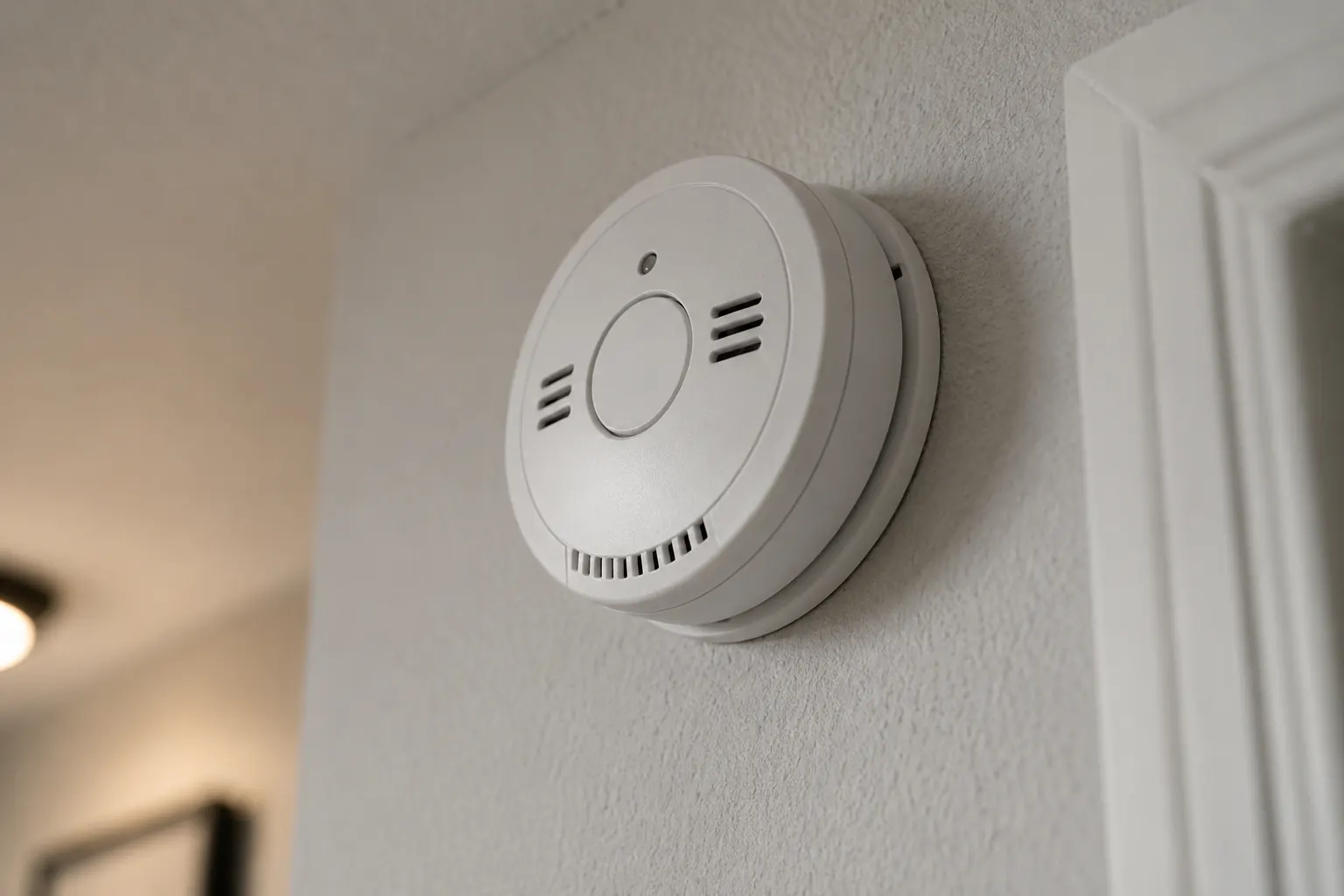
Start with the rule that governs everything else
An alarm is a warning layer, not permission to operate unsafe equipment.
No placement makes it acceptable to run a generator in a garage, use a grill indoors, heat a home with an oven, or operate any outdoor combustion device in an enclosed or partly enclosed space. The generator carbon monoxide warning owns that boundary, and it is not negotiable regardless of how many alarms are installed.
CO and smoke alarms detect different hazards. Follow the instructions for each; one does not replace the other.
Where alarms belong
CPSC’s January 30, 2026 warning calls for CO alarms on each level of the home and outside separate sleeping areas, with battery power or backup. EPA also emphasizes floor coverage and following the installation booklet exactly. (Sources: CPSC, Winter Storms Aren’t Over; EPA, Where should I place a carbon monoxide detector?.)
That produces a practical baseline:
- One outside each separate sleeping area. A home with bedrooms at two ends of the house has two sleeping areas, and therefore two alarms — not one in the middle.
- One on every level, including a finished basement that contains a sleeping area.
- Check attached-garage requirements with the local authority and exact model instructions. Do not infer that the alarm belongs inside a garage or directly above a fuel appliance.
- Interconnected where possible, so an alarm at one end of the house is heard at the other. CPSC notes interconnected alarms provide broader warning when one activates.
The exact mounting location, distance and allowed environment come from the model instructions and applicable local requirements, not a generic distance from a bedroom door.
Height comes from the model instructions
Do not choose a mounting height by assuming the gas rises or sinks. A plug-in model and a wall-mounted model may have different installation requirements. Follow the exact model’s instructions for height, clearance, orientation and power supply; if the intended spot does not meet them, resolve the location before installation. EPA explicitly directs readers to the manufacturer’s installation booklet.
Where alarms do not belong
CPSC’s separate CO Alarms page excludes attics and basements without sleeping areas, while its January 2026 warning says each level; EPA says each floor. Do not use that difference to remove an existing alarm or decide a basement needs none. Confirm coverage with the local authority and model instructions. Check the intended location against the model’s exclusions, including:
- Directly above or beside a fuel-burning appliance, where normal brief startup emissions can trigger nuisance alarms.
- In humid areas such as directly in a bathroom, where moisture affects some sensors.
- In direct sunlight, near vents, fans, or open windows, where air movement can dilute the sample or temperature can affect the unit.
- Behind furniture, curtains, or doors, or anywhere the sound is muffled.
- In an unconditioned space outside the alarm’s stated temperature range.
- Where the warning is obstructed or cannot be heard from bedrooms. Resolve warning and assistance needs rather than assuming an installation location guarantees that everyone will wake.
Check the manufacturer’s exclusions. They are model-specific and more authoritative than any list here.
Audibility is part of placement
A correctly placed alarm that nobody can hear has not been placed correctly.
- Use the manual’s test procedure in normal, safe conditions and check warning audibility from bedrooms with doors closed and usual background noise. An awake check does not prove that every sleeping person will wake.
- Households with hearing loss should use alarms with compatible visual or vibrating alerts. Do not assume a standard sonic alarm will wake everyone.
- Older adults, people who sleep deeply, people who use sleep medication, and children may not wake or may not recognize the alarm. Someone must be responsible for them in a real event.
- Anyone who cannot self-evacuate needs a plan that names who assists them, decided before the alarm sounds.
Renters and apartments
Many jurisdictions require CO alarms in rental housing, and requirements vary. Two practical rules:
- Report a missing, dead, or expired alarm in writing to the landlord or building management and keep a copy. A written request creates a record and is the right escalation path.
- Do not remove, disable, cover, or relocate a hardwired or building-supplied alarm yourself. Confirm responsibility for battery maintenance with management and follow the exact instructions; sealed units are not opened for battery replacement.
Where you cannot add hardwired units, a plug-in or battery alarm placed per the manufacturer’s instructions in the right room is a legitimate supplement. Shared-building sources — an attached garage, a neighboring unit, a shared mechanical room — are a management issue, not a resident repair.
A placement worksheet
| Location | Alarm needed? | Installed | Audible from bedrooms? | Notes |
|---|---|---|---|---|
| Outside sleeping area 1 | Yes | |||
| Outside sleeping area 2 (if separate) | Yes | |||
| Each additional level | Yes | |||
| Attached-garage coverage | Confirm code and model instructions | |||
| Basement with sleeping area | Yes | |||
| Basement/attic without sleeping area | Confirm code and model instructions | Do not remove an existing alarm based on this table | ||
| Directly above fuel appliance | No | — | — | Nuisance alarms |
Fill it once, keep it with the household records, and revisit it after any move, renovation, appliance change, or new occupant.
Placement is not maintenance
An installed alarm is not a working alarm. Sensors have a service life, and “the light is on” does not prove the unit is still within it. Testing intervals, battery changes, and end-of-life replacement are their own discipline — see the CO detector testing and replacement schedule.
Placement also does not substitute for maintaining the equipment that produces CO in the first place. Fuel-burning appliance service and venting belong to qualified professionals; the HVAC resilience hub holds those records, and the extreme cold and emergency heating hub covers the cold-weather decisions that tempt households into unsafe heat.
What to do before you buy anything
- Map separate sleeping areas and levels. Use that map to check coverage, not to infer a universal product count.
- Check what already exists, including hardwired units and their manufacture dates.
- Confirm local code and, for renters, lease and landlord obligations in writing.
- Read the intended model’s placement, height, temperature, and exclusion instructions before choosing a spot.
- Place, test for audibility from every bedroom, and record the install and replacement dates.
- Rehearse the response — because the alarm’s whole purpose is the action it triggers.
ReadyLience has not tested any CO alarm and does not recommend a product. Certification, listing, local code, and the manufacturer’s instructions decide what is appropriate for your home.
Sources reviewed
The source basis is CPSC alarm and carbon-monoxide information, CDC poisoning basics, EPA detector placement, and U.S. Fire Administration heating safety. The CPSC placement pages, CDC basics and EPA installation guidance were checked October 2, 2026. Their differing basement language is stated above rather than turned into a universal exclusion. Local requirements, the exact instructions and property authority control installation. Emergency responders control re-entry; clinicians and qualified professionals control evaluation and repair. No product is recommended or tested here.