
A portable generator must run outside, at least 20 feet from the house, with its exhaust directed away from the home and every opening. A garage, basement, crawlspace, shed, porch, carport, or doorway is not safe, even with doors or windows open.
Carbon monoxide (CO) is colorless and odorless. You cannot use your senses to decide that a generator location is safe.
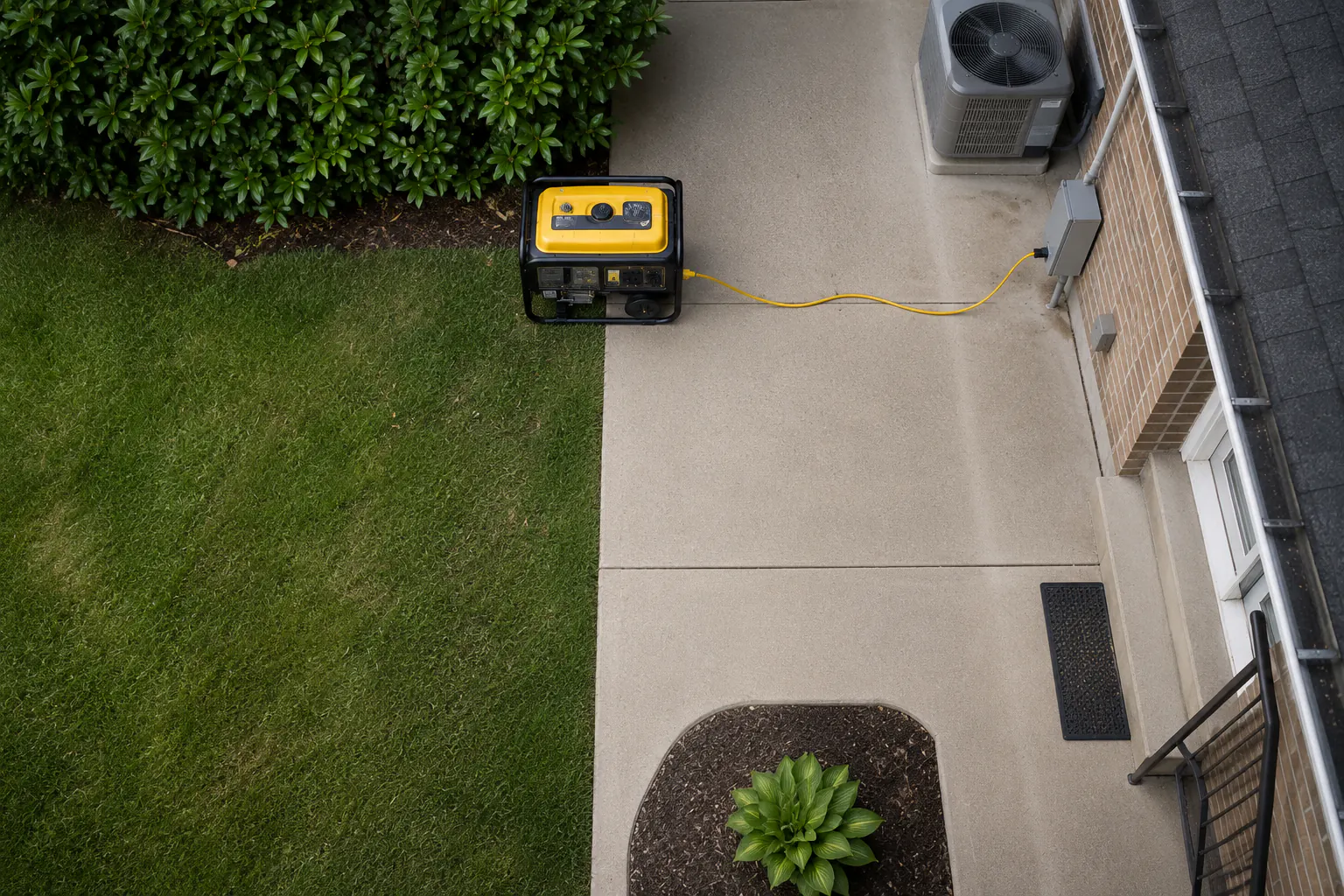
Non-negotiable generator placement
- Place the generator outdoors at least 20 feet from the home.
- Point exhaust away from windows, doors, vents, and neighboring buildings.
- Keep it on a dry, stable surface under a manufacturer-approved open-sided cover if weather protection is required.
- Never move a running generator closer because of rain, noise, theft concerns, or cord length.
- Follow the manufacturer’s clearance, operation, grounding, and weather instructions when they are more restrictive.
Walk the 20-foot distance before the outage and mark the location. Confirm that cords can reach without passing through water, door pinch points, or a shared walkway.
The CPSC’s current guidance explicitly excludes porches and carports and says opening doors or windows does not provide enough ventilation for an enclosed location. It also directs exhaust away from the home and other buildings where someone can enter. (Source: CPSC, 2026 winter storm and power outage safety warning.)
Do a placement walkaround before buying
Start at the proposed generator position and inspect in every direction:
- Measure at least 20 feet to your home rather than estimating by sight.
- Identify doors, windows, crawlspace openings, soffit vents, dryer vents, fresh-air intakes, and basement entries.
- Look for neighboring windows, doors, tents, RVs, garages, and occupied structures.
- Check where exhaust points and whether wind or building geometry could carry it toward an opening.
- Plan a dry, manufacturer-compliant operating surface and weather cover.
- Plan cords without routing them through standing water, damaged areas, or doors that crush insulation.
- Decide how the unit can be shut down quickly without approaching the exhaust side.
If the property cannot provide a compliant location, the generator is not an appropriate solution for that site. A smaller generator, longer cord, open garage door, fan, or CO shutoff feature does not erase the placement requirement.
Apartment, townhome, and dense neighborhood limits
A balcony, shared courtyard, walkway, rooftop access area, parking garage, or space beside another unit may expose neighbors even when it appears “outside.” Renters should not improvise a location. Use battery-based options for suitable loads and plan relocation for needs the battery cannot support.
In a dense neighborhood, coordinate placement so two households do not direct exhaust toward each other. Noise rules and theft concerns matter, but neither justifies moving a running unit closer to a building.
Carbon monoxide alarms are a second layer
Install working CO alarms on every level of the home and outside sleeping areas. Test them according to their instructions and replace batteries and units on schedule. An alarm does not make unsafe generator placement acceptable; it provides warning if the first layer fails.
The detector placement guide covers where alarms belong and where they must not go, and the testing and replacement schedule covers the sensor service life that an indicator light does not prove.
Keep alarms audible for everyone in the home. Households with hearing loss should use compatible visual or vibrating alerts.
The CPSC recommends battery-operated alarms or alarms with battery backup on each level and outside separate sleeping areas; interconnected alarms provide broader warning when one activates. Test CO and smoke alarms monthly and never ignore an alarm. (Source: CPSC, 2026 winter storm and power outage safety warning.) When any CO alarm sounds, act immediately — the alarm response guide owns those steps, and none of them start with investigating the generator.
Check the manufacture or replacement date and the instructions printed on each alarm. “The light is on” does not prove the sensor is within service life. Do not cover, relocate, or silence an alarm to make generator operation more convenient.
Symptoms require immediate action
Possible CO poisoning can resemble flu or fatigue: headache, dizziness, weakness, nausea, vomiting, chest pain, or confusion. Multiple people developing symptoms at the same time is a major warning sign.
If an alarm sounds or symptoms may be related to combustion:
- Move every person and pet into fresh air immediately.
- Call 911 from outside.
- Do not re-enter the building until responders say it is safe.
- Do not silence the alarm and continue operating the generator.
Electrical and fuel hazards still matter
CO is not the generator’s only risk. Never backfeed a home through a wall outlet. Use only approved transfer equipment installed for the intended system. Keep fuel outside living areas in approved containers, away from ignition sources. Turn the generator off and let it cool before refueling.
Plan for theft deterrence without compromising ventilation or emergency access. Any enclosure must be designed and approved for the specific generator; a homemade box can trap exhaust and heat.
Never backfeed the home
Do not connect a generator to a dryer outlet, range outlet, or any receptacle using a cord with two male ends. This can energize circuits in an uncontrolled way, bypass intended protection, start a fire, damage equipment, or expose utility workers and neighbors to voltage they do not expect.
For selected household circuits, use listed transfer equipment appropriate to the service and generator, installed and permitted by a qualified electrician. For direct appliance cords, follow the generator and appliance manuals and use cords rated for the load and environment.
Refuel only after shutdown and cooling
Gasoline spilled on a hot engine can ignite. Turn the generator off, let it cool as directed, and refuel away from ignition sources. Store fuel in approved containers outside living areas and follow local fire code, lease, insurance, and manufacturer requirements. Never refuel while the generator is running.
Weather protection cannot become an enclosure
Shock and electrocution risks increase in rain and snow. Follow the manufacturer’s instructions, which may specify an appropriate noncombustible generator tent or may require waiting for conditions to improve. Do not place the generator in a garage or shed as a weather workaround.
Before every run
- Recheck the outdoor location and wind-facing exhaust direction.
- Verify CO alarms are powered and within service life.
- Inspect cords, plugs, fuel lines, and the generator for damage or leaks.
- Confirm every connected load is within generator and cord limits.
- Tell another adult where the shutoff is and how to call for help.
During operation
- Recheck that doors and windows remain closed near the operating area.
- Keep children and pets away from the unit, fuel, cords, and hot surfaces.
- Watch for damaged cords, overload warnings, fuel leaks, unusual sound, or changing weather.
- Follow the exact manual’s supervision and shutdown requirements. This checklist does not authorize unattended or overnight operation.
- Shut down rather than improvising if rain, flooding, exhaust direction, cord damage, or an alarm changes the risk.
After shutdown
Let the unit cool, store fuel safely, inspect cords, and record running hours for maintenance. Recharge starter batteries where applicable. Check alarm power and follow each alarm’s battery instructions; an outage does not automatically require replacing every battery, and sealed units must not be opened. Document any alarm event and follow responders’ instructions rather than assuming it was false.
Dangerous generator myths
| Myth | Safer conclusion |
|---|---|
| “The garage door is open.” | A garage remains unsafe; lethal CO can accumulate and enter the home. |
| “It is only running for a few minutes.” | CO can incapacitate quickly; unsafe placement is never acceptable for a short run. |
| “The exhaust points out of the doorway.” | Enclosed and partly enclosed operation remains unsafe. |
| “The generator has automatic CO shutoff.” | A safety feature is an additional layer, not permission to ignore outdoor distance and exhaust direction. |
| “My indoor CO alarm will protect us.” | Alarms are warning layers, not ventilation or safe placement. |
| “Rain means I have to move it under the porch.” | Stop operation and follow the manufacturer’s weather instructions. |
For load selection, transfer methods, and battery alternatives, continue to Backup Power for Home. Return to the power outage preparedness hub for the household-wide plan.
If an alarm is sounding now, the alarm response guide owns the sequence: everyone out, call 911 from fresh air, and let responders decide re-entry. For heat sources other than a generator, the fuel-burning heater limits warning draws the line between vented, restricted, and never-indoors equipment.
For the first minutes of an outage, use the immediate actions checklist.
Sources reviewed
- CPSC Carbon Monoxide Information Center
- CPSC power outage warning, January 30, 2026
Sources reviewed July 13, 2026. If a generator is part of the plan, follow its current manual and public-safety guidance; no amount of equipment changes the need for safe outdoor placement and a working CO alarm.
Placement, alarm-response and monthly-testing guidance in the January 30 CPSC warning was checked again October 2, 2026. This is not a product test or approval of a particular operating site.