
Find the model and replacement date on each CO alarm, then keep its instructions with a household maintenance record. Use the prescribed test, battery and cleaning procedures. An illuminated indicator is not a substitute for those checks or end-of-life replacement.
This is the maintenance discipline behind the placement guide. Placement decides where the warning comes from; this page decides whether the warning still works. Both support the operating boundaries set in the generator carbon monoxide safety guide.
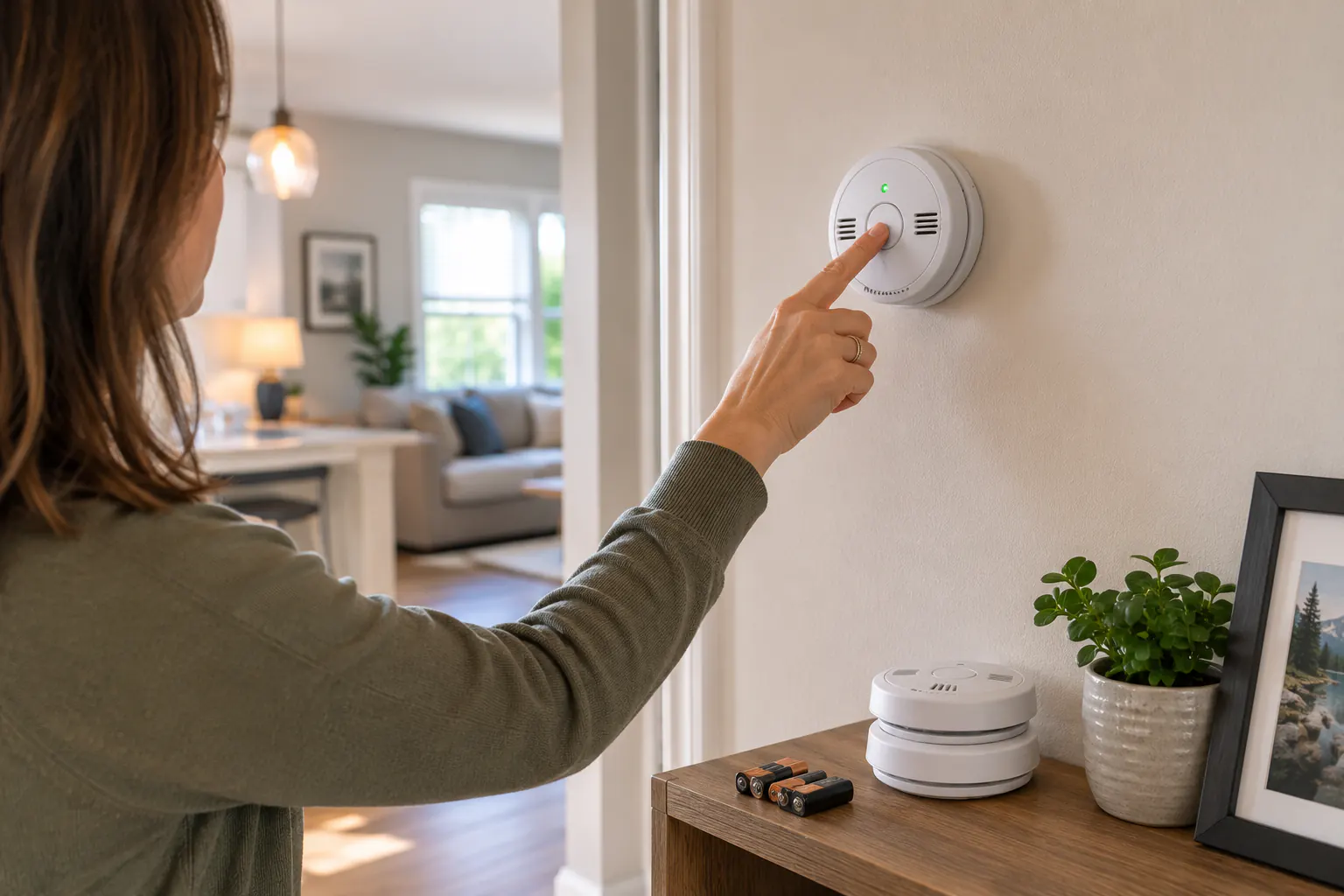
The intervals
CPSC’s guidance is straightforward: use battery-operated alarms or alarms with battery backup on each level and outside separate sleeping areas, test CO and smoke alarms monthly, and never ignore an alarm. (Source: CPSC, 2026 winter storm and power outage safety warning.)
Build the household routine around four intervals:
| Interval | Task |
|---|---|
| Monthly, or more often if the manual requires it | Follow the test-button procedure on every alarm; check audibility from bedrooms in normal, safe conditions |
| Per manufacturer | Replace batteries on the schedule in the instructions, or immediately on a low-battery chirp |
| Per manufacturer; add a calendar reminder | Check the replacement date and clean only by the specified method and interval |
| End of life | Replace the entire unit per the manufacturer’s stated service life — not just the battery |
Put the required checks on a calendar you already use. Record the result and follow the manual if a test fails.
The failure people do not see coming: sensor end of life
CO alarms have a stated service life. Replace the unit when its instructions require it; power and appearance do not extend that date.
CPSC’s own framing is blunt: check the manufacture or replacement date and the instructions printed on each alarm. “The light is on” does not prove the sensor is within service life.
Practical rules:
- Find the model and date on every alarm. If the date or instructions are missing, resolve replacement timing with the manufacturer or responsible property manager rather than guessing.
- Record the replacement date with the location and model. Do not obscure labels, openings or controls by marking the unit.
- Replace the whole unit at end of life. A fresh battery does not renew its service life.
- Do not rely on the chirp to tell you about end of life. Some units signal it, some do not, and the signal patterns differ by model. The manual is the authority.
Decode the chirp before you touch the battery
Learn the exact model’s CO, low-battery, fault and end-of-life signals before an event. Both emergency and maintenance signals can use repeating sounds; a pause does not identify a maintenance chirp.
Do not remove a battery and leave the warning disabled. Follow the identified maintenance remedy, or ask the responsible property manager or manufacturer to resolve it.
For a CO alarm, suspected poisoning or a signal you cannot confidently distinguish from a CO alarm, use the alarm response guide: everyone out, call 911 from outside, no re-entry until responders clear it. Do not stay inside looking for the manual during a possible alarm.
Test correctly
The manual explains what the test button checks on that model. Passing its test is not proof of safe air, a substitute for replacement, or a guarantee of performance in every exposure.
That distinction matters:
- The test button is still worth pressing monthly — it catches dead batteries, failed horns, and units that have been quietly disconnected.
- Do not attempt to test the sensor by exposing an alarm to exhaust, smoke, or any combustion source. Never create CO to test a detector.
- Replace at end of life and follow the remedy for a failure, fault or recall even if the replacement date has not arrived.
Also confirm audibility, not just function. An alarm heard in the hallway but not through a closed bedroom door at night is a placement problem — see the placement guide.
Check for recalls
CO alarms are safety devices, and safety devices get recalled. Check the exact model and manufacture date against CPSC recalls, and follow the stated remedy. (Source: CPSC, Recalls.)
Check applicable recalls for fuel-burning appliances and portable heaters too. The indoor limits for fuel-burning heaters explain operating restrictions; an alarm does not waive them.
Renters and landlord-supplied alarms
- Confirm maintenance responsibility with the landlord or management and follow the exact battery instructions. Never open a sealed unit for a battery change.
- Report a dead, expired, missing, or chirping-and-unfixable alarm in writing to the landlord or management, and keep a copy. Written requests create records.
- Do not remove, disable, cover, relocate, or “fix” a hardwired or interconnected alarm. That is qualified-electrician or landlord work.
- Many jurisdictions impose specific requirements on rental housing; local code may be stricter than any general guidance here.
A maintenance log
Keep one record for the household and update it when anything changes.
| Alarm location | Model | Manufacture date | Replace by | Battery changed | Last monthly test | Notes |
|---|---|---|---|---|---|---|
| Outside sleeping area 1 | ||||||
| Outside sleeping area 2 | ||||||
| Each additional level | ||||||
| Near attached garage |
The seasonal energy efficiency checklist and home inspection calendar can hold reminders, but they do not replace the alarm’s required schedule.
Combination and smart alarms do not change the schedule
For a combination smoke-and-CO alarm, follow the exact unit’s testing and replacement instructions for both functions. A battery change or reset is not replacement of the unit. Do not assume two different models share a service life.
For connected alarms, read what each app status actually means and what happens without internet or phone power. Do not treat an app status as clearance of a building or rely on a phone notification to meet every occupant’s warning needs.
Sealed-battery units have their own test and replacement instructions. Do not open them or assume they require the battery procedure for a replaceable-battery model.
Five maintenance problems to resolve
Check the whole household, including alarms outside rooms you use less often:
- Disabling a warning without resolving it. Identify the model’s signal and follow its remedy; use emergency action if exposure is possible.
- Replacing the battery in an expired unit and treating the problem as solved. The unit still needs replacement.
- Testing only the alarm you walk past. The one outside the far bedroom is the one that has to wake somebody.
- Assuming a hardwired alarm is maintenance-free. It still has a service life and, usually, a backup battery.
- Moving an alarm to stop nuisance activations near a fuel appliance, instead of asking why an appliance near the alarm is producing enough CO to trigger it. That activation may be the warning.
Start with the model instructions and the maintenance record above. Report unresolved faults rather than leaving them for the next storm.
Why this matters more before winter
Check alarms before heating season alongside fuel-appliance service. Do not wait for a storm to resolve a fault or an expired unit.
Do the date check in the fall, before the first cold snap and before the first storm — the same pass that schedules furnace service. The fuel-burning heater limits warning explains why the alarm is a warning layer and never a permission slip, and the extreme cold hub holds the plan the alarm is protecting.
The honest limit
A maintained, correctly installed alarm is a warning layer. It does not remove carbon monoxide, make unsafe equipment safe, guarantee time to escape, or establish a concentration you can tolerate. Follow the emergency response whenever it sounds.
ReadyLience has not tested any CO alarm and recommends no product. Certification, listing, local code, and the manufacturer’s instructions decide what is appropriate.
Sources reviewed
The source basis is CPSC alarm and carbon-monoxide information, its January 30, 2026 outage warning and recall resources, plus U.S. Fire Administration heating safety. CPSC’s monthly-test and exit/911 guidance was checked October 2, 2026. Model-specific tests, batteries, cleaning, service life and local requirements remain controlling; the calendar is a record, not a new universal maintenance interval. No exhaust test or safe exposure level is provided. Responders, clinicians and qualified professionals retain emergency, medical and repair decisions. No product has been tested or recommended here.