
When the power fails, do the highest-consequence checks first. People and hazards come before appliances.
First 10 minutes
- Locate everyone. Give each person a flashlight or place battery lanterns on stable surfaces.
- Check for fire, smoke, gas odor, flooding, and downed lines. Leave if the building may be unsafe. Never enter standing water near electrical equipment.
- Check powered medical needs. Follow the care plan and contact the medical provider or emergency services when the approved backup cannot be maintained.
- Listen for carbon monoxide alarms. If one sounds, get everyone into fresh air and call 911. Do not search for the source first.
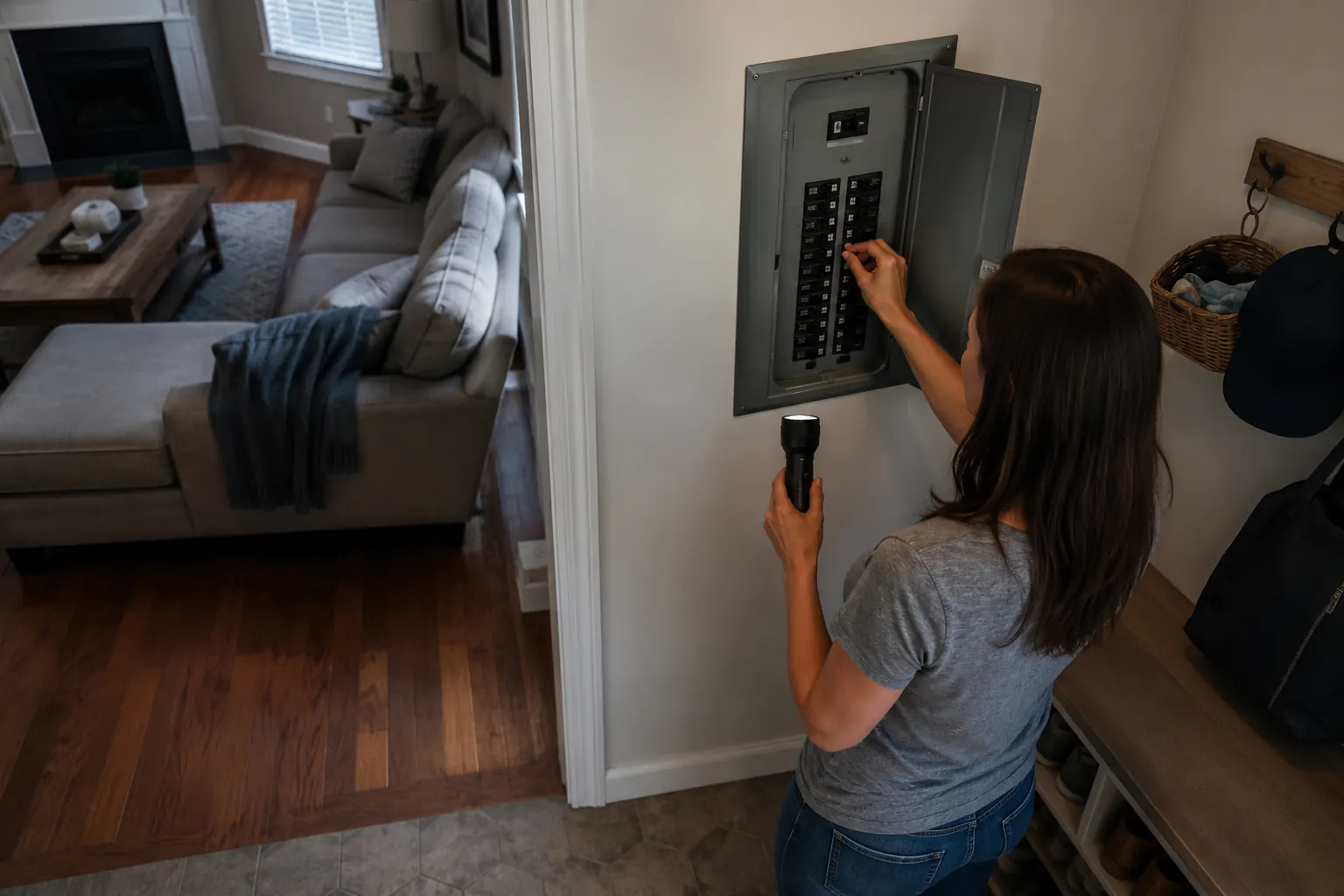
- Confirm the scope. Look for streetlights or neighbors with power, then check the main breaker only if the panel and surrounding area are dry and undamaged.
- Report the outage. Use the utility’s official app, website, or phone number.
The CDC’s power-outage guidance prioritizes carbon monoxide, food, water, medication, and temperature hazards because an outage can affect several systems at once. (Source: CDC, What to Do to Protect Yourself During a Power Outage.)
Use this decision order
1. Is anyone in immediate danger?
Call 911 for fire, suspected CO exposure, serious injury, or a medical emergency. Leave immediately for a gas odor or an alarm when instructed. Do not delay evacuation to retrieve supplies, investigate the source, or shut down equipment.
2. Is the building itself unsafe?
Look and listen from a safe position for smoke, sparks, arcing, damaged service equipment, floodwater, shifting structure, or broken glass. Stay far away from downed lines and anything touching them. Do not enter a basement or utility room containing water and electrical equipment.
3. Does a person depend on power or temperature control?
Activate the written care plan. Check approved battery status, backup location, transportation, and clinician/manufacturer contacts. A consumer power station estimate is not a medical continuity plan.
4. Can the household remain safely for the next review interval?
Consider temperature, air quality, water, sanitation, building access, official orders, and the next reliable check-in. Set a time to reassess, such as every 30 or 60 minutes during severe conditions, rather than waiting passively.
Should you touch the breaker panel?
Only approach a panel that is dry, undamaged, normally accessible, and free of smoke, heat, buzzing, burning odor, or water. Use a flashlight from a stable position. Do not remove the panel cover, touch service conductors, improvise a repair, or repeatedly reset a breaker that trips.
If only your home is affected, a tripped main or branch breaker may be involved, but the cause matters. A qualified electrician should handle damaged equipment, repeated trips, heat, arcing, or uncertainty. If the whole area is dark, leave the panel alone and report the utility outage.
Never assume a circuit is dead merely because neighborhood power is out. Backup systems, solar equipment, generators, and restoration work can energize conductors unexpectedly.
Use breaker-panel basics for the exterior-only household boundary. The broader basic electrical safety hub covers trips, cords, protective devices, visible damage, and qualified escalation.
Protect the home
- Turn off or unplug heat-producing appliances, power tools, and sensitive electronics.
- Leave one light switched on so you know when grid power returns.
- Keep refrigerator and freezer doors closed.
- Prefer flashlights and battery lanterns to candles.
- If weather caused damage, photograph it from a safe location. Do not climb onto a roof or approach electrical debris during the event.
Do not connect a portable generator directly to household wiring. A generator-to-panel connection requires approved transfer equipment and qualified electrical installation. Extension cords must be correctly rated, intact, and kept away from water and pinch points.
Plan any permitted temporary route with the extension-cord safety guide, then use the post-outage load restart checklist when utility service returns.
If a generator will be used, read Generator Carbon Monoxide Safety before startup. It must remain outside at least 20 feet from the home with exhaust directed away from openings; a garage, porch, shed, or carport is not an acceptable operating location.
Preserve light without starting a fire
Give each moving person a flashlight or headlamp and place lanterns on stable, nonflammable surfaces. Use the room-by-room emergency lighting plan to protect stairs, bathrooms, and task areas. The CPSC recommends flashlights or battery-operated candles instead of flame and warns never to leave burning candles unattended. (Source: CPSC, 2026 winter storm and power outage safety warning.)
Communicate once, then conserve
Text the household’s designated contact with four facts: who is safe, where you are, what you need, and when you will check in again. Text messages may work when calls are congested. Lower screen brightness and enable battery-saving mode.
Use a battery radio or official local alerts for weather, evacuation, boil-water, shelter, and restoration information. Treat social posts as unverified until an authoritative source confirms them.
Decide whether staying is safe
Staying depends on indoor temperature, air quality, medical equipment, building damage, available water, sanitation, and the expected duration. Establish departure triggers before conditions deteriorate. Examples include:
- an unsafe indoor temperature for a child, older adult, or medically vulnerable person;
- inability to power prescribed equipment using the approved backup plan;
- fire, gas, flood, structural, or carbon monoxide risk;
- an official evacuation order;
- loss of safe drinking water or usable sanitation beyond the household plan.
Tell your out-of-area contact where you are going. Do not wait until phones, roads, and fuel are all under more pressure.
Heat and cold change the timeline
An outage during mild weather may be inconvenient for hours. The same outage during extreme heat or cold can become dangerous quickly for infants, older adults, pregnant people, people with chronic conditions, and anyone using temperature-sensitive medication.
Close blinds against daytime heat or use sunlight strategically in cold weather, but do not use an oven, grill, camp stove, charcoal, or an unvented improvised heater to warm the home. Follow public-health instructions, identify cooling/warming centers, and leave before a vulnerable person develops symptoms.
Water may not remain available
Private wells commonly depend on electricity, and municipal systems can issue advisories after pressure or treatment problems. Check official utility and health-department messages. Use the emergency water storage guide and distinguish a boil-water notice from a do-not-use notice.
Keep children and pets out of secondary hazards
Block access to cords, generators, fuel, damaged rooms, candles, and open refrigerator/freezer doors. Give children one clear instruction and meeting place. Keep pets leashed or contained before doors are opened in darkness.
At 4 hours and beyond
Apply the food safety thresholds, inventory stored water, and calculate which loads can be supported by backup power. Reassess at a fixed interval rather than reacting to every rumor.
Use a written status board:
| Item | Current status | Next check | Trigger for action |
|---|---|---|---|
| People/medical | Accounted for, care plan active | Set time | Approved backup cannot continue |
| Indoor temperature | Record actual reading | 30–60 min | Household-specific unsafe threshold |
| Refrigerator/freezer | Doors closed, outage start recorded | Before food deadline | Cooler transfer or discard decision |
| Water/sanitation | Gallons and toilet plan | Each meal/shift | Reserve below relocation threshold |
| Power | Battery %, fuel, active loads | Each load change | Reserve needed for higher priority |
| Information | Utility/local alert | Scheduled | Evacuation, advisory, route change |
This reduces repeated door opening, phone checking, and conflicting decisions.
When power returns
Confirm that there is no floodwater, burning odor, gas odor, or visibly damaged equipment. Switch loads back on gradually. Check refrigerator and freezer temperatures before deciding what food to keep. Reset clocks and alarms, recharge every backup, and write down the first thing your plan failed to provide.
Wait for stable power before connecting every sensitive device. Verify unattended heat-producing appliances are off. Check sump pumps, well equipment, garage controls, alarms, routers, and medical devices according to their instructions.
Do not assume tap water is safe merely because pumps restart; monitor utility and health-department advisories. Photograph damage and spoiled food before cleanup when insurance or assistance may require documentation.
After-action questions
- How long did it take to find the first light?
- Did every person receive and understand the check-in message?
- Which load used more energy than expected?
- Did the refrigerator/freezer decision rely on recorded time and temperature?
- Could everyone operate locks, exits, water containers, and chargers?
- Which supply was missing, inaccessible, expired, or unnecessary?
- What one change would reduce the most risk before the next outage?
Use the answers to update the complete Power Outage Preparedness guide rather than simply replacing consumed batteries.
Sources reviewed
- Ready.gov power outage hazard information sheet
- CPSC Carbon Monoxide Information Center
Sources reviewed July 13, 2026.