
Power returning is another transition, not proof that every circuit and appliance is ready. Utility restoration can occur in stages, equipment can restart automatically, and hidden storm, water, heat, battery, or mechanical damage may remain.
The safe objective is to confirm the building is clear of immediate hazards, preserve critical systems, restore ordinary loads in a deliberate order, and stop before abnormal equipment is energized. The observation skills this sequence relies on come from the basic electrical safety guide.
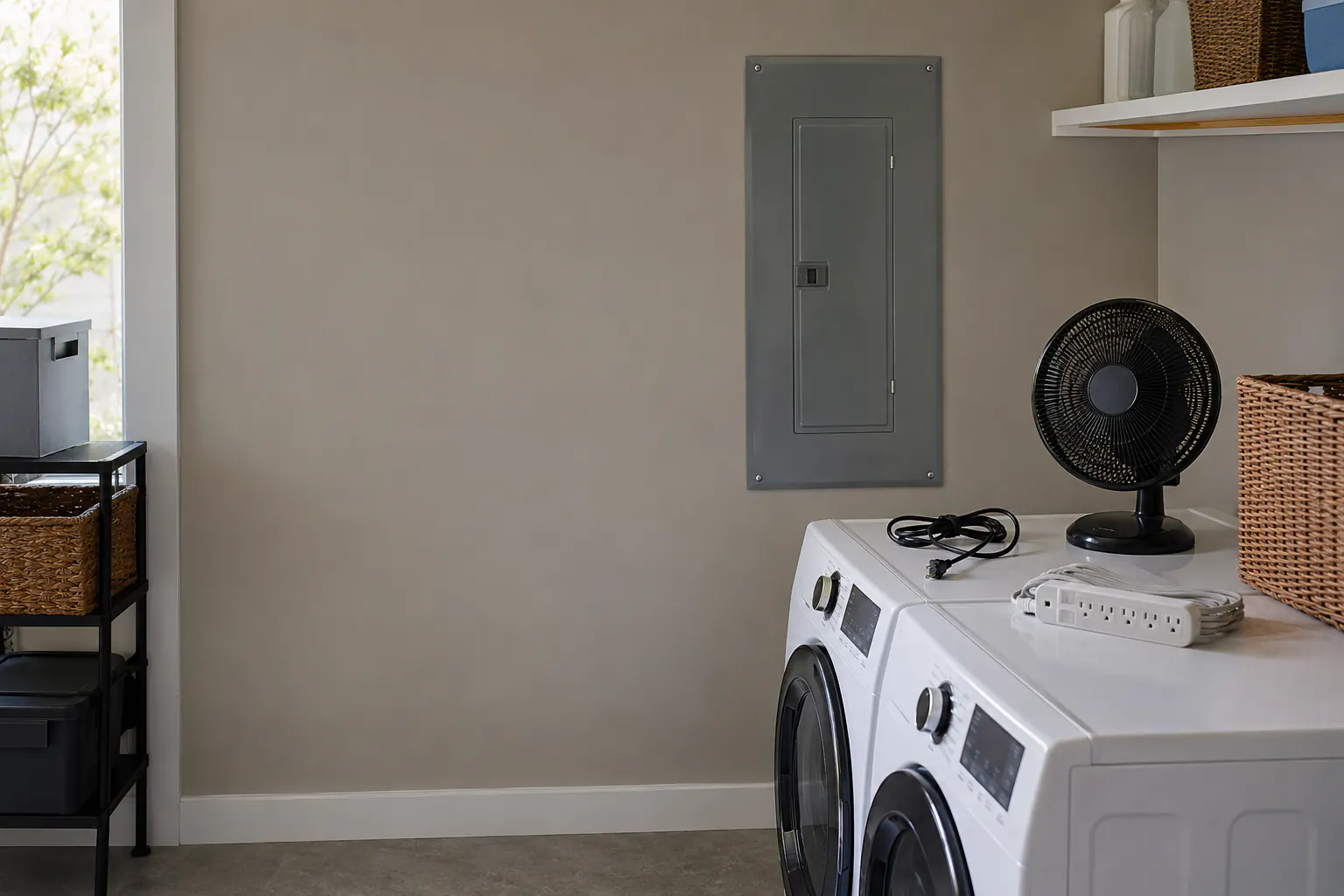
Do not enter or restore for active hazards
Call 911 for fire, smoke, active arcing, explosion, shock injury, gas odor, carbon monoxide alarm, or immediate danger. Stay away from downed lines and damaged service equipment.
Do not restore or touch equipment that is:
- wet, flooded, snow-covered, contaminated, or located on wet flooring;
- hot, burned, melted, discolored, smoking, buzzing, popping, sparking, or odorous;
- physically damaged by wind, tree, impact, debris, pest, or structural movement;
- connected to a damaged receptacle, cord, plug, panel, meter, or service;
- recalled, previously tripping, or under repair;
- part of a gas, fuel, boiler, fire-sprinkler, elevator, medical, solar, battery, generator, EV, well, septic, sump, or other specialized system without its release procedure.
Dry appearance is not electrical clearance. CDC advises avoiding damaged buildings and wet electrical hazards after disasters. Use qualified inspection.
Confirm that restoration is real and stable
Check the utility’s official outage map, alert, or account message. One light returning may reflect partial service, a local backup source, or unstable restoration. Ask building management about shared systems and elevator status.
Do not repeatedly switch the main or branch breakers to chase intermittent service. Do not open the panel. Use the breaker-panel guide when the enclosure is dry, intact, normally accessible, and the building procedure calls for a simple exterior observation.
If lights are unusually bright or dim, several rooms behave abnormally, equipment cycles repeatedly, or restoration sounds or smells wrong, switch off ordinary loads only through safe normal controls and call the utility and electrician.
Review the pre-outage state
Before reconnecting anything, write down:
- what was operating when power failed;
- what was unplugged or switched off;
- any breaker, GFCI, AFCI, inverter, UPS, generator, or battery event;
- water leaks, flooding, roof damage, lightning, heat, cold, smoke, or fire-service activity;
- alarms, error codes, unusual temperatures, smells, or sounds;
- repair, inspection, utility, manufacturer, or insurer instructions;
- critical medical, refrigeration, pump, security, and communication loads.
Do not reproduce an unexplained fault merely because utility power is back.
Preserve critical-load continuity first
Follow clinician and manufacturer plans for medical devices and medication storage. Confirm the approved source before transferring a medical load. Do not interrupt a functioning backup merely to return to utility power without the documented sequence.
Check smoke and carbon monoxide alarms through their manufacturer procedure. Restore communication and official alerts through approved chargers and network equipment. Keep sump, well, septic, heat, refrigeration, security, and accessibility systems within their professional restart plans.
Critical does not mean “connect by any means.” Do not use an unapproved cord, adapter, power strip, inverter, or wet receptacle.
Separate automatic from manual loads
Some equipment may restart without user action: HVAC, pumps, compressors, fans, chargers, garage doors, irrigation, water treatment, refrigerators, freezers, and smart controls. Keep people, children, pets, tools, and debris away from moving machinery.
Ask a qualified service provider whether fixed equipment should have been isolated before restoration. Do not open equipment to stop a motor or fan.
For portable loads, leave switches off or plugs disconnected until their turn in the sequence, provided the connection is cool, dry, undamaged, and safe to handle.
Restore ordinary loads in stages
Use equipment manuals and the property plan. A conservative household order is:
- battery lighting and communications already operating safely;
- smoke and carbon monoxide alarm confirmation;
- one ordinary low-load light on a verified intact circuit;
- essential communication and approved medical continuity;
- refrigeration after food-safety and appliance checks;
- pumps, HVAC, well, septic, security, and fixed equipment only through their service procedures;
- ordinary small appliances one at a time;
- high-load, heating, cooling, cooking, laundry, shop, and charging equipment last, after circuit and equipment suitability is confirmed.
HVAC remains on its own system-specific restart checklist; this household sequence does not authorize a thermostat, breaker, disconnect, fuel control, or hardwired restart.
This order is a planning framework, not a switching procedure for every building. Utility, manufacturer, electrician, clinician, landlord, and equipment-service instructions override it.
Pause between loads. Watch from a safe distance for flicker, sound, odor, heat, breaker or protective-device operation, and repeated startup. Stop at the first abnormality.
Do not reset protection repeatedly
If a breaker, fuse, GFCI, AFCI, UPS, inverter, surge device, or appliance protection operates, leave the affected load off. Do not keep resetting, move the appliance to another outlet, bypass protection, replace a fuse with a different rating, or open equipment.
Follow the one-time reset boundary in the GFCI/AFCI guide and breaker guide. Repeated or unexplained operation requires qualified diagnosis.
Handle refrigeration as both electrical and food safety
Do not reconnect a refrigerator or freezer through an extension cord when its manual requires direct wall connection. Inspect the plug, cord, receptacle, and appliance exterior from a safe position.
Use the power-outage food-safety guide for temperatures and discard decisions. Electrical restoration does not make temperature-abused food safe.
Stop for compressor clicking, repeated startup, burning odor, abnormal heat, sparks, damaged cord, or tripping. Use qualified appliance and electrical service.
Transition away from backup power safely
Follow the exact generator, transfer switch, battery, inverter, UPS, solar, and appliance instructions. Do not parallel sources, improvise a neutral or grounding connection, or move a plug between live sources without the approved sequence.
Never backfeed household wiring. Shut down a portable generator only through its manual, outdoors, with fuel, heat, and carbon monoxide controls maintained. Do not carry a hot generator indoors.
Selected-circuit systems, stationary batteries, solar, and automatic transfer equipment require qualified commissioning and service. Use the backup-power hub.
Inspect plug-in equipment before reconnecting
Use the visual inspection guide. Remove from service any plug, cord, strip, charger, or appliance with cracking, crushing, missing pins, looseness, corrosion, discoloration, melting, moisture, odor, or recall.
Do not repair a cord with tape, dry equipment with a heater, or use a tester to approve storm- or water-damaged equipment.
Account for surge devices and UPS units
A surge protector may sacrifice protection or indicate a fault after an event. A UPS may have depleted, failed, overheated, or switched repeatedly. Follow the exact indicators and replacement instructions; a lit power switch does not prove protection remains.
Do not daisy-chain strips or UPS units. Do not connect heaters, cooking appliances, pumps, medical devices, or other excluded loads. Replace batteries only through the manufacturer-supported procedure and safe battery route.
Apartment and renter sequence
Wait for building management to release common electrical, elevator, water, HVAC, fire-alarm, access-control, and garage systems. Do not enter utility rooms or operate shared panels.
Report partial power, unusual brightness, burning odor, repeated trips, hot outlets, alarms, leaks, or common-area damage immediately. Preserve written instructions and work-order numbers.
If heat, cooling, water, sanitation, medical support, accessibility, or fire protection is not safely restored, use the relocation plan and local emergency or housing resources.
Record the recovery
Log restoration time, utility notice, loads restarted, protective-device events, temperatures, equipment warnings, professional clearances, and repairs needed. Update the circuit and critical-load map after the incident.
A smooth restart does not erase an earlier warning. Schedule inspection for lightning, flooding, repeated interruptions, service damage, unexplained trips, or abnormal equipment.
Sources reviewed
- Ready.gov: Power Outages
- U.S. Consumer Product Safety Commission: Home Electrical Safety Checklist
- U.S. Fire Administration: Appliance and Electrical Fire Safety
- CDC: Natural-Disaster Re-entry Safety
Sources reviewed July 14, 2026. Emergency services, utility and building directions, equipment manuals, clinicians, code, property authority, and qualified electrical and equipment professionals control actual restoration.