
Ask the landlord, building manager or electrician which panel serves your home and where its circuit records are kept. Note the contact to call and keep the normal access route clear. This is an outside-the-enclosure task, not permission to open a panel or experiment with its switches.
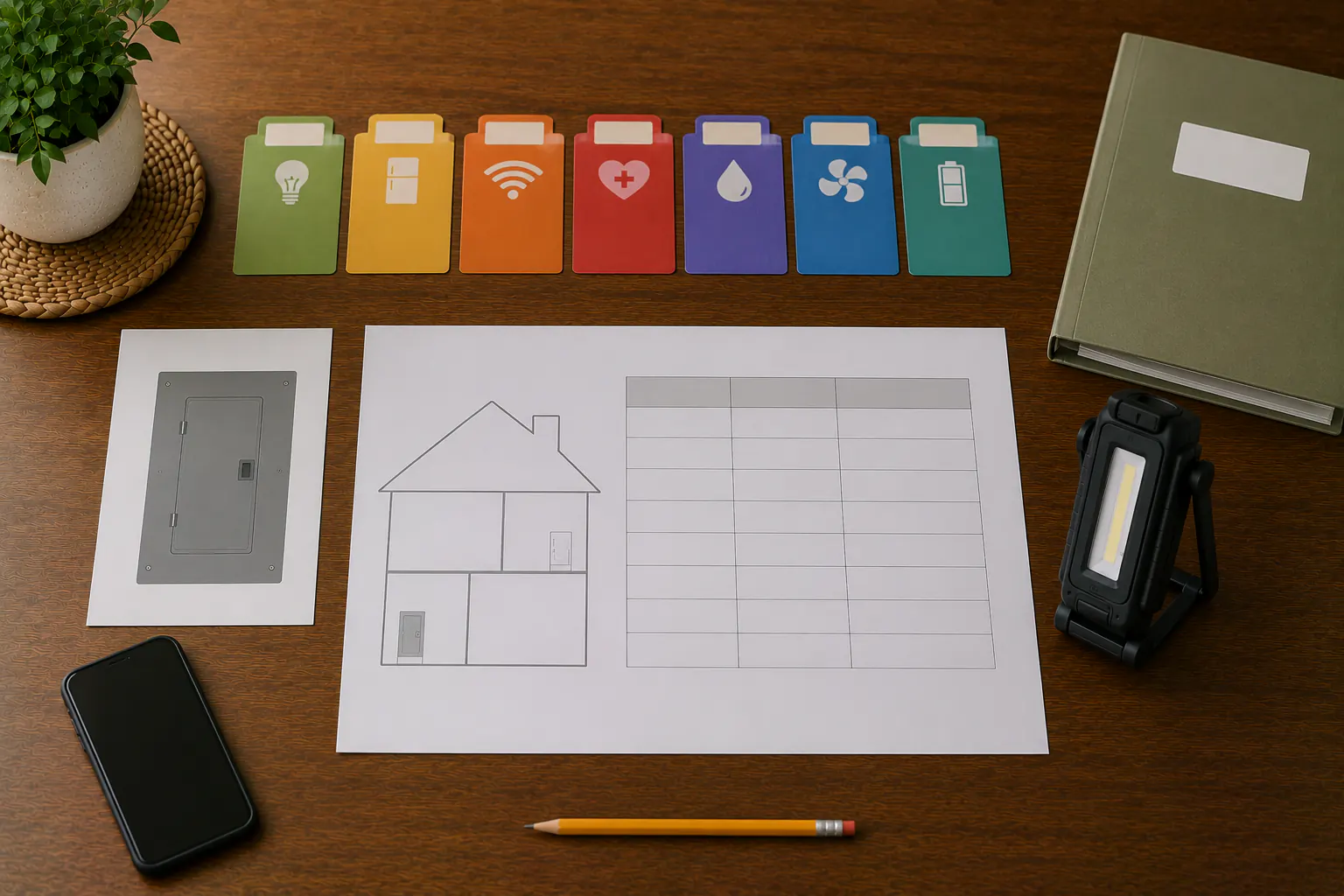
Start with the basic electrical safety hub. This guide never requires removal of the outer cover, dead front, breaker, filler, meter seal, or any internal part.
Do not approach these conditions
Leave and call 911 for fire, smoke, active arcing, explosion, shock injury, or immediate danger. Call the utility and building authority for damaged service equipment or downed lines.
Stay away from a panel when:
- the floor, wall, enclosure, or route is wet or flooded;
- water is leaking above or behind it;
- it is hot, smoking, buzzing, crackling, popping, sparking, or smells burned;
- the cover is missing, open, loose, bent, corroded through, or visibly damaged;
- a breaker, filler, wire, or internal part is exposed;
- the wall or structure has moved, cracked, burned, or been struck;
- insects, animals, debris, storage, or combustible material block safe access;
- a generator, solar array, battery, EV, or other source may energize equipment unexpectedly.
Do not use a metal object, broom, towel, fan, heater, or vacuum around a questionable panel. Do not stand in water to reach a main disconnect.
Identify the enclosure without opening it
Ask the owner, landlord, building manager, inspector, utility, or licensed electrician to identify the panel or panels serving the residence. A home may have a service disconnect, main panel, subpanel, apartment panel, separate equipment disconnects, and backup-power controls.
Record from intact exterior labels and qualified documentation:
- location and which dwelling or area it serves;
- whether it is a service panel, subpanel, or equipment disconnect;
- utility and emergency-maintenance contacts;
- main-disconnect location if separate;
- solar, battery, generator, transfer, well, sump, HVAC, EV, or medical dependencies;
- date of the last qualified inspection or modification;
- known access, moisture, corrosion, or labeling issues.
Do not infer ownership or function from proximity. A panel in a hallway, basement, garage, or utility room may serve common or neighboring loads.
Preserve clear, dry access
Keep the normal approach clear of boxes, shelving, coats, tools, fuel, cleaners, furniture, bicycles, and waste. Maintain building-required working space through the property authority and electrician; this guide does not prescribe dimensions because code and equipment conditions vary.
Provide battery lighting from outside the hazard zone. Do not attach magnets, hooks, shelves, decoration, paper, or storage to the enclosure. Do not paint over labels, seams, hinges, warning marks, or fasteners.
Renters should report blocked or locked access rather than moving another resident’s property or defeating a lock. Building management must preserve emergency and qualified-worker access.
Understand what a breaker does
A circuit breaker is intended to interrupt certain overcurrent conditions. It is not a universal detector for loose connections, every arc, shock hazard, overheating plug, damaged appliance, incorrect wiring, or water entry.
GFCI and AFCI protection have different functions and may be integrated into breakers or devices elsewhere. The GFCI and AFCI guide explains those roles without turning the panel into a test project.
A handle position can indicate that a breaker opened, but it does not reveal the cause. Do not assume a reset is the repair. Loads, wiring, appliances, connections, and environmental conditions may require evaluation.
Build accurate circuit records safely
Use existing labels, appliance manuals, building documents, and a licensed electrician’s circuit mapping. Avoid random switching because it can interrupt refrigerators, alarms, medical devices, pumps, network equipment, security systems, HVAC, fire protection, or another unit.
For each circuit, record:
| Field | Useful record |
|---|---|
| Area or equipment | room, fixed appliance, or documented function |
| Critical dependency | medical, sump, well, refrigeration, alarm, communication |
| Protection | breaker, GFCI, AFCI, or combination as verified |
| Backup interaction | none, approved transfer, battery system, or unknown |
| Responsible party | resident, landlord, building manager, electrician, utility |
| Last verified | date and person or document |
Do not create a circuit map by opening receptacles, probing conductors, using a tracer inside a panel, or switching circuits under unsafe or uncontrolled conditions. Hire a licensed electrician when labels are missing or wrong.
Decide whether a breaker may be reset
A one-time reset may be permitted by the manufacturer and building procedure when the panel is dry, intact, normally accessible, the cause is understood and corrected, no critical system will be disrupted, and no warning sign exists.
Before any permitted reset:
- Stop using and unplug the suspected portable load only when its plug and route are cool, dry, undamaged, and safe to touch.
- Confirm there is no water, heat, odor, smoke, sound, damage, exposed part, or structural issue.
- Follow the exact panel and breaker instructions and property procedure.
- Stand on dry stable flooring with normal lighting from a battery source.
- Use only the handle; do not remove any cover or touch adjacent hardware.
Stop if the breaker will not reset, immediately trips, trips again, feels loose, sounds abnormal, or the cause remains unknown. Leave it off and call a licensed electrician. Never hold a breaker on, tape it, bypass it, or move the appliance to another circuit to defeat the warning.
Treat the main disconnect as a coordinated control
Turning off a main may interrupt medical devices, alarms, refrigeration, heating, well pumps, sump pumps, accessibility equipment, and communication. It may not de-energize utility service conductors or equipment supplied from another source.
Prepare a written main-disconnect decision with the electrician, utility, landlord, and household. Define who may operate it, when emergency dispatch should be called, and what solar, battery, generator, or transfer equipment changes the procedure.
Do not switch a main during fire, flooding, structural damage, arcing, gas odor, or service damage unless emergency authorities direct a safe action from a safe location.
Keep labels factual and durable
Use a typed or neatly written directory approved for the enclosure. Describe actual areas and equipment rather than vague terms such as “plugs” or “lights.” Do not cover manufacturer labels, warnings, ratings, or inspection marks.
Record shared receptacles and critical loads when verified. Date the directory after qualified changes. Do not relabel a breaker based only on one lamp turning off; several loads may share the circuit.
Keep a duplicate circuit map with the household emergency records, without exposing sensitive home-system details publicly.
Plan for power outages
During a neighborhood outage, do not open or repeatedly switch the panel merely because the lights are out. Confirm utility scope first. Wiring may still be energized from solar, batteries, generators, or restoration activity.
Use the power-outage action guide and keep critical loads on approved backup systems. Never backfeed a panel through a receptacle. Selected-circuit backup requires listed transfer equipment and qualified installation.
When power returns, use the load-restart checklist rather than resetting every control at once.
Request qualified inspection after warning events
Call a licensed electrician after repeated trips, shock or tingling, burning odor, heat, buzzing, flicker across several loads, discoloration, loose equipment, water entry, pest damage, renovation, recalled equipment, lightning, flood, fire, service damage, or an unapproved backup connection.
Document the time, active loads, affected rooms, weather, outage, equipment behavior, and breaker position without recreating the fault.
Sources reviewed
- U.S. Consumer Product Safety Commission: Home Electrical Safety Checklist
- NIOSH: Electrical Safety in the Workplace
- Ready.gov: Power Outages
- OSHA: Qualified-Person and Testing Boundaries
Sources reviewed July 14, 2026. Current emergency services, utility direction, code, equipment instructions, property authority, and licensed electrical assessment control the actual procedure.