
Find the instructions for the exact protective device installed in your home, or ask management or an electrician to identify it. Before any permitted user test, confirm which critical loads it affects and who to call if power does not return. Do not press buttons on wet, damaged or abnormal equipment.
GFCI and AFCI devices can both interrupt power, but they address different conditions. Neither substitutes for correct wiring, overcurrent protection, grounding where required, smoke alarms, dry conditions, intact appliances or qualified installation.
The household skill is to recognize the device, follow its documented user test, treat a trip as information rather than nuisance, and call an electrician when behavior is abnormal.
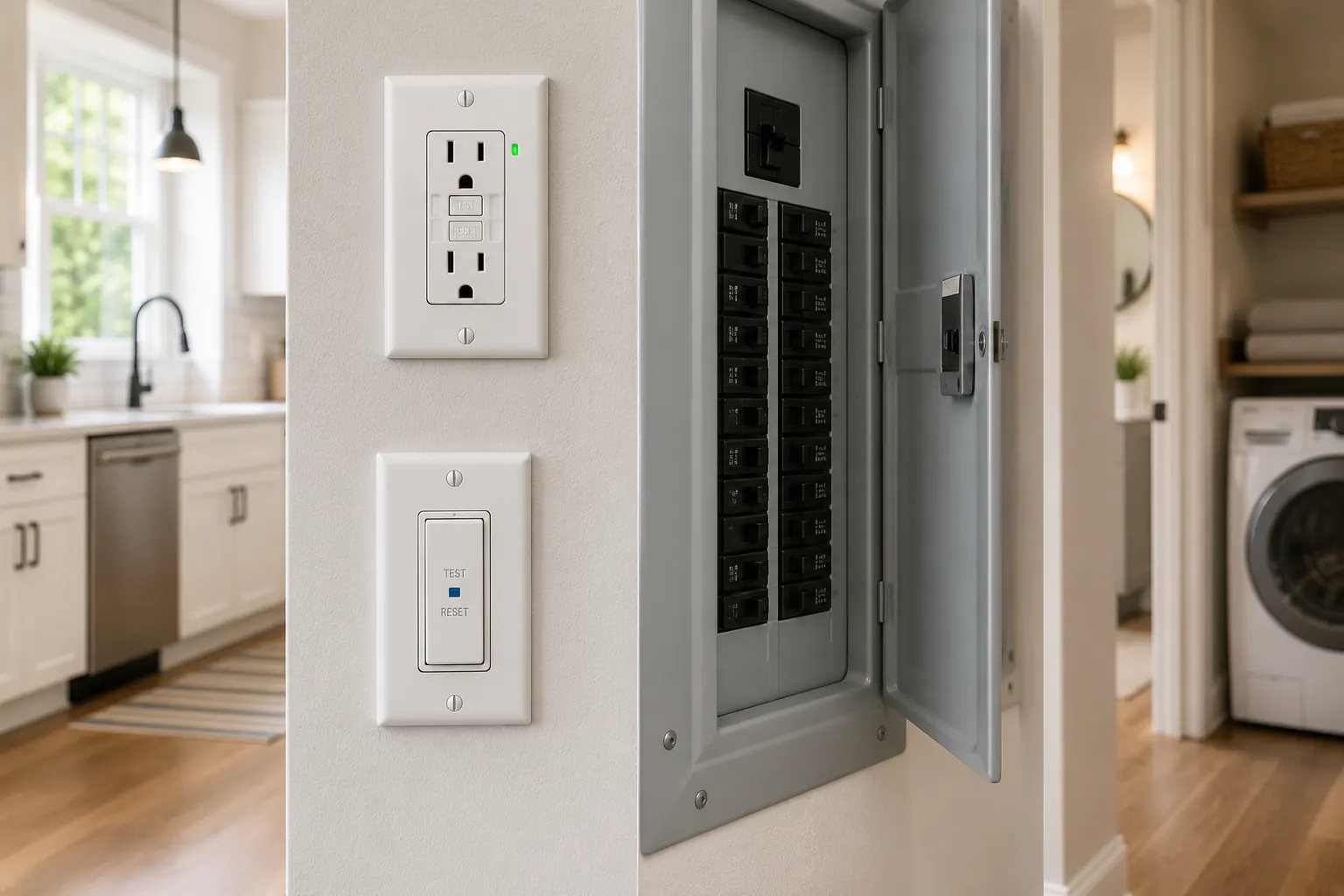
Stop before any test when danger is present
Do not approach or operate a device that is wet, hot, smoking, sparking, buzzing, cracked, loose, discolored, missing a cover, or near structural damage. Leave and call 911 for fire, active arcing, explosion, shock injury, or immediate danger.
Do not stand in water to press a test or reset button. Do not use a plug-in tester in a wet, damaged, loose, outdoor, construction, generator, or uncertain receptacle merely because the tool fits.
Use a licensed electrician for any protective device that does not behave exactly as its current instructions describe.
Understand the GFCI role
A ground-fault circuit interrupter compares current traveling through intended conductors and interrupts when it detects a qualifying imbalance. Its purpose is to reduce certain shock and electrocution hazards, especially where electricity and grounding paths can interact.
A GFCI does not:
- prevent every shock or electrical injury;
- protect against all line-to-line or line-to-neutral contact;
- prove that a receptacle is grounded or wired correctly;
- make wet equipment safe to handle;
- increase circuit capacity;
- replace overcurrent protection, AFCI protection, or correct installation;
- authorize use of an indoor cord, appliance, or connection outdoors.
GFCI protection may be at a receptacle, breaker, portable device, cord set, or upstream location. One device can protect downstream receptacles, so the visible outlet may not contain the reset control. Have the system mapped by an electrician.
Understand the AFCI role
An arc-fault circuit interrupter is intended to detect certain arcing signatures associated with wiring or cord faults and interrupt the circuit. CPSC has supported AFCI technology as a way to reduce residential electrical fire hazards.
An AFCI does not:
- detect every possible arc or fire cause;
- replace overload and short-circuit protection;
- make damaged cords, loose outlets, or poor connections acceptable;
- replace GFCI protection where it is required;
- prove that an appliance or branch circuit is fault-free;
- authorize repeated resets when it trips.
Some devices combine GFCI and AFCI functions. Identify the exact product and instructions rather than assuming from button color, label position, or panel appearance.
Compare the functions without treating either as universal
| Question | GFCI | AFCI |
|---|---|---|
| Primary concern | qualifying current leakage or ground-fault shock hazard | qualifying arcing condition and fire hazard |
| Common forms | receptacle, breaker, portable or cord-connected device | breaker, receptacle, or combination device depending on system |
| User test | exact device test/reset procedure | exact device test/reset procedure |
| Trip meaning | condition or device behavior requires attention | condition or device behavior requires attention |
| What it cannot prove | grounding, dry equipment, correct wiring, universal shock protection | no wiring fault, no overload, no fire risk, correct installation |
Current local code decides where protection is required. Do not use a national article to determine whether an older installation is compliant, grandfathered, altered, or in need of upgrade.
Test only through the installed device procedure
Use the manufacturer’s current instructions and building procedure for test frequency, sequence, expected indicators, and reset. The CPSC checklist includes user testing for GFCI and AFCI devices, but the exact installed model controls.
Before testing:
- notify household members;
- protect medical, alarm, refrigeration, pump, network, security, and other critical loads;
- confirm the device and surrounding area are dry, intact, and normally accessible;
- use normal lighting from a battery source if an outage will darken the area;
- identify who to call if power does not restore.
Press only the intended user controls. Do not remove a cover, insert a probe, open a panel, or touch wiring. Stop if the button binds, the enclosure moves, an indicator is abnormal, the expected load does not turn off, reset fails, or the device trips again.
Do not use a plug-in tester as complete verification
Three-light outlet testers and GFCI test functions can indicate a limited set of conditions under defined assumptions. They cannot detect every wiring error, conductor condition, grounding issue, shared-neutral problem, voltage quality issue, upstream protection problem, or hazard.
OSHA’s own field program requires training even for basic non-contact testers and three-light circuit analyzers. A consumer tool does not qualify a resident to diagnose wiring or certify an outlet.
Use the electrical tester comparison for purchase boundaries. Qualified electrical testing belongs to a licensed electrician using appropriate instruments and procedures.
Respond to a trip without defeating it
When a GFCI or AFCI trips:
- Stop using affected loads.
- Look from a safe distance for water, damage, odor, heat, smoke, sound, or a recalled appliance.
- Keep critical systems on their approved continuity plan.
- Follow the exact one-time reset procedure only when the cause is understood, removed, and no warning sign exists.
- Stop if it will not reset, immediately trips, or trips again.
- Leave it off and call a licensed electrician.
Do not hold a reset button, tape it, replace the device with ordinary hardware, use an adapter, move the appliance to an unprotected outlet, or disconnect a grounding conductor. A trip is not a nuisance to route around. Knowing which breaker owns which circuit makes a trip response calmer, and the household electrical safety boundaries frame what a resident may touch at all.
Separate appliance fault from circuit fault through qualified diagnosis
A trip may involve an appliance, cord, moisture, wiring, connection, device, shared circuit, or another condition. Do not recreate it by reconnecting items one by one when heat, water, damage, odor, critical systems, or uncertainty exists.
Record the active equipment, location, weather, water use, outage, startup event, and exact device indicators. Preserve model information and recall status. Let an electrician determine the safe diagnostic method.
Plan around outages and backup power
A portable generator, power station, inverter, transfer system, solar array, or battery may have its own grounding and protective design. Do not add adapters or portable GFCI devices based on generic advice. Follow the complete source and load instructions and qualified installation.
Never backfeed household wiring. A breaker or GFCI is not transfer equipment. Use the backup-power guide.
After utility restoration, stop if a GFCI or AFCI will not reset or repeatedly trips. Do not restore critical equipment through an unapproved alternate outlet.
Renter and shared-building boundaries
Report nonworking, missing, damaged, loose, warm, or repeatedly tripping protection immediately. Do not replace a receptacle, breaker, or device, access a shared panel, or change labels without written authority and licensed service.
Ask management which device controls the unit receptacle and how critical equipment will be supported during inspection. In a common area, keep people away and use emergency maintenance rather than testing it yourself.
Keep records
Record manufacturer, exact model, location, protected area as verified, test instructions, last user test, trip history, electrician findings, and recall checks. Do not claim downstream coverage merely because one receptacle lost power during a casual test.
Update the map after renovation, device replacement, panel work, or a change in critical loads.
Sources reviewed
- U.S. Consumer Product Safety Commission: Home Electrical Safety Checklist; AFCI Fire Technology
- OSHA: Ground-Fault Circuit Interrupters; Electrical Testing Boundaries
- NIOSH: Electrical Safety in the Workplace
Sources reviewed July 14, 2026. OSHA field-program training limits checked October 2, 2026; that employee program is not a residential code determination. Current product instructions, emergency services, utility direction, code, permits, property authority, and licensed electrical findings control the actual system.