
Before buying a detector or outlet tester, name the question you want answered. If it is whether wiring can be touched, opened or repaired, call a qualified electrician. A consumer tool cannot give an untrained resident clearance for that work, even when it stays silent or displays an apparently normal result.
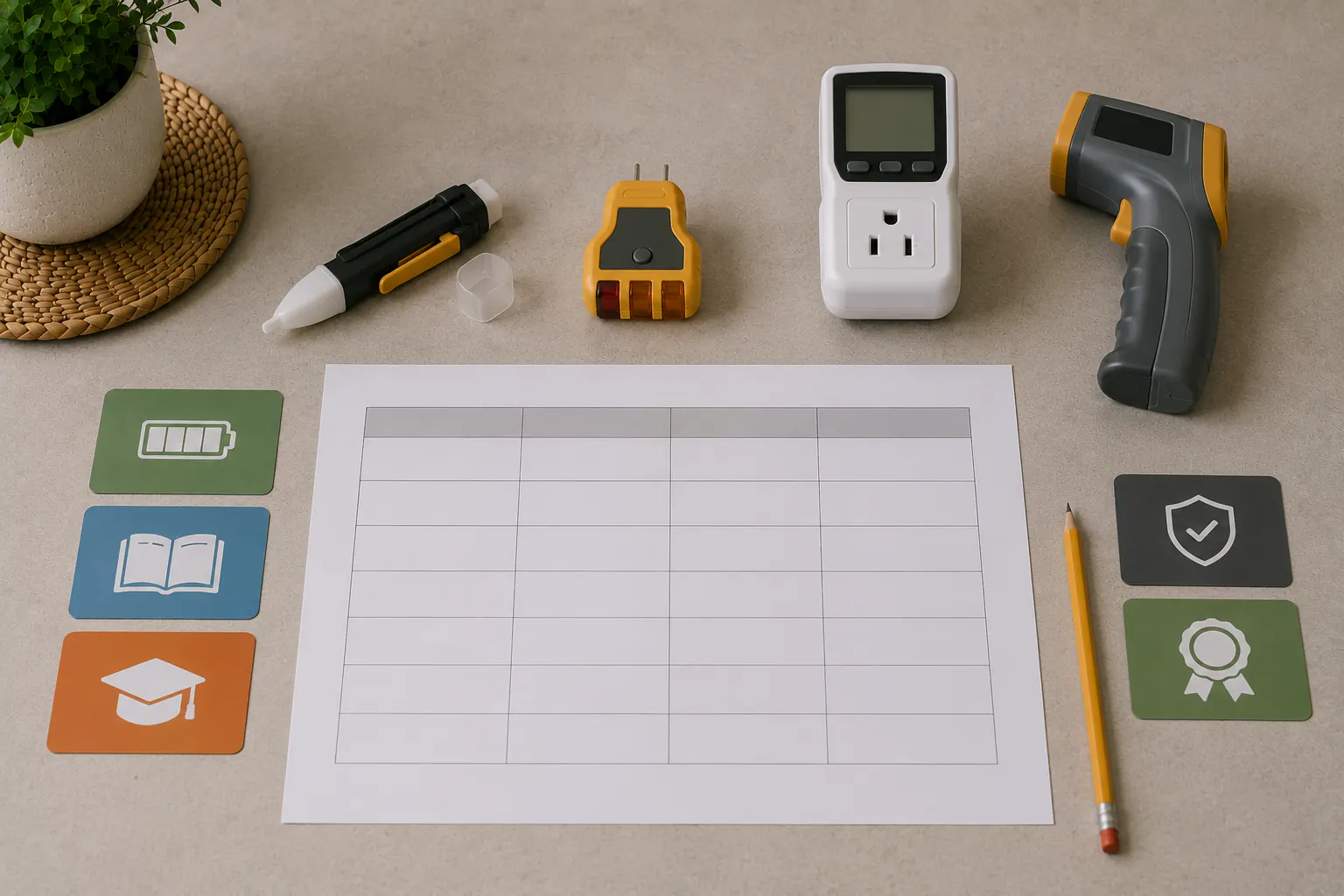
ReadyLience has not completed hands-on comparative testing for this category. This page is a research and purchase framework, not a ranking or instruction to test household wiring. No tool on this page qualifies an untrained person or proves that equipment is safe to touch or open.
Decide whether a tool belongs in the household at all
For most residents, the useful electrical safety kit is small: battery lighting, readable circuit records, manufacturer manuals, emergency contacts, “do not use” tags, and a phone camera for observations from a safe distance.
A detector or tester is not required to recognize smoke, heat, odor, melting, water, loose equipment, exposed parts or repeated trips. Those conditions already require stopping and calling a licensed electrician. The household electrical safety boundaries and jobs that belong to an electrician explain the handoff. A visual inspection of outlets, plugs and power strips can reveal reasons to stop use without an instrument; it cannot find every hazard.
OSHA’s field safety program states that even low-voltage non-contact testers and three-light circuit analyzers require training. Direct-contact measurements on exposed energized parts are not for unqualified people.
Compare categories by indication, not marketing name
| Tool category | Intended indication | Critical limitation |
|---|---|---|
| Non-contact AC voltage detector | electric-field response near certain AC sources | can miss voltage or respond to nearby fields; no proof of de-energization |
| Three-light receptacle tester | limited wiring patterns at a compatible energized receptacle | cannot identify every dangerous wiring condition |
| Receptacle tester with GFCI function | limited pattern plus a test signal under assumptions | does not prove grounding, full GFCI coverage, or code compliance |
| Plug-in energy monitor | volts, watts, current, or energy for compatible plug loads | not for hardwired, wet, damaged, high-risk, or out-of-rating equipment |
| Multimeter | direct electrical measurements across selected functions | selection and use can expose user and instrument to hazardous energy |
| Clamp meter | current indication around an appropriate conductor | usually requires access and training; not a household panel tool |
| Circuit tracer | transmitter/receiver indication for certain paths | can misidentify circuits and may require panel access |
| Infrared thermometer or camera | surface temperature indication | emissivity, distance, hidden heat, and interpretation limits |
Do not buy a broader tool simply because it appears more professional. Greater measurement capability can create greater exposure and configuration risk.
Treat non-contact voltage detectors as indicators only
A non-contact detector senses an electric field under conditions defined by its design. Response can depend on voltage range, frequency, distance, orientation, shielding, conductor geometry, grounding, user coupling, nearby energized objects, battery, environment, and self-test.
A light or beep may indicate a field, not the exact conductor or safe boundary. Silence does not prove absence of voltage. It cannot establish an electrically safe work condition.
Do not use one to decide that a panel, outlet, fixture, wire, appliance, solar system, generator circuit, or battery system can be opened or touched. Qualified de-energization verification uses selected instruments and procedures beyond this site’s scope.
Understand three-light receptacle tester blind spots
Three-light testers compare a limited set of conditions at an energized compatible receptacle and translate combinations into a legend. They may not detect every open, reversed, bootleg, shared-neutral, high-resistance, voltage, grounding, upstream, or intermittent problem.
Do not insert one into a loose, wet, damaged, scorched, buzzing, hot, outdoor, generator-fed, construction, or uncertain receptacle. Do not use it to certify a landlord’s wiring, authorize a replacement, or prove that a grounding path is effective.
If an indication is unexpected, stop and call a licensed electrician. Do not move the tester through the home to diagnose the circuit.
Keep multimeters out of unqualified household mains work
Multimeters require correct function, range, input terminal, lead rating, measurement category, voltage limit, environment, technique, and PPE. A configuration error can place the meter or user across hazardous energy.
OSHA states that only qualified people may perform testing work on electric circuits or equipment in its regulated context. NIOSH likewise says electrical work belongs to qualified people.
ReadyLience does not provide procedures for measuring mains voltage, current, resistance, continuity, grounding, insulation, or panel circuits. A low purchase price or auto-ranging feature does not reduce the qualification requirement.
Evaluate ratings and certification precisely
For any instrument, require:
- exact intended use and prohibited use;
- maximum voltage, current, frequency, and environmental limits;
- measurement category and transient rating where applicable;
- lead, probe, fuse, accessory, and battery requirements;
- ingress, temperature, altitude, and drop limits;
- self-test or proving method;
- calibration and maintenance instructions;
- current recall and safety notice status;
- exact third-party certification evidence.
OSHA’s NRTL list includes standards such as UL 61010-2-033 for hand-held multimeters capable of measuring mains voltage. Verify the exact model, certifier mark, standard, and scope. OSHA emphasizes that NRTL recognition is not a product endorsement.
A marketplace logo or “CAT rated” text without traceable model documentation is not enough.
Compare human factors
Useful design evidence includes:
- controls that reduce function-selection errors;
- clear display and audible or vibration indications;
- battery status and failed-self-test behavior;
- probes and leads that remain protected in storage;
- durable instructions available offline;
- one-hand handling only where the qualified procedure permits it;
- no exposed battery or loose conductive accessory;
- readable model and rating after years of storage.
Accessibility matters, but louder alarms and larger displays do not expand the safe task. A person who cannot confidently interpret every state should stop and call a professional.
Inspect and maintain without testing live household wiring
Follow manufacturer instructions for exterior condition, batteries, self-test, storage, calibration, and retirement. Remove the tool from service for cracked housing, damaged leads, loose parts, corrosion, contamination, illegible rating, failed self-test, recall, out-of-date calibration where required, or abnormal behavior.
Do not prove a detector by approaching an unknown hazardous source. Use only the manufacturer-defined proving method in a safe context, or have the qualified user manage it.
Store instruments separately from general hand tools so probes and controls are not damaged. A tool-box impact can alter safety even when the display still turns on.
Do not let a tool expand the task
The purchase gate should ask:
- What exact observation is needed?
- Does the household have a safe, authorized, trained use for it?
- Would calling an electrician answer the question without exposure?
- Could a result be misread as permission to open or repair equipment?
- Is the model certified and rated for the exact environment?
- Can it be maintained and retired correctly?
If the tool’s main appeal is avoiding an electrician for panel, receptacle, fixture, wire, or fault diagnosis, do not buy it for that purpose.
Ask what the product evidence actually shows
Look for documentation identifying the exact model, ratings, intended environment, required training and limits of each indication. A comparison that reports measured performance should explain its qualified method and test conditions, including the situations the instrument cannot detect.
Do not reproduce an electrical fault at home to check a claim. Neither a product demonstration nor this article provides a procedure for opening panels, approaching energized parts or verifying de-energization for work.
This page compares documented functions and limitations. It does not recommend a tested model or claim one is safest or most accurate.
Separate useful non-electrical tools
For household planning, a bright battery light, labels, circuit directory, camera, notebook, barrier tape, and secure storage often provide more value than a meter. The essential home toolkit keeps electrical test equipment outside the general core.
Use “do not use” tags to quarantine suspect plug-in equipment and call the responsible professional.
Renter limits
Do not test common-area or landlord-owned outlets, panels, alarms, fixed appliances, or wiring to build a dispute. Report observed symptoms and request licensed inspection. Preserve work orders and qualified findings.
A consumer tester result is not a code inspection or legal determination.
Sources reviewed
- OSHA: Electrical Field Safety Program; Testing on Electrical Equipment
- NIOSH: Electrical Safety in the Workplace
- OSHA: NRTL Appropriate Test Standards and FAQ
- U.S. Consumer Product Safety Commission: Recalls
Sources reviewed July 14, 2026. Current emergency services, product manuals, certification directories, recalls, code, property authority, and appropriately qualified electrical professionals control actual selection and testing.