
The most valuable DIY electrical skill is recognizing when the task is not DIY. Electricity can cause fatal shock, burns, arc blast, fire, falls, hidden damage, and unexpected energization. A breaker switched off, a non-contact tester that stays silent, or prior renovation experience does not establish a safe work condition.
Patrick’s renovation experience supports careful project planning, documentation, and trade coordination. It does not make him an electrician, and ReadyLience does not turn that experience into wiring instructions. This article defines a stop boundary for everything the basic electrical safety guide does allow a household to observe and check.
Call emergency services for active danger
Call 911 for fire, smoke, active arcing, explosion, shock injury, downed lines, or immediate threat. Keep people away and follow dispatch instructions.
Do not touch a person still connected to electricity. Do not enter water to reach a switch or panel. Do not approach service equipment damaged by a vehicle, tree, storm, fire, flood, or structure.
Use the utility for downed lines, meter or service damage, transformer events, and public-supply problems. Use the fire department for fire and electrical emergency conditions.
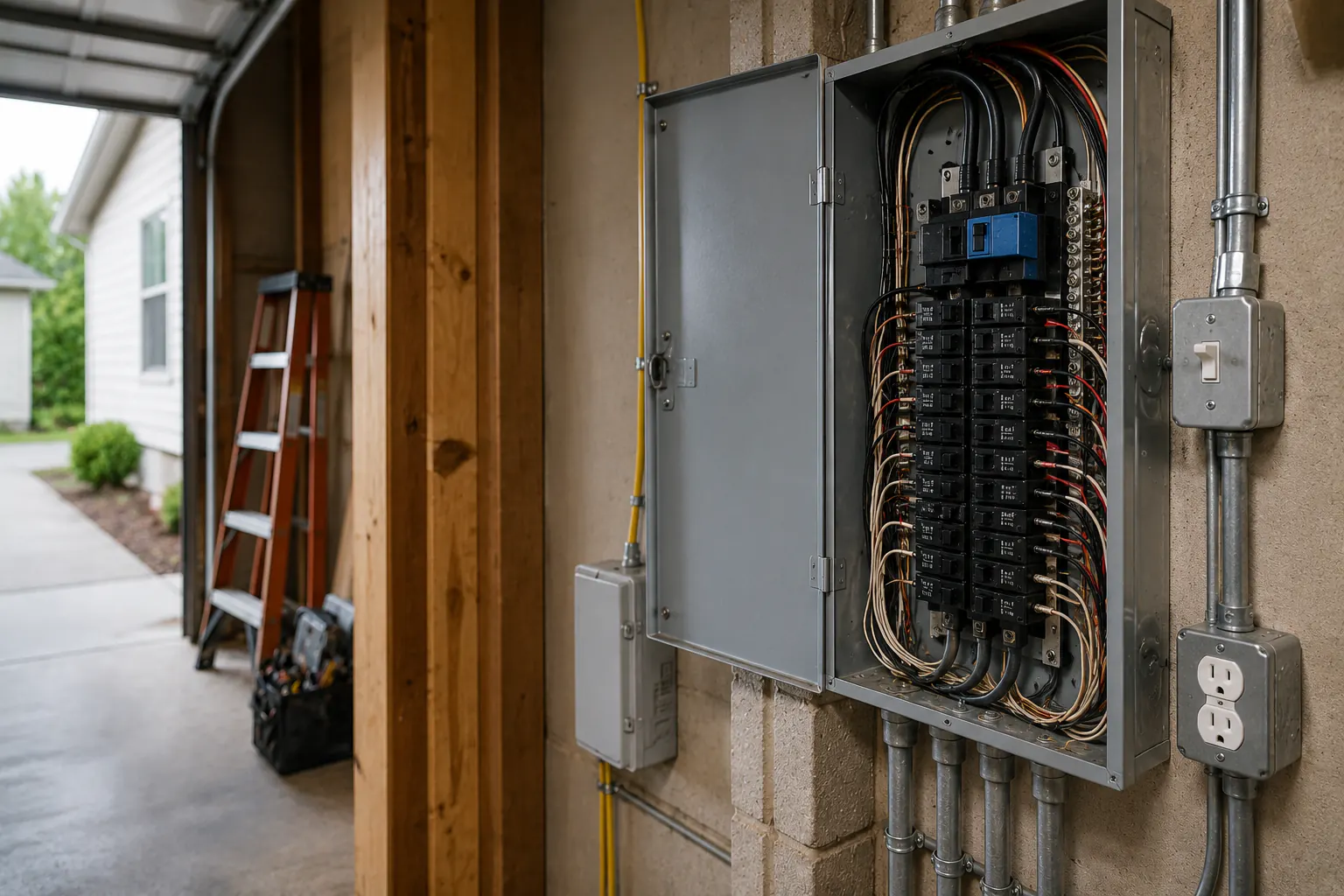
Leave every panel and service task to a professional
Do not remove a panel cover or dead front, replace or add a breaker, move a circuit, tighten a lug, install a filler, clean corrosion, trace inside the enclosure, or touch service equipment.
Service conductors may remain energized even when a main disconnect is off. Solar, batteries, generators, transfer equipment, EV systems, and shared building supplies can introduce additional sources.
Panel replacement, capacity changes, service upgrades, subpanels, grounding and bonding, surge devices, transfer equipment, and generator connections require electrical design, permits, utility coordination, listed equipment, and qualified installation.
Leave fixed wiring and boxes closed
Receptacle, switch, light, fan, thermostat, junction-box, cable, conductor, splice, connector, and hardwired-appliance work can expose energized parts or create hidden fire hazards after the wall is closed.
Do not:
- remove an outlet, switch, fixture, or junction-box cover to diagnose a problem;
- replace two-slot receptacles with three-slot hardware without a compliant design;
- defeat or omit grounding, bonding, GFCI, AFCI, or overcurrent protection;
- extend wiring with flexible cord or concealed plug connections;
- bury a splice, adapter, strip, or extension cord in a wall or ceiling;
- select wire or breaker size from a generic online chart;
- reuse heat-damaged, corroded, wet, recalled, or unidentified components;
- modify fire-rated, weather-resistant, damp, wet, exterior, or hazardous-location assemblies.
Use a licensed electrician and obtain property authority and permits as required.
Leave testing and diagnosis to qualified people
NIOSH states that only qualified people should perform electrical work. OSHA says unqualified people may not take direct-contact measurements on exposed energized parts, and even basic non-contact testers and three-light analyzers require training in its field program.
Do not use a multimeter, clamp meter, probes, tracer inside a panel, insulation tester, or improvised lamp to test household wiring. Do not insert anything except a normal intact plug into a receptacle.
Consumer detectors have limited indications and false-positive or false-negative conditions. The tester comparison is a buying-boundary article, not a testing procedure.
Leave wet, flooded, burned, or storm-damaged systems untouched
Water can contaminate insulation, devices, panels, appliances, motors, batteries, solar equipment, and hidden wiring. Dry appearance does not prove electrical safety.
After a flood, plumbing leak, fire-suppression discharge, roof failure, or storm:
- keep power isolated through emergency and qualified controls;
- do not enter a wet room to unplug equipment;
- do not use fans, heaters, rice, compressed air, or repeated energization to “dry” equipment;
- do not clean a panel, receptacle, motor, battery, or appliance;
- obtain electrical and equipment-specific evaluation before restoration.
Structural, mold, contamination, and insurer requirements may also apply. Use the plumbing incident hub for cross-hazard planning.
Leave recurring warnings unresolved until inspected
Repeated breaker, GFCI, or AFCI trips; flicker; buzzing; heat; loose plugs; shocks; odor; scorch marks; and intermittent operation require diagnosis. Do not keep resetting, replace protection with a higher rating, move the appliance, or add a power strip.
Record the pattern without recreating it. The overload warning guide helps prepare a useful service call.
Leave backup-power connections to designed systems
Never use a double-male cord or feed a panel through a receptacle. Backfeeding can energize utility lines and endanger workers, responders, neighbors, and occupants.
Selected-circuit or whole-home backup requires listed transfer equipment or another permitted design, installed and commissioned by qualified professionals. Generator grounding, neutral configuration, overcurrent protection, load management, fuel, exhaust, weather, and utility interaction are system-specific.
A portable power station should supply only compatible plug-in loads through approved connections. Do not adapt its output to household wiring. Use the backup-power hub.
Leave solar, batteries, and EV charging to specialized service
Solar arrays can produce whenever illuminated. Battery systems store substantial energy. EV charging is a sustained load and vehicles contain high-voltage systems. Labels and disconnects do not make this household work.
Use qualified installers for:
- photovoltaic modules, rapid shutdown, inverters, optimizers, disconnects, and interconnection;
- stationary batteries, energy-management systems, ventilation, clearances, and fire-service coordination;
- EV supply equipment, receptacles, hardwired chargers, load calculations, cable routing, and bidirectional operation;
- vehicle-to-home, vehicle-to-grid, or generator integration;
- damaged, flooded, overheated, recalled, or abnormal battery systems.
Do not open battery enclosures, improvise connectors, repair charge cables, or use adapters not approved by every manufacturer.
Leave hardwired appliances and mechanical systems to the right trades
Water heaters, boilers, furnaces, heat pumps, central air conditioning, pumps, ranges, dryers, disposals, alarms, elevators, gates, and fire systems can combine electricity with heat, pressure, fuel, refrigerant, water, movement, or life-safety functions.
Use the equipment service provider and licensed electrician. One trade may not release every hazard. For example, a plumber’s completed leak repair does not prove a wet circuit is ready to energize.
Treat permits and inspections as part of safety
Electrical requirements vary by jurisdiction, occupancy, building age, use, and project. A video or article from another state cannot determine the permit, license, inspection, utility, or property requirements for one address.
Before hiring:
- verify the license through the relevant authority;
- confirm permit and inspection responsibility;
- define scope, exclusions, equipment, and cleanup in writing;
- ask how power will be controlled and critical loads supported;
- preserve model, certification, permit, inspection, and test records;
- do not accept a request to conceal unpermitted work or bypass protection.
NRTL certification means the certifier evaluated the exact product within a recognized scope; OSHA notes it is not an endorsement. Certification does not replace correct installation or code compliance.
Keep household contributions valuable and safe
Residents can inventory loads, photograph intact exterior labels, clear access, collect manuals, preserve permits, report symptoms, arrange critical-load continuity, check recall databases, and coordinate appointments.
They can also mark damaged plug-in equipment “do not use” and keep others away. Do not open or repair it.
Renter boundaries
Renters should report electrical concerns immediately and keep written records. Do not access a shared panel, replace landlord-owned devices, install fixed equipment, drill near hidden wiring, or authorize work outside the lease process.
For unresolved immediate hazards, use emergency services and local housing or fire authorities. Rights and remedies vary; obtain jurisdiction-specific advice rather than relying on generic legal claims.
Sources reviewed
- NIOSH: Electrical Safety in the Workplace
- OSHA: Electrical Testing, Qualified-Person, and NRTL Guidance
- U.S. Fire Administration: Prevent Home Electrical Fires
- U.S. Consumer Product Safety Commission: Home Electrical Safety Checklist
Sources reviewed July 14, 2026. Emergency responders, utilities, local authorities, code, permits, product instructions, property authority, and appropriately licensed electrical professionals control actual work.