
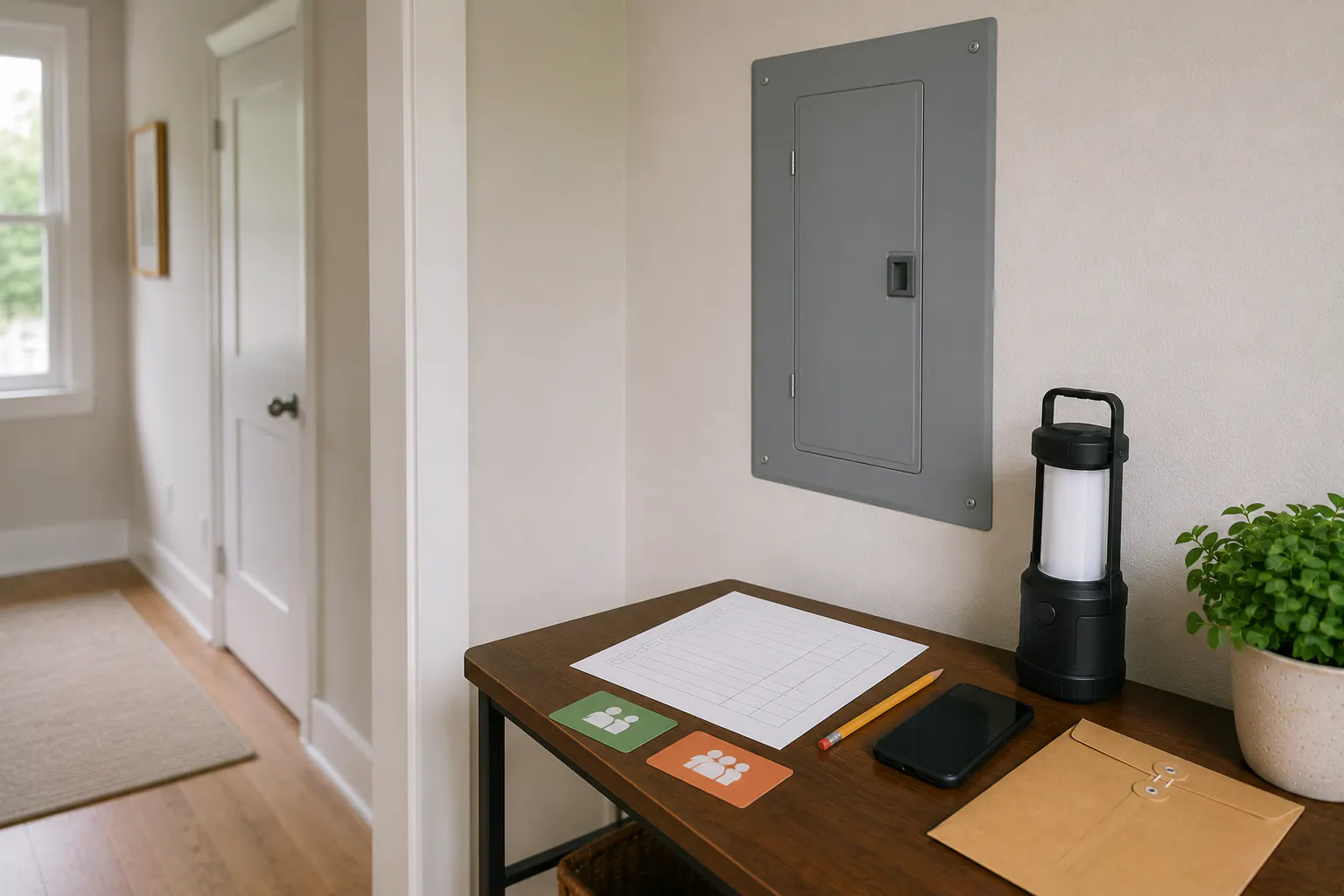
Start with two things you can keep outside the electrical equipment: the emergency contacts and the existing circuit records. Leave panel covers and fixed wiring closed. If you notice smoke, heat, odor, buzzing, water or damage, keep people away and use the emergency or qualified-service instructions below; do not investigate the fault yourself.
Patrick’s renovation experience across his apartment, his wife’s professional office, and his parents’ home reinforced a practical limit: planning, labeling, visual observation, and equipment inventories are useful homeowner work; opening electrical equipment or diagnosing energized wiring is not. That hands-on context informs this conservative framework, but it is not an electrical credential.
Choose the guide that matches the decision
| Need | Start here |
|---|---|
| Identify the panel and record circuit functions safely | Breaker-panel basics for every household |
| Respond to heat, odor, flicker, buzzing, or repeated trips | Signs of an overloaded electrical circuit |
| Select and route a temporary cord during an outage | Extension-cord safety during a power outage |
| Understand the different jobs of GFCI and AFCI protection | GFCI and AFCI protection explained |
| Decide when a job belongs to an electrician | Electrical jobs to leave to a licensed electrician |
| Bring household loads back after utility restoration | Restart household loads after an outage |
| Check plug-in equipment for visible damage | Inspect outlets, plugs, and power strips |
| Compare detectors and testers without mistaking them for training | Electrical safety-tool comparison |
Leave before touching a switch or panel
Call 911 for fire, smoke, explosion, shock injury, active arcing, or immediate threat. Stay away from downed lines and anything they touch. Follow the utility’s distance and reporting instructions.
Do not approach a panel, receptacle, appliance, or cord when there is:
- water, wet flooring, flooding, condensation inside equipment, or a leak above;
- burning odor, smoke, abnormal heat, crackling, buzzing, popping, sparks, or visible arcing;
- a damaged meter, service mast, panel enclosure, cable, wall, or structure;
- an exposed conductor, missing cover, scorched surface, melted plastic, or fallen equipment;
- gas odor, carbon monoxide alarm, fire-suppression discharge, or chemical contamination;
- uncertainty about solar, battery, generator, vehicle, or other sources that may keep wiring energized.
Leave the area and call the utility, fire department, landlord, building manager, or licensed electrician as appropriate. Do not turn power off by entering water or reaching past damaged equipment.
Keep household work outside the enclosure
The safe household boundary is the exterior of intact, normally accessible equipment. Do not remove a panel cover or dead front, replace a breaker, tighten a terminal, probe a slot, expose wiring, open a junction box, modify a receptacle, or work on service equipment.
NIOSH states that unqualified people should not work on energized parts. Even qualified workers use energy-control procedures, verify de-energization with appropriate instruments, and apply task-specific PPE. Switching a breaker off is not the same as establishing an electrically safe work condition, especially with generators, solar, batteries, shared buildings, mislabeling, or damaged systems.
This site does not teach live testing, lockout/tagout, panel work, wire sizing, grounding, bonding, breaker replacement, or electrical repair.
Build a household electrical map
From labels, manuals, normal controls, and a qualified electrician’s documentation, record:
- utility and electrical emergency numbers;
- panel location and unobstructed dry access route;
- main disconnect location as identified by the electrician or utility;
- circuit labels and the rooms or fixed equipment they serve;
- smoke, carbon monoxide, security, communication, sump, well, refrigeration, HVAC, and medical-device dependencies;
- GFCI and AFCI devices and the manufacturer’s test instructions;
- solar, battery, generator, transfer equipment, EV, or vehicle-to-load systems;
- critical loads that require an approved backup plan;
- landlord, building, condominium, permit, and inspection contacts.
Do not map circuits by deliberately overloading them, removing covers, or switching off medical, life-safety, security, refrigeration, pump, elevator, or shared systems without a coordinated plan. The breaker-panel guide keeps the exercise observational.
Separate capacity from convenience
The number of receptacles or power-strip sockets does not indicate available circuit capacity. Multiple outlets may share one branch circuit, and fixed loads may be hidden from the room. Plug shape alone does not prove that an outlet, cord, or backup source is suitable for an appliance.
Record each critical appliance’s nameplate input, manufacturer connection instructions, startup behavior, and whether direct wall connection is required. Major appliances and heat-producing equipment often require dedicated or direct connections. USFA advises plugging major appliances directly into wall outlets and never using extension cords for them.
Do not use an adapter, splitter, power strip, or different room merely to avoid a tripping breaker. Repeated trips, heat, odor, discoloration, flicker, or loose plugs require evaluation.
Treat cords as temporary equipment
An extension cord is not a substitute for permanent wiring. It adds plug connections, routing damage, voltage drop, trip hazards, moisture exposure, and the possibility of overload.
Before any approved temporary use, match the appliance instructions, cord type, conductor size, current rating, length, environment, grounding configuration, temperature, and listing. Fully uncoil the cord when the manufacturer requires it. Keep it visible and protected from doors, windows, rugs, furniture, wheels, sharp edges, heat, water, children, and pets.
Never daisy-chain extension cords or power strips, remove a grounding pin, force a plug, use indoor equipment outdoors, or repair a damaged jacket with tape. The dedicated outage cord guide includes generator and apartment limits.
Understand protection without assuming immunity
Circuit breakers, fuses, GFCIs, and AFCIs perform different functions. A standard breaker addresses overcurrent; a GFCI addresses certain ground-fault shock hazards; an AFCI addresses certain arcing conditions. None makes damaged wiring, wet equipment, overloaded cords, improper installation, or unsafe behavior acceptable.
Test GFCI and AFCI devices only through the current manufacturer and building procedure. A device that will not test, reset, remain set, or behaves unexpectedly needs qualified evaluation. Do not bypass it or move the load to an unprotected location.
Smoke and carbon monoxide alarms remain essential. Electrical protection does not guarantee that a fire or combustion hazard will be prevented.
Inspect plug-in equipment without energizing a fault
Before use, look for a cracked jacket, crushed section, missing or loose pin, discoloration, melted plastic, corrosion, exposed material, loose strain relief, damaged switch, unusual odor, or recalled model. Remove suspect equipment from service without opening or repairing it.
Check CPSC recalls using the exact manufacturer, model, and date information. Follow stop-use and remedy instructions; do not donate or sell recalled or damaged equipment.
Do not touch or smell closely when a battery is swollen, leaking, smoking, hot, or making noise. Move away and follow manufacturer, CPSC, fire-service, and local disposal instructions.
Plan for an outage and restoration
Ready.gov advises disconnecting appliances and electronics to reduce surge-related damage during outages. Preserve medical, alarm, communication, refrigeration, and other critical functions through their approved continuity plans rather than a blanket rule.
Never connect a generator to household wiring through a receptacle or double-male cord. Selected-circuit backup requires listed transfer equipment or another code-permitted system installed by qualified professionals. The backup-power hub explains this boundary.
When utility power returns, do not restore every portable heater, pump, charger, compressor, and appliance at once. Use the load-restart checklist, stop for abnormal behavior, and keep wet or damaged equipment isolated until released by qualified service.
Include renters and accessibility
Renters should obtain the written panel and outage procedure, emergency maintenance number, circuit restrictions, and permission process for installed equipment. Do not enter locked electrical rooms, operate shared disconnects, relabel building circuits, or install permanent devices without authority.
Plan for reach, grip, vision, hearing, cognition, and mobility. Labels should be readable, the route should remain clear, and backup lighting should not require approaching damaged electrical equipment. A person who cannot access a panel safely needs a contact-and-relocation plan, not an improvised handle or unlocked service room.
Review twice a year and after any incident
Confirm contacts, labels, access, critical loads, alarm tests, recall status, backup-power instructions, and any changes from renovation or new appliances. Ask a licensed electrician to correct missing, ambiguous, or inaccurate circuit information.
After a trip, shock, outage, flood, lightning event, service work, or electrical smell, document what happened and obtain the appropriate inspection before returning suspect equipment to service.
Sources reviewed
- U.S. Consumer Product Safety Commission: Home Electrical Safety Checklist
- U.S. Fire Administration: Appliance and Electrical Fire Safety
- NIOSH: Electrical Safety in the Workplace
- Ready.gov: Power Outages
- OSHA: Electrical Testing and Qualified-Person Boundaries
Sources reviewed July 14, 2026. Current emergency services, utility instructions, product manuals, recalls, code, permits, property authority, and licensed electrical professionals control actual work.