
A household inspection can find visible reasons to stop using a plug-in product. It cannot certify an outlet, cord, power strip, charger, or appliance as electrically safe. Internal damage, loose building connections, incorrect wiring, failed protection, and heat history may not be visible.
Use this checklist to observe intact equipment from the outside, remove suspect portable products from service, document the condition, and call a licensed electrician before fixed electrical repair or testing.
Treat active warning signs as an emergency boundary
Call 911 for fire, smoke, active arcing, explosion, shock injury, or immediate danger. Keep people away and leave the equipment alone.
The following conditions are outside a household inspection. Do not touch, unplug, switch, smell closely, or move equipment that is:
- hot, smoking, sparking, buzzing, crackling, popping, or burning;
- wet, flooded, snow-covered, chemically contaminated, or on wet flooring;
- melted, blackened, exposed, broken open, or structurally damaged;
- connected to a loose, damaged, discolored, or moving receptacle;
- part of a damaged panel, service, solar, battery, generator, EV, medical, pump, or fire system.
Use a safe normal upstream control only when emergency or qualified instructions identify it and the route is safe. Do not enter water or reach past damaged equipment.
Set a visual inspection boundary
This checklist covers visible exterior surfaces of normally accessible, de-energized portable items and intact receptacle faces. Its boundary stops before removing a cover, opening a product, probing a slot, testing voltage, tightening hardware, replacing a plug, straightening a pin, or pulling an outlet from a wall.
Do not inspect hardwired, wet, fire-damaged, recalled, battery-damaged, or medically critical equipment as a DIY task. Use the appropriate licensed or manufacturer-authorized service. The household electrical safety boundaries explain why this line sits where it does.
Record identity before condition
For each cord, strip, charger, adapter, and appliance, record:
- manufacturer and exact model;
- electrical input and output markings;
- indoor, outdoor, wet, dry, or temperature limits;
- listing or certification mark and directory evidence when relevant;
- intended appliance or load;
- purchase or installation date if known;
- manual and recall status;
- prior overload, trip, heat, water, impact, or repair event.
An unreadable rating is a reason not to use the item for a planned critical load. Do not infer rating from appearance.
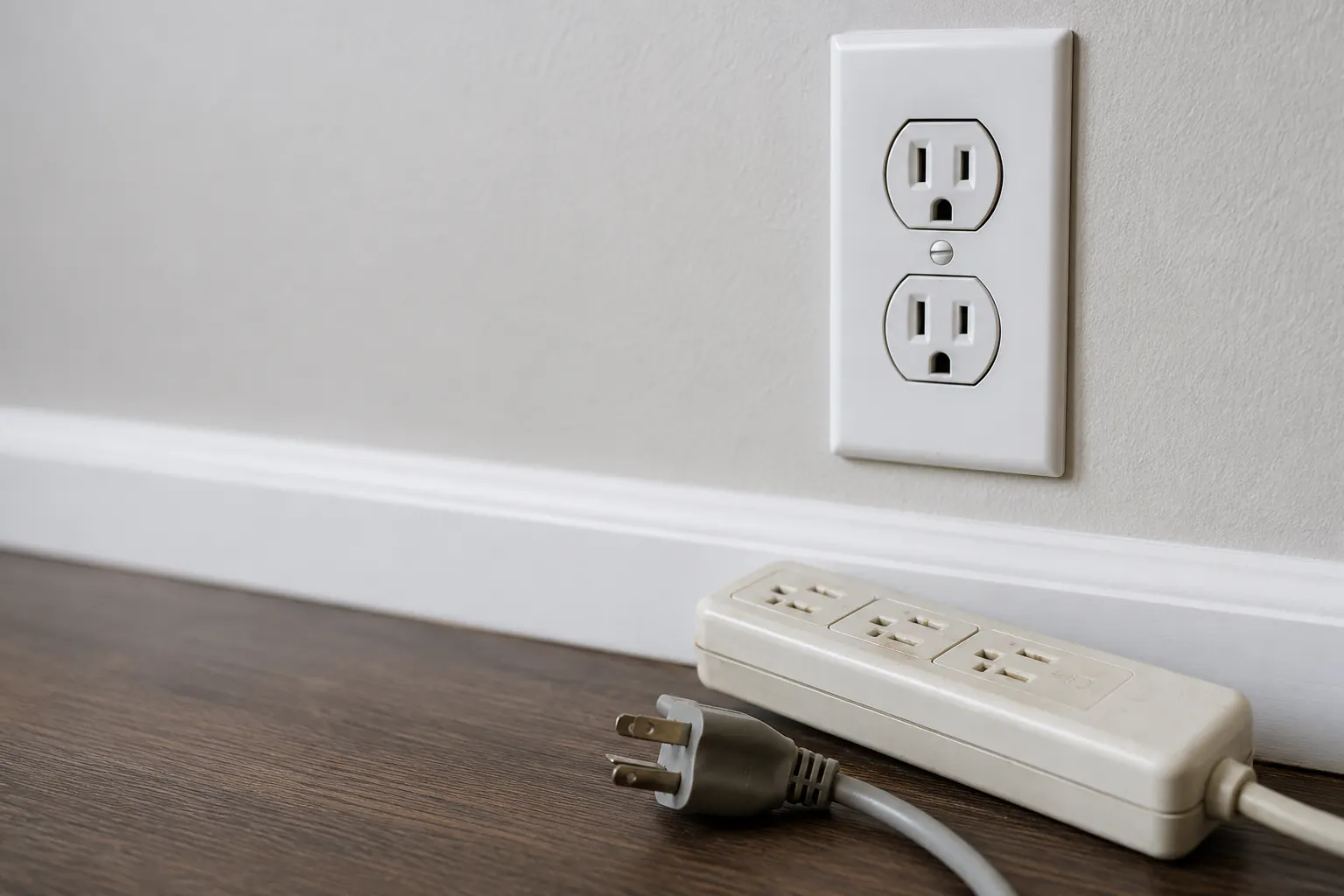
Inspect receptacle exteriors without inserting a tool
From a dry stable position, look for:
- cracked, chipped, loose, missing, or scorched faceplate;
- receptacle movement, gap, deformation, discoloration, or melted area;
- paint, debris, foreign object, corrosion, or moisture in slots;
- plug that previously fell out or would not insert fully;
- buzzing, odor, warmth, spark history, or repeated loss of power;
- missing weather cover or damaged exterior enclosure;
- nearby leak, condensation, pest, impact, or wall damage.
A questionable receptacle face is a visual finding, not a test opportunity. Mark the area off and call a licensed electrician or property manager; do not test-fit another plug, tighten or remove the plate, clean inside slots, or use a tester.
USFA advises replacing wall outlets when plugs do not fit snugly. That replacement is fixed electrical work for qualified service, not a cue to bend pins or squeeze slots.
Inspect plugs and pins
With the portable product safely disconnected and cool, look for:
- missing, loose, bent, pitted, corroded, blackened, or altered pins;
- a removed grounding pin or adapter used to defeat grounding;
- melting, cracks, deformation, odor, or discoloration at the plug body;
- loose cable entry or failed strain relief;
- exposed conductor or separation between cable and plug;
- residue, moisture, dirt, or metal debris.
Do not bend a pin back, sand corrosion, glue a plug, wrap the body, or install a replacement end unless performed through a manufacturer-approved qualified repair. Remove the item from service.
Never force a three-prong plug into a two-slot outlet. USFA explicitly warns against it.
Inspect cord jackets and strain points
Run a visual check along the entire visible cord without flexing damaged areas. Look for cuts, cracks, abrasions, brittleness, flattening, crushing, pinch marks, kinks, stretched sections, exposed material, tape, splices, burn marks, pet damage, and chemical attack.
Pay attention near plugs, connectors, appliance entries, door routes, wheels, furniture, heaters, and storage hooks. Internal conductors may be damaged even when the jacket has not opened.
OSHA requires damaged portable cords in workplaces to be removed from service until repaired and tested. At home, do not rely on tape or a cosmetic jacket patch. Follow manufacturer repair or replace the product.
Inspect power strips and surge protectors
Record the strip’s total rating, individual outlet limits if stated, overload protection, surge-protection indicator meaning, environment, cord length, and mounting instructions.
Stop use for:
- cracked, loose, scorched, melted, or discolored sockets;
- plug fit that is loose or incomplete;
- damaged switch, breaker, indicator, cord, or housing;
- abnormal sound, odor, heat, intermittent power, or prior trip;
- missing rating or unsupported mounting;
- a recalled model or expired service life under manufacturer instructions;
- evidence of daisy chaining, overload, moisture, crushing, or high-load appliance use.
Do not open a strip, replace an internal fuse, tape a switch, or assume a glowing light proves surge protection. Follow the exact indicator and replacement guidance.
Inspect chargers, adapters, and battery products
Use only manufacturer-approved combinations. Look for cracked housings, loose blades, damaged cables, discoloration, heat history, swelling, leakage, corrosion, odor, sound, or recall.
Do not use a charger simply because the connector fits. Voltage, current, communication, polarity, battery chemistry, and temperature controls matter.
For a swollen, hot, smoking, hissing, leaking, or damaged lithium-battery product, move away and follow emergency, CPSC, manufacturer, and local disposal guidance. Do not carry it through the home, puncture it, charge it, or put it in household trash.
Check the intended load and connection
An undamaged-looking strip can still be unsuitable. Verify whether the appliance requires direct wall connection, a dedicated circuit, grounding, GFCI, or a specific environment.
Do not connect heaters, air conditioners, refrigerators, freezers, cooking equipment, pumps, washers, dryers, or other major loads through strips or extension cords contrary to instructions. A strip does not increase circuit capacity.
Use the extension-cord guide for temporary outage routes.
Remove suspect equipment from service
When a portable item is safely disconnected, attach a clear “do not use” tag and secure it where nobody can reconnect it. Keep the model and photos for recall, warranty, insurer, or repair review.
Do not donate, sell, or leave damaged equipment in a free pile. Follow manufacturer, CPSC, battery, electronic-waste, and local disposal instructions.
For fixed equipment, do not tape over the outlet or block emergency access in a way that creates another hazard. Notify the property authority and arrange qualified isolation.
Keep consumer test tools in their lane
A receptacle tester, GFCI button, non-contact detector, electricity monitor, or thermal camera can provide limited information. It cannot replace qualified diagnosis or prove the absence of voltage, correct wiring, safe temperature, circuit capacity, or internal damage.
Do not energize damaged equipment to test it. Use the electrical tool comparison to understand limitations, not to authorize repair.
Create an annual inventory
Review high-use cords, strips, chargers, seasonal equipment, storm supplies, workshop tools, and stored backup-power accessories at least annually and after hard use, impact, water, overload, or outage.
Track status as ready, qualified review, recalled, or retire. Keep critical replacement equipment model-specific; avoid buying an anonymous universal substitute during an emergency.
Sources reviewed
- U.S. Consumer Product Safety Commission: Home Electrical Safety Checklist; Recalls
- U.S. Fire Administration: Appliance and Electrical Fire Safety
- OSHA: Use of Cord- and Plug-Connected Equipment
Sources reviewed July 14, 2026. Emergency services, manufacturer instructions, current recalls, certification directories, code, property authority, and licensed electrical or equipment service control actual use and repair.