
If a plug, outlet or panel smells burned, buzzes, sparks, shows abnormal heat, or repeatedly trips protection, do not recreate the problem to find its cause. Keep people away and follow the stop instructions below. Call 911 for fire, smoke, arcing, shock injury or immediate danger.
Overload is only one possible explanation. A loose connection, damaged receptacle, failing appliance, incorrect installation, deteriorated wiring, wet equipment, arcing fault or utility problem can produce similar symptoms. An electrician identifies the cause; you do not need a diagnosis before responding to a warning.
The safe response is to stop the condition without reproducing it, keep people away, document the pattern, and let a licensed electrician identify the cause. Do not use a breaker trip as permission to experiment. The wider household boundaries live in the basic electrical safety guide.
Call for immediate danger
Call 911 for fire, smoke, explosion, active arcing, shock injury, or an immediate threat. Move people out and use the household fire plan. Do not fight an electrical fire unless trained, the correct extinguisher is available, the fire is small and contained, and a clear exit remains behind you; evacuation comes first.
Stay away from:
- burning odor, smoke, sparks, popping, crackling, or visible arc;
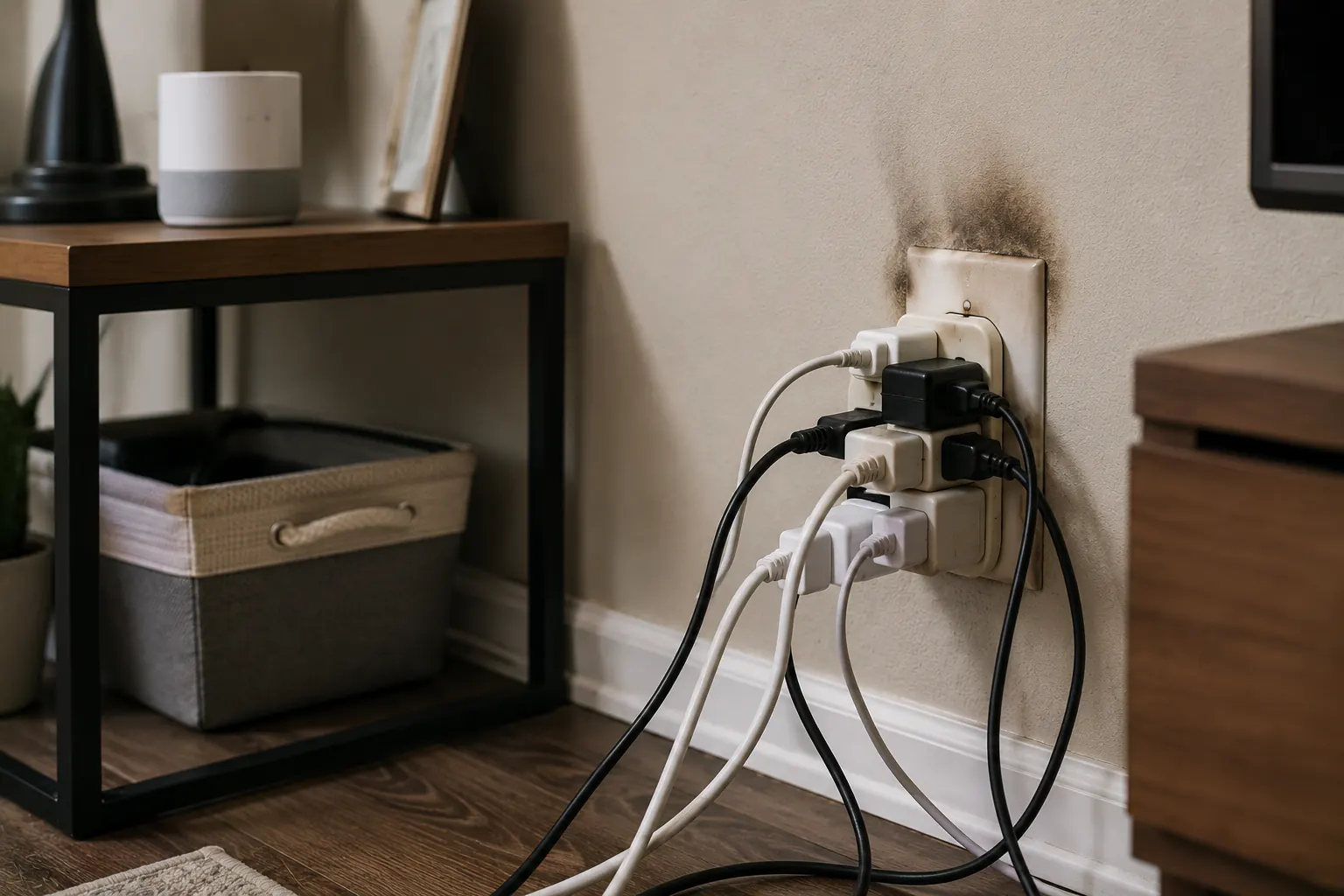
- a hot, melted, blackened, or deformed plug, receptacle, strip, cord, or panel;
- water touching electrical equipment or wet flooring around it;
- exposed metal or conductors, missing covers, or damaged service equipment;
- a person who is still in contact with an energized source.
Do not touch a shocked person until emergency responders confirm the source is controlled. Follow dispatch instructions.
Recognize warning patterns
Stop use and arrange qualified evaluation for:
- repeated breaker or fuse operation;
- lights dimming or flickering when another load starts;
- buzzing, sizzling, crackling, or popping from a plug, outlet, switch, strip, panel, or appliance;
- burning or hot-plastic odor;
- unusual warmth at a plug, receptacle face, switch, strip, cord, or wall;
- discoloration, soot, melting, brittleness, or a loose fit;
- a spark beyond the small normal event described by the exact manufacturer, or any recurring spark;
- tingling, shock, or sensation from an appliance or metal surface;
- damaged grounding pin, adapter, or evidence that a plug was forced;
- extension cord or power strip used for heaters, cooking equipment, air conditioning, refrigeration, laundry, or another high-load appliance contrary to instructions.
One symptom is enough to stop. Do not wait for several to appear.
Keep the observation visual
Observe a suspect wall, panel, outlet, plug, strip, or appliance from a normal distance. Do not use a hand to judge whether it is “too hot” or lean close to identify an odor; heat and arcing can worsen suddenly.
Observe from a safe distance. If a portable load can be switched off through its normal control without approaching the suspect connection, do so. Unplug it only when the plug, cord, outlet, floor, and route are cool, dry, intact, and free of warning signs. Otherwise leave it and call for help.
Do not use an infrared thermometer, non-contact detector, outlet tester, or thermal camera to authorize handling. Those tools have blind spots and require context; the tester comparison does not turn them into clearance devices.
Understand load without doing live measurement
Electrical load planning begins with nameplates and manuals, not probes. Record the stated input watts or amperes for portable appliances and whether the manufacturer requires a dedicated circuit or direct wall connection.
Several receptacles may share one branch circuit. The total connected and operating load matters, including equipment in another room. Startup currents and cycling can change the pattern.
The calculation identifies a problem; it never authorizes running at the maximum. Nameplate arithmetic cannot detect loose terminals, damaged wiring, incorrect breaker protection, voltage problems, or hidden fixed loads. Ask a licensed electrician to assess capacity and condition.
Treat high-load appliances conservatively
Portable heaters, air conditioners, cooking appliances, refrigerators, freezers, washers, dryers, pumps, dehumidifiers, and large chargers can place substantial or sustained load on a circuit. Their instructions may require direct connection or a dedicated circuit.
USFA advises plugging major appliances directly into a wall outlet and not using an extension cord. It also warns against outlet and power-strip overload. Do not move a tripping heater or appliance from one outlet to another to find a circuit that “holds.” That relocates the symptom without proving safety.
The space-heater safety guide requires direct suitable outlet connection and stop conditions. Cooling equipment has similar manual and circuit constraints.
Use a breaker trip as a stop boundary
A breaker that opens has interrupted a condition; it has not diagnosed or repaired it. Treat the open breaker as a boundary while you follow the breaker-panel guide.
Do not reset when there is heat, odor, sound, smoke, water, damage, exposed equipment, uncertain cause, critical-system risk, or a previous trip. Leave the circuit off and call an electrician.
When the manufacturer and property procedure allow a one-time reset after a clearly removed ordinary portable load, stop if it does not reset, immediately opens, or trips again. Never hold it on, tape it, bypass it, substitute a larger breaker or fuse, or open the panel.
Remove damaged plug-in equipment from service
Damaged equipment gets retired, not patched: no taped cord jackets, casually replaced plugs, bent-back prongs, tightened power strips, or opened appliances. Mark the equipment “do not use,” disconnect it only if safe, and store it where nobody can reconnect it.
Check CPSC recalls using the exact model and follow the remedy. Do not donate, sell, or place a recalled or damaged item back into household use.
For a hot, swollen, leaking, smoking, or noisy battery product, move away and follow fire-service, CPSC, manufacturer, and local disposal instructions — it stays where it is, out of the trash and out of a trip through the home.
Document the pattern for the electrician
Record without recreating the event:
- date, time, room, receptacle, and circuit label if verified;
- appliances operating and their nameplate inputs;
- whether the warning occurred at startup, continuously, or intermittently;
- light flicker, sound, odor, visible condition, and breaker behavior;
- outage, storm, heat, renovation, water, pest, or utility context;
- photos from a safe distance;
- previous trips, repairs, or similar reports.
Leave equipment off even for a video. A qualified electrician can decide what testing and inspection are needed.
Correct the system, not the inconvenience
The solution may involve load scheduling, a new receptacle or circuit, appliance repair, connection repair, protection changes, service work, or another finding. Those decisions depend on the installed system and current code.
No purchase fixes a branch circuit: a new power strip, heavier extension cord, surge protector, smart plug, or higher-rated portable power source cannot increase the building circuit’s safe capacity.
Emergency conditions can make the pattern worse. Several chargers, lights, heaters, cooking devices, pumps, or cooling appliances may be added to the same room during an outage or temperature emergency. Build an approved load plan before the event; urgency does not change the circuit, receptacle, cord, or appliance limits.
Apartment and renter response
Report heat, odor, flicker, trips, loose outlets, or damaged common-area equipment immediately through the emergency maintenance channel. Include unit, room, time, loads, and whether neighbors are affected.
Do not enter a locked electrical room, operate a shared panel, remove an outlet cover, or alter wiring. Keep written records and request the qualified finding. If the unit cannot safely support heat, cooling, medical equipment, refrigeration, or other essential needs, use the relocation and continuity plan.
Separately from any wiring fault, reducing how much a circuit is asked to carry is worthwhile. The home energy efficiency cluster shows how to measure loads and cut waste, which lowers everyday demand — though it never substitutes for a qualified electrical repair when warning signs appear.
Sources reviewed
- U.S. Consumer Product Safety Commission: Home Electrical Safety Checklist; Recalls
- U.S. Fire Administration: Appliance and Electrical Fire Safety
- NIOSH: Electrical Safety in the Workplace
Sources reviewed July 14, 2026. Emergency services, utility direction, equipment instructions, code, property authority, and licensed electrical diagnosis control actual action.