
Before switching on a portable heater, read the exact model’s instructions and check its condition, permitted location, connection, clearances, and supervision. If any requirement is unclear or cannot be maintained, do not use it; return to the household’s warmth and relocation plan.
The safe question is not simply “electric or propane?” It is whether the exact appliance is approved for that indoor location, supplied correctly, kept clear, supervised, and compatible with the household’s alarms and exit plan. A cold-season blackout adds the context these rules assume — alerts, travel limits, relocation triggers — all set in the winter storm preparedness plan.
No heater makes an unsafe building, blocked exit, failed medical plan, or severe outage safe to occupy indefinitely.
Stop before using any improvised heat
Never use these to heat an indoor living space:
- a kitchen oven or range;
- charcoal or any charcoal grill;
- a gas or charcoal barbecue;
- a camp stove;
- a patio heater;
- a vehicle running in a garage, carport, or near openings;
- a generator in a home, garage, basement, crawlspace, shed, porch, or carport;
- a homemade burner, open can, candle array, or flowerpot heater;
- any appliance whose instructions prohibit indoor or residential use.
Opening a window or garage door does not make an outdoor combustion appliance safe indoors. Carbon monoxide is colorless and odorless, can incapacitate people quickly, and cannot be managed by smell.
If a CO alarm sounds, get everyone and pets outside, call 911, and remain out until emergency authorities give clearance.
Identify the exact heater category
Portable electric resistance heater
This category converts electricity directly to heat and usually imposes a high continuous load. It does not produce CO at the point of use, but damaged cords, overloaded outlets, power strips, extension cords, combustible clearance, tip-over, and unattended operation create fire risk.
Vented fuel-burning heater
A permanently installed or specifically vented heater depends on a designed exhaust and combustion-air system. Snow, ice, damage, poor maintenance, or loss of powered controls can make the system unsafe. Do not bypass switches, draft controls, sensors, or vent requirements.
Portable fuel-burning heater labeled for indoor use
Some products are designed for limited indoor use under strict fuel, room, ventilation, clearance, and supervision requirements. Other visually similar products are not. The exact label and manual control the decision, along with local code, lease rules, fire restrictions, and professional advice.
An “indoor safe” marketing phrase is not enough. Verify the model’s listing, instructions, allowed fuel, prohibited rooms, minimum room size, ventilation, oxygen-depletion or tip-over features, maintenance, and storage rules. Working CO alarms remain essential but do not cancel any instruction.
Use an electric heater only on a suitable circuit
Before operation:
- Inspect the heater, plug, and full cord for cracks, cuts, looseness, discoloration, bent blades, repairs, or heat damage.
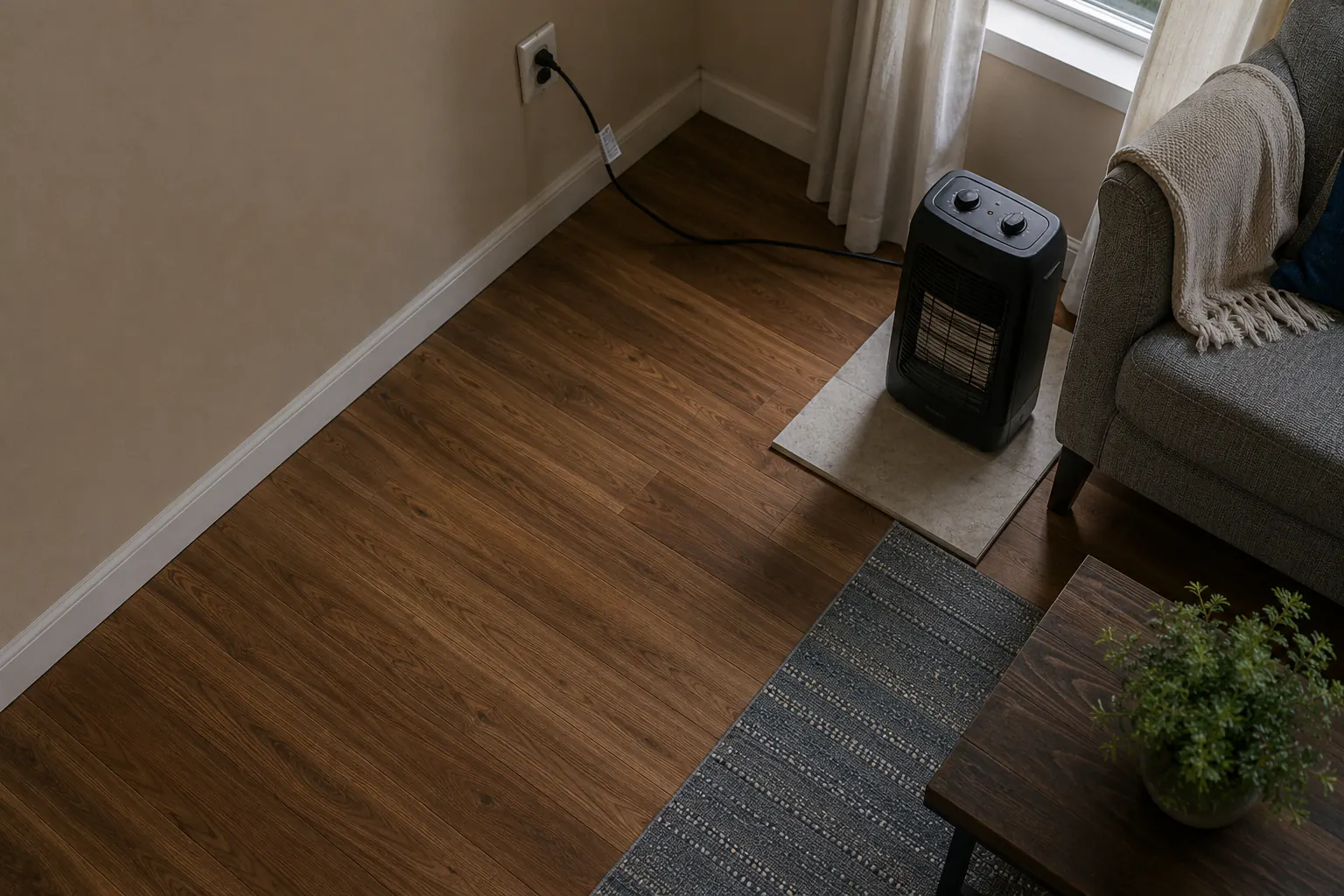
- Place the unit on a stable, level, non-combustible floor where it cannot be knocked over.
- Keep every side at least three feet from beds, blankets, curtains, clothing, paper, sofas, and other combustible material, following any greater manufacturer clearance.
- Keep children and pets outside the clearance zone.
- Plug the heater directly into a suitable wall outlet. Current CPSC and USFA guidance says not to use a power strip or extension cord.
- Do not place the cord under a rug, carpet, mat, furniture, doorway, or traffic path.
- Keep the heater dry and away from bathrooms or wet locations unless the exact unit and outlet arrangement are approved for that use.
- Preserve a clear exit route and access to the heater’s controls.
Stop if the plug or outlet becomes hot, there is discoloration or odor, lights flicker, a breaker trips, the fan sounds abnormal, the unit tips, or the cord is damaged. Do not move the heater to another outlet merely to defeat a repeated electrical warning. Have the appliance and circuit evaluated.
The circuit-overload warning guide explains why moving the heater does not diagnose the problem. Use the plug and outlet visual checklist before seasonal use; the inspection never includes opening or testing fixed wiring.
Never defeat a tip-over switch, thermostat, guard, grounding feature, or overheat protection.
Do not add an extension cord or power strip. The outage extension-cord guide preserves this direct-connection boundary for high-load equipment.
Keep active supervision
USFA advises turning space heaters off when leaving the room or going to bed. Treat “supervised” as an awake adult who can see or promptly reach the unit, recognizes alarms, and can turn it off without crossing a hazard.
Do not:
- dry clothing, gloves, boots, or blankets on the heater;
- aim it into bedding or furniture;
- cover it to distribute warmth;
- place it on a table, crate, bed, or unstable surface;
- let a child operate, refuel, or reposition it;
- leave it running for a sleeping person who cannot respond;
- use it in a crowded route where someone can fall onto it;
- combine it with candles or open flame in the same small room.
Plan sleep warmth with dry clothing, suitable bedding, a safe room-temperature strategy, and relocation rather than unattended portable heat.
Treat portable fuel as a separate high-risk system
Use only the fuel specified by the manufacturer. Never substitute, blend, or refill with the appliance operating or hot. Follow instructions for cooling, refueling location, approved containers, storage quantities, spill response, and separation from ignition sources.
Do not store gasoline in the home. Lease terms, fire codes, and local rules may prohibit fuels or fuel-burning portable heaters in apartments, attached buildings, shelters, or certain rooms.
Combustion equipment needs correct air and exhaust conditions. Do not improvise a ventilation calculation, duct, flue, hood, or window gap. A professional installation or a different shelter plan may be the only safe option.
Stop and leave for fresh air if a CO alarm sounds or people develop headache, dizziness, weakness, nausea, chest pain, confusion, or unusual sleepiness. Call 911. Do not assume symptoms are flu, fatigue, altitude, or “stale air” during combustion use.
Do not assume a battery can run the heater
A common portable electric heater can consume most of the output of a standard 120-volt household circuit. On a battery power station, the continuous draw can exhaust usable capacity rapidly.
Check all of the following before connection:
- heater rated input at the selected setting;
- power source continuous output and permitted appliance types;
- usable battery watt-hours after reserve and conversion loss;
- heater startup behavior and thermostat cycling;
- power-source operating-temperature range;
- outlet grounding and protection;
- manufacturer instructions for both products.
For a rough planning illustration, a 1,500-watt heater running continuously uses 1,500 watt-hours each hour before losses. That is an energy relationship, not a runtime promise. Real batteries reserve capacity, lose energy in conversion, and can perform differently in cold conditions.
Use the backup-power guide and runtime calculator for planning. Do not connect a heater through a light-duty cord, vehicle inverter, multi-outlet adapter, or undersized source.
Place alarms and preserve escape
Follow current codes and manufacturer instructions for smoke and CO alarm placement, testing, replacement, and battery backup. CPSC’s 2026 winter warning calls for working CO alarms on each level and outside separate sleeping areas, and smoke alarms on every level and inside each bedroom.
Do not move an alarm next to a heater to “test” the air, disable nuisance alarms, cover a detector, or use an alarm as a substitute for correct equipment.
Keep doors, windows required for emergency escape, halls, stairs, sprinklers, extinguishers, and building fire systems clear. A warm room that traps occupants is not a safe room.
Review the generator CO safety guide separately; portable generators create distinct placement, weather, fueling, and electrical hazards.
Decide when not to use the heater
Do not operate the heater when:
- the model, label, manual, or listing is missing or unclear;
- the cord, plug, outlet, guard, fuel system, or housing is damaged;
- the required clearance cannot be maintained;
- a responsible adult cannot supervise it;
- the household lacks working smoke or CO protection required for the setup;
- a child, pet, oxygen system, mobility aid, or crowded room makes contact likely;
- the circuit is shared with heavy loads or shows overheating or trips;
- fuel storage or ventilation would violate instructions or rules;
- water, condensation, flooding, or snow has affected the equipment;
- the heater blocks the only safe exit;
- anyone has possible CO symptoms or a detector alarmed.
Use the winter outage heat plan to conserve body heat and relocate before an unsafe device becomes the household’s only option.
Questions to settle before choosing a heater
This guide does not recommend or claim to have tested a heater. For an exact model, find documented answers to these questions:
- What listing, label, permitted setting, and instructions apply?
- What rated input and supply restrictions apply to each mode?
- What clearances, placement, and awake supervision does it require?
- How do its controls behave after power is interrupted?
- What maintenance, damage checks, and recall information apply?
- What limits apply to children, pets, medical equipment, moisture, and sleep?
- Do both manufacturers permit the proposed backup-power connection?
Missing documentation is a reason to pause, not to test a shutoff, heat a plug, or defeat a protection at home. A product choice still has to fit the person, room, and instructions above.
Sources reviewed
- U.S. Fire Administration: Heating Fire Safety
- U.S. Consumer Product Safety Commission: 2026 Winter Storm CO and Fire Warning
- U.S. Consumer Product Safety Commission: Winter Fire and CO Safety
- CDC: Safety Guidelines During and After a Winter Storm
- CDC: Carbon Monoxide Poisoning Basics
Sources reviewed July 14, 2026. A damaged appliance, an alarm, abnormal heat, odor, sound, repeated electrical trip, uncertain fuel or ventilation condition, or changing household need is a stop signal, not a reason to improvise around the equipment.