
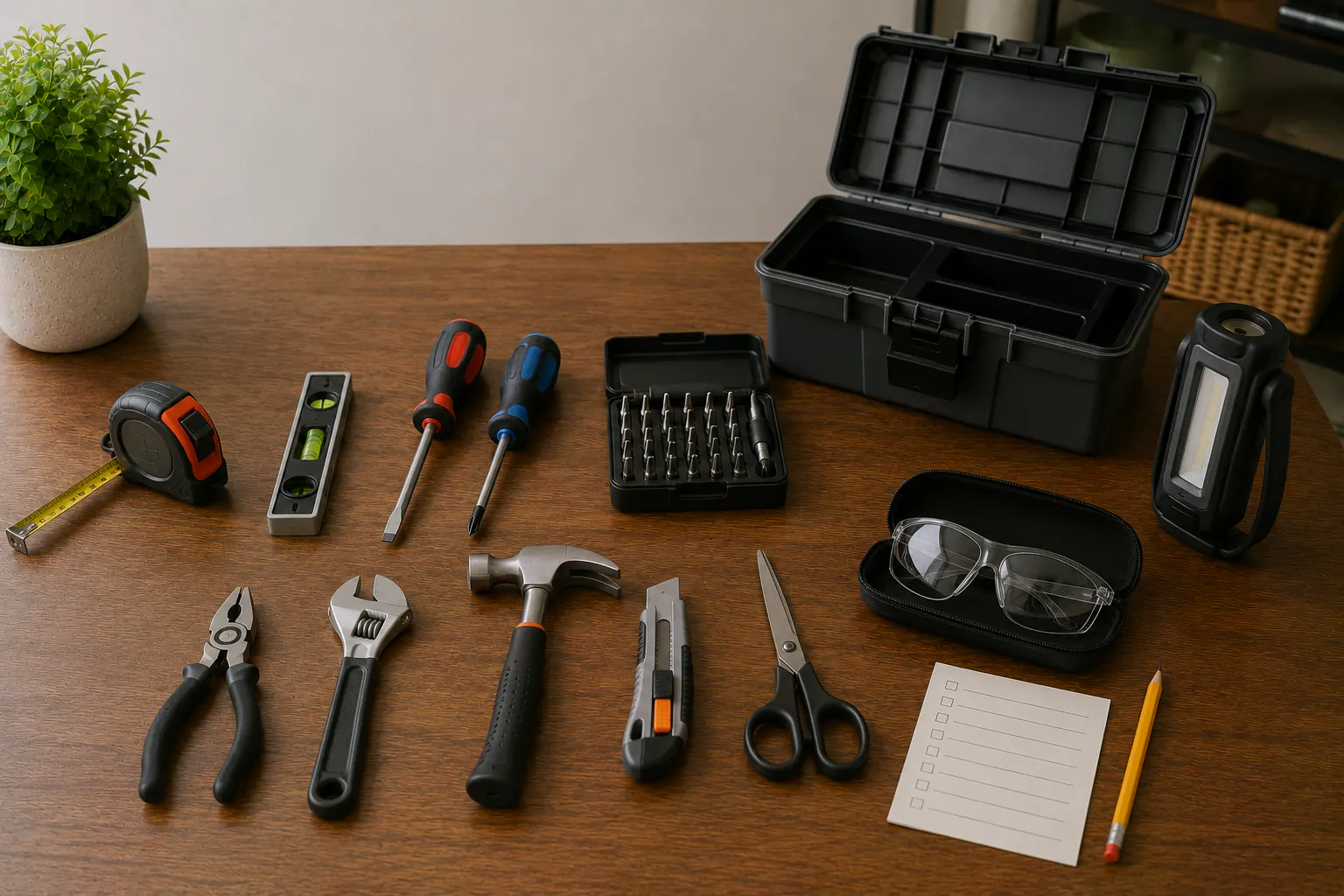
Start with one ordinary job you are allowed to do, such as measuring a shelf or assembling your own furniture. Find the tools you already have for that job before making a shopping list. A useful toolkit does not need to be a large set; it needs to match the task, the person using it, and a secure storage space.
My practical background includes renovating my apartment, my wife’s professional office, and my parents’ home, along with hands-on locksmithing work. This guide helps you choose a manageable household kit, not qualify for trade work. Owning a tool does not make every repair appropriate.
Choose the guide that matches the decision
| Need | Start here |
|---|---|
| Build a first toolkit without buying duplicates | Practical starter toolkit for new homeowners |
| Fit useful tools into limited renter storage | Compact apartment toolkit in one box |
| Prepare for inspection and minor work around storms | Tools for storm and blackout readiness |
| Decide whether a multi-tool can replace a dedicated tool | Multi-tools versus dedicated hand tools |
| Prevent rust, looseness, dull damage, and unsafe reuse | Clean, inspect, and maintain hand tools |
| Store tools around children, moisture, vehicles, and exits | Safe tool storage at home |
| Run a repeatable annual condition check | Annual home toolkit inspection |
| Compare hand-tool categories using evidence | Essential hand tools comparison |
If the problem is dangerous now
Do not reach for a toolbox first when there is:
- fire, smoke, gas odor, carbon monoxide alarm, or active sparking;
- a live conductor, wet electrical equipment, damaged service, or unknown breaker-panel condition;
- uncontrolled water near electricity, a bulging ceiling, sewage, or structural movement;
- broken unstable glass, a damaged exterior opening, or evidence of a break-in;
- a downed line, unstable tree, flooded space, or storm debris under tension;
- suspected asbestos, lead dust, chemical contamination, or hidden utility;
- a task requiring roof access, unsafe ladder use, confined-space entry, hot work, refrigerant, combustion service, or energized diagnosis.
Move to safety, call the responsible emergency or utility service, and follow official direction. A wrench in an emergency kit does not authorize turning an unidentified valve. A voltage detector does not qualify a homeowner to work energized. A drill does not make damaged framing safe.
Build by function, not by aisle
Organize the kit around nine household functions:
| Function | Basic capability | Typical limit |
|---|---|---|
| Observe | bright task light, mirror, camera, notebook | no destructive opening or hidden-hazard diagnosis |
| Measure | tape, level, ruler, simple gauge | measurement does not prove structure or code compliance |
| Mark | pencil, removable tape, labels | protect finished surfaces and private data |
| Fasten | correctly sized drivers, hex keys, small wrench set | stop before stripping, splitting, or modifying rated assemblies |
| Grip | adjustable pliers and appropriate general pliers | never substitute for insulated electrical or specialty work |
| Cut | controlled utility knife and scissors | no body-facing cuts, hidden services, or unsupported material |
| Shut off | only the documented household key or wrench | identify, label, and practice only under authorized safe conditions |
| Protect | task-specific eye, hearing, hand, dust, and floor protection | PPE does not make an unsafe task safe |
| Document | manual, receipt, model, photo, work log | no credentials, key codes, or vulnerable-home details in shared files |
Buy only after defining the task. “Pliers” is not one universal function, and “screwdriver” does not mean one bit fits every fastener. A poorly fitting tool rounds hardware and encourages excess force.
Separate core tools from project modules
The core box should cover normal inspection, measurement, assembly, hanging light items under correct instructions, basic hardware adjustment, and documented shutoff access. Keep project modules outside the core:
- plumbing observation and approved shutoff module;
- weatherproofing and temporary sealing module;
- bicycle or vehicle-specific module;
- painting and surface-preparation module;
- battery and charging module;
- manufacturer-specific furniture or appliance tools;
- trade tools used only by a trained person.
This prevents the everyday box from becoming heavy, disorganized, or full of sharp and chemical items. It also keeps dangerous specialty tools from being treated as general household equipment.
Fit the tool to the person
Tool selection should account for grip strength, reach, vision, dominant hand, tremor, fatigue, arthritis, and experience. A longer handle may add leverage but also increases the force that can damage a fastener or injure the user. A compact handle may fit a drawer but demand more grip. High-contrast markings, readable sizes, organized slots, and a stable work light can matter more than a larger set.
Check that every intended user can:
- identify the exact tool without sorting through exposed blades;
- hold and control it under the expected force;
- see the work without placing a hand behind the material;
- release or stop the tool immediately;
- return it to secure storage;
- state the stop condition for the task.
Children may learn tool skills only through age-appropriate direct supervision. Storage must assume curiosity and access attempts, not perfect compliance.
Before adding a tool
Before a tool enters the kit, answer:
- Which recurring task requires it?
- Is that task authorized for this resident, lease, building, and skill level?
- Does the exact tool match the fastener, material, force, voltage, or other relevant rating?
- Can it be stored dry, secured, and visible enough to inspect?
- Are instructions, replacement parts, and current recall information available?
- Does it duplicate a tool that already performs the task safely?
- Can the household maintain, sharpen, calibrate, charge, or retire it correctly?
- What PPE and workspace does its actual use require?
- What condition makes the tool unusable?
ASME’s B107 program covers performance and safety requirements for categories of hand tools. That is useful evidence at the category and manufacturer level, but a standard name is not proof that an exact marketplace listing conforms. Verify the model and its documentation.
Treat power tools as a separate controlled layer
The essential core can be built largely from hand tools. A cordless drill/driver may be useful for experienced residents, but it introduces batteries, chargers, rotating parts, torque, bits, noise, debris, hidden utilities, and child-access risks.
CPSC advises reading and following the owner’s manual and using appropriate eye protection. OSHA and NIOSH references emphasize safe condition and guards. For household planning:
- keep guards, handles, and safety controls present and functional;
- remove the battery or unplug before inspection, accessory change, clearing, or storage as the manual directs;
- use only compatible manufacturer-approved batteries and chargers;
- stop for swelling, heat, odor, cracks, liquid, corrosion, damaged cord, abnormal sound, or repeated protection shutdown;
- never defeat a switch, guard, interlock, or trigger;
- keep loose clothing, hair, jewelry, cords, children, pets, and bystanders away;
- use the correct bit or accessory and documented speed/application;
- do not use wet tools or operate where gas or flammable vapor may be present.
This hub does not teach cutting, grinding, drilling, or electrical work. Those tasks require their own reviewed procedure and competence.
Keep the kit storm-ready without doing storm repair
Before severe weather, the toolkit supports inspection, documentation, bringing loose items inside, normal hardware checks, assembling manufacturer-approved supplies, and locating shutoffs. During active wind, lightning, flooding, fire, extreme cold, or unsafe darkness, outdoor and elevated work stops.
After an event, wait for official clearance and assess from a safe location. Do not cut loaded branches, enter a damaged structure, climb onto a roof, open wet electrical equipment, move downed lines, disturb unknown debris, or improvise structural bracing. The storm and blackout tool guide distinguishes preparation from hazardous response.
Inspect the kit every year and after hard use
Quarantine a tool that is cracked, bent, mushroomed, loose, corroded at a critical surface, missing a guard, damaged at the cord or battery, or no longer holds the intended part securely. Do not tape over structural damage or grind away a defect without manufacturer authorization.
Check exact model and date information in the CPSC recall database. Follow recall instructions; do not sell, donate, or keep a recalled item in circulation when the remedy says stop use.
Use the annual inspection checklist and record condition, action, owner, and date. EPA guidance controls household battery recycling and notes that lithium-ion batteries should not enter household trash or curbside recycling.
Sources reviewed
- U.S. Consumer Product Safety Commission: Home Power Tool Safety; Recalls and Product Safety Warnings
- OSHA: Hand and Power Tools
- NIOSH: Portable Hand and Power Tools Self-Inspection Checklist
- ASME: B107 Hand Tools and Accessories
- U.S. EPA: Used Household Batteries
Sources reviewed July 14, 2026. Current manufacturer instructions, recalls, product certification, lease/building authority, code, utility direction, and qualified trade guidance control actual tool selection and use.
Klein’s 32500 datasheet and the exact Amazon variant were checked October 12, 2026 for identity, tip sizes and the explicit non-insulated limit. Manufacturer warnings require approved eye protection and prohibit prying or chiseling. No tool was acquired or tested, and no ASME conformity, recall clearance, measured control or rated-work approval is established. The listing carries a California chemical-exposure warning; check its current safety information and the received product’s instructions.