
Start with one storage spot: can an authorized adult reach the tools without moving a heavy box over someone, blocking an exit, or giving a child access? Keep sharp items contained and secured, with heavy tools low and stable. Check battery and chemical storage separately under their own instructions.
The storage plan should control access, weight, moisture, temperature, fire, inventory, and retrieval at the same time. It should also work when the lights are out and the person who usually manages the tools is away.
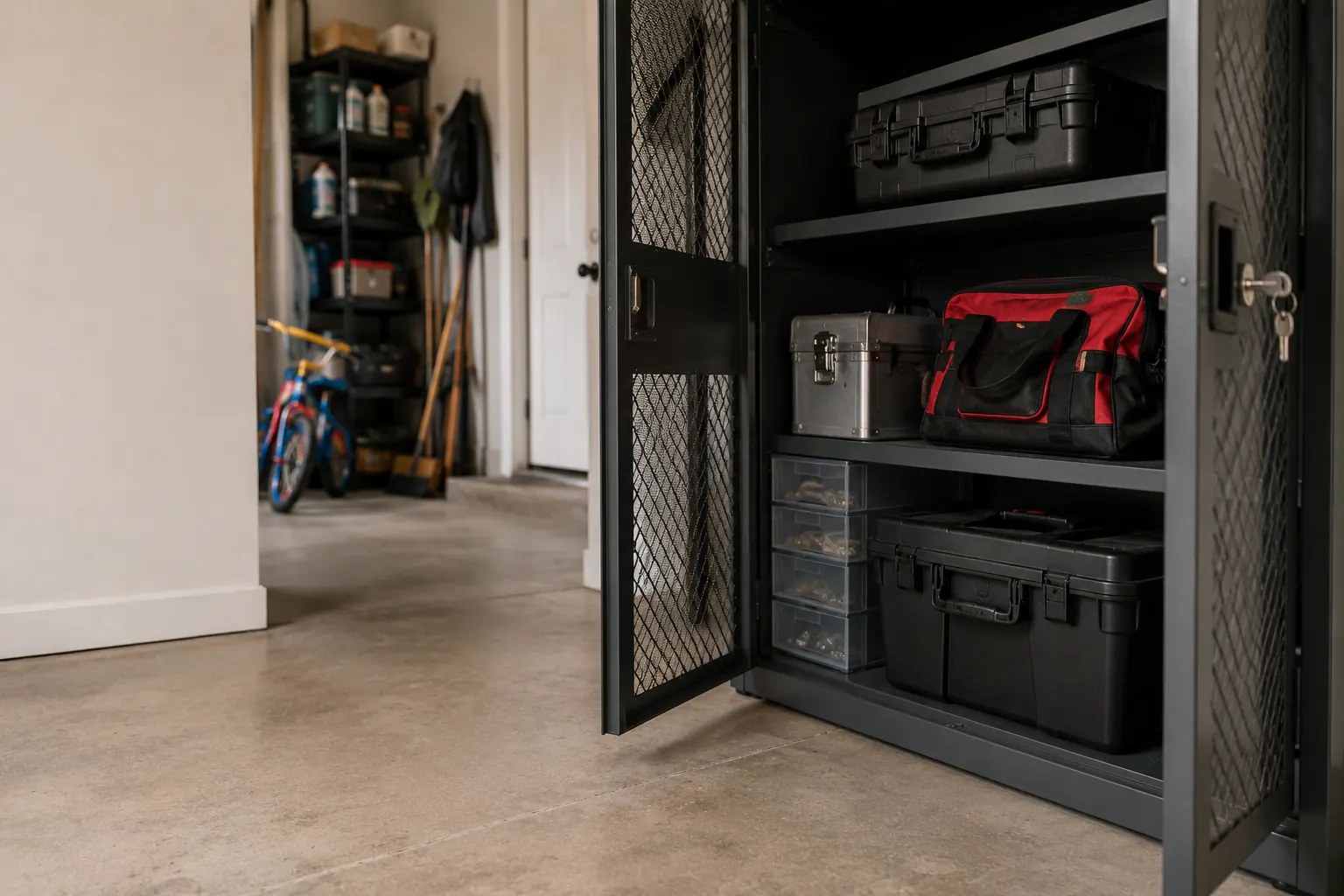
Start with the people and space
Consider the people who use or can reach the space. You do not need to collect names, health information, or a household profile to make the storage safer:
- children by age, reach, climbing ability, and supervision pattern;
- adults with visual, grip, mobility, memory, or cognitive needs;
- pets that chew, climb, knock over, or access cabinets;
- roommates, guests, caregivers, cleaners, contractors, and maintenance staff;
- emergency tools that an authorized adult must reach quickly;
- domestic-abuse, stalking, self-harm, or coercive-control risks requiring individualized secure storage;
- lease, association, fire, and building restrictions;
- moisture, heat, cold, salt, pests, dust, and flood exposure.
CPSC notes that safety latches can reduce child access to knives and sharp objects but that no device is completely childproof. Storage should combine a reliable lock or latch, appropriate placement, direct supervision, and immediate return after use.
Divide tools into storage classes
| Class | Examples | Minimum control |
|---|---|---|
| emergency access | task light, approved shutoff key, contact card | known, reachable to authorized adult, not buried |
| ordinary hand tools | drivers, tape, level, pliers | dry organized box or cabinet |
| sharp and pointed | knife, blades, scissors, awl | locked compartment; edge covered |
| heavy and striking | hammer, wrench set, pry tool | low stable storage; no overhead fall path |
| powered | drill, saw, charger | disabled for storage as manual directs; secured |
| batteries | removable packs and cells | manufacturer temperature/separation; terminal protection |
| precision | torque, meter, calibrated or optical tools | protected case and environment |
| chemical-adjacent | oils, adhesives, solvents, cleaners | outside tool box in original labeled storage |
| contaminated or damaged | flooded, recalled, cracked, suspect | quarantine away from ready tools |
Do not mix the quarantine zone with usable inventory. Mark suspect items clearly without relying on memory.
Apartment storage
In limited space:
- choose one liftable rigid box with organized compartments;
- secure the box inside a cabinet rather than leaving it under a bed or on the floor;
- keep it out of exits, hallways, stairs, electrical-panel clearance, and heater zones;
- avoid storage above a bed, desk, changing area, or frequently occupied chair;
- use low stable shelves for dense tools;
- protect walls and floors from sharp edges and rust transfer;
- keep batteries away from direct sun, radiators, and unconditioned balconies;
- do not drill storage anchors into unknown walls without authorization and hidden-service review;
- maintain building access for fire, utility, and inspection equipment.
The one-box apartment toolkit includes a weight and slot plan. A wall-mounted board can save space but may expose tools to children, guests, moisture, and public view; open display is not automatically safer.
Garage and basement storage
Garages and basements often have temperature swings, condensation, dust, pests, vehicle exhaust, fuels, chemicals, and flood risk. Evaluate the exact environment rather than assuming it is a workshop.
- Keep tools off floors that may flood, but do not create heavy overhead storage.
- Use cabinets and shelving rated and installed for the actual load and wall construction.
- Keep tools away from water heaters, furnaces, panels, combustion air, vents, and ignition sources.
- Separate batteries and chargers from fuels, paint, solvents, pesticides, and direct vehicle impact.
- Protect precision tools from condensation and corrosive vapors.
- Maintain clear paths around vehicles and exits.
- Do not run engines for heat or charge tools in a closed garage.
- Inspect after seasonal temperature change, leak, pest activity, or storm.
If shelving moves, bows, pulls from the wall, or has unknown load capacity, keep people away and obtain qualified help before approaching or unloading it. Do not stand beneath or climb unstable storage to remove a heavy case.
Homes with children
Use layered controls:
- Keep tools under an adult’s active control during use.
- Return each tool before moving to another task.
- Lock sharp, cutting, powered, and hazardous items.
- Store small bits, blades, fasteners, and batteries as ingestion and puncture hazards.
- Keep keys or combinations controlled but available to the appropriate adult.
- Reengage latches every time and periodically test normal operation.
- Do not rely only on height; children climb and heavy objects fall.
- Keep the work zone physically separate during supervised use.
- Teach age-appropriate names and boundaries without treating education as access control.
- Count tools and blades before reopening the area.
Do not leave a battery installed in a trigger tool if the manual directs removal for storage. Use trigger locks or transport modes only as documented; never defeat a guard or safety feature to fit a case.
Store blades, bits, and fasteners visibly
Loose small items create cuts, punctures, ingestion hazards, tire damage, and inventory gaps.
- Keep new utility blades in their original or rigid dispenser.
- Put used blades in an approved rigid sharps-style container according to local rules; do not mix them loose with medical sharps.
- Cover saw and cutting edges with the designed guard or sheath.
- Keep bits in labeled indexed holders.
- Sort fasteners by known type and size; discard unidentified critical hardware.
- Store nails and screws in closed bins that cannot spill.
- Count specialty or security-related fasteners without recording sensitive access details publicly.
A magnet can help collect ordinary ferrous fasteners on a clean floor but may affect electronics, magnetic media, medical devices, and sharp handling. Use it only where compatible.
Keep the labeled bags or divided box you already use for known furniture screws and washers. If those groups keep mixing, one Plano 2360001 Classic 3600 divider organizer is a format to compare inside independently secured adult storage. Its adjustable compartments separate parts; they do not control who can reach them. Check the actual footprint, contents and closure, and retain the original part labels. Do not use it as blade, battery, chemical or contaminated-item containment. It is not locked, childproof, waterproof or antistatic. (Source: Plano, StowAway Classic 3600.)
Compare the Plano 2360001 organizer on Amazon(opens in a new tab)Store batteries and chargers separately
Follow exact manufacturer instructions for state of charge, temperature, humidity, pack removal, charger use, and long-term storage. General household controls include:
- use only compatible listed or manufacturer-approved chargers;
- charge on the documented noncombustible, ventilated surface while attended;
- unplug after charging when instructed;
- protect exposed terminals from metal contact;
- avoid loose batteries with screws, keys, coins, or steel tools;
- stop using swollen, cracked, hot, wet, odorous, leaking, or recalled packs;
- keep packs out of extreme vehicle, attic, shed, and garage temperatures;
- retain exact model and date codes for recall checks.
EPA says lithium-ion batteries should not enter household garbage or curbside recycling. Tape terminals or use separate bags for end-of-life batteries as EPA and local instructions specify, but do not handle a damaged or recalled pack beyond its special guidance.
Keep chemicals out of the tool cabinet
Oils, solvents, adhesives, paints, cleaners, fuels, and pesticides need original labels, compatible separation, ventilation, temperature control, and child protection. A leaking bottle can contaminate grips, PPE, batteries, and absorbent cases.
Do not transfer a chemical into a food or drink container. Do not use an unlabeled jar for “tool oil.” Do not store oily rags in the box. Follow product fire and disposal directions and the cleaning chemical warning.
Preserve emergency access and egress
Storage must not block:
- primary or alternate exit;
- fire door, stair, hallway, or window assigned to escape;
- smoke or CO alarm access;
- extinguisher or fire department connection;
- water, gas, electrical, sprinkler, telecom, or building service access;
- mobility device charging or transfer space;
- safe reach to a task light and contact card.
The fire-egress security warning applies to locks and storage alike. A secured cabinet should still permit the authorized adult to retrieve emergency items without searching in darkness.
Keep track of missing tools when useful
A private note about a borrowed, missing, or damaged tool may be enough; a full inventory or sign-out system is optional. Do not list security weaknesses, key codes, or exact hidden locations in a shared spreadsheet.
After every project:
- count tools, blades, bits, and batteries;
- quarantine damage or contamination;
- clean and dry under the hand-tool maintenance guide;
- return each item to its slot;
- reengage locks;
- clear floors and exits;
- update the inventory.
Use the annual toolkit inspection and essential toolkit hub to keep storage connected to readiness rather than accumulation.
Sources reviewed
- U.S. Consumer Product Safety Commission: Childproofing Your Home; Recalls
- U.S. EPA: Used Household Batteries
- OSHA: Hand and Power Tools
Sources reviewed July 14, 2026. Current manufacturer, child-safety, battery, fire, building, lease, and local disposal requirements control actual storage.