
The safest household rule is simple: use one cleaning product at a time, exactly as its label directs, and never add bleach or another disinfectant to any other cleaner or chemical.
Bleach mixed with ammonia or acids can release dangerous gases. Other cleaner combinations can create heat, splashing, pressure, toxic vapor, or an ineffective mixture. An outage or disaster increases the risk because labels may be hard to read, ventilation may be poor, water may be limited, and people may try to make a stronger product. This warning sits inside the wider emergency sanitation and hygiene plan for when water and drains fail.
This warning intentionally does not provide mixing recipes, neutralization steps, or at-home gas identification.
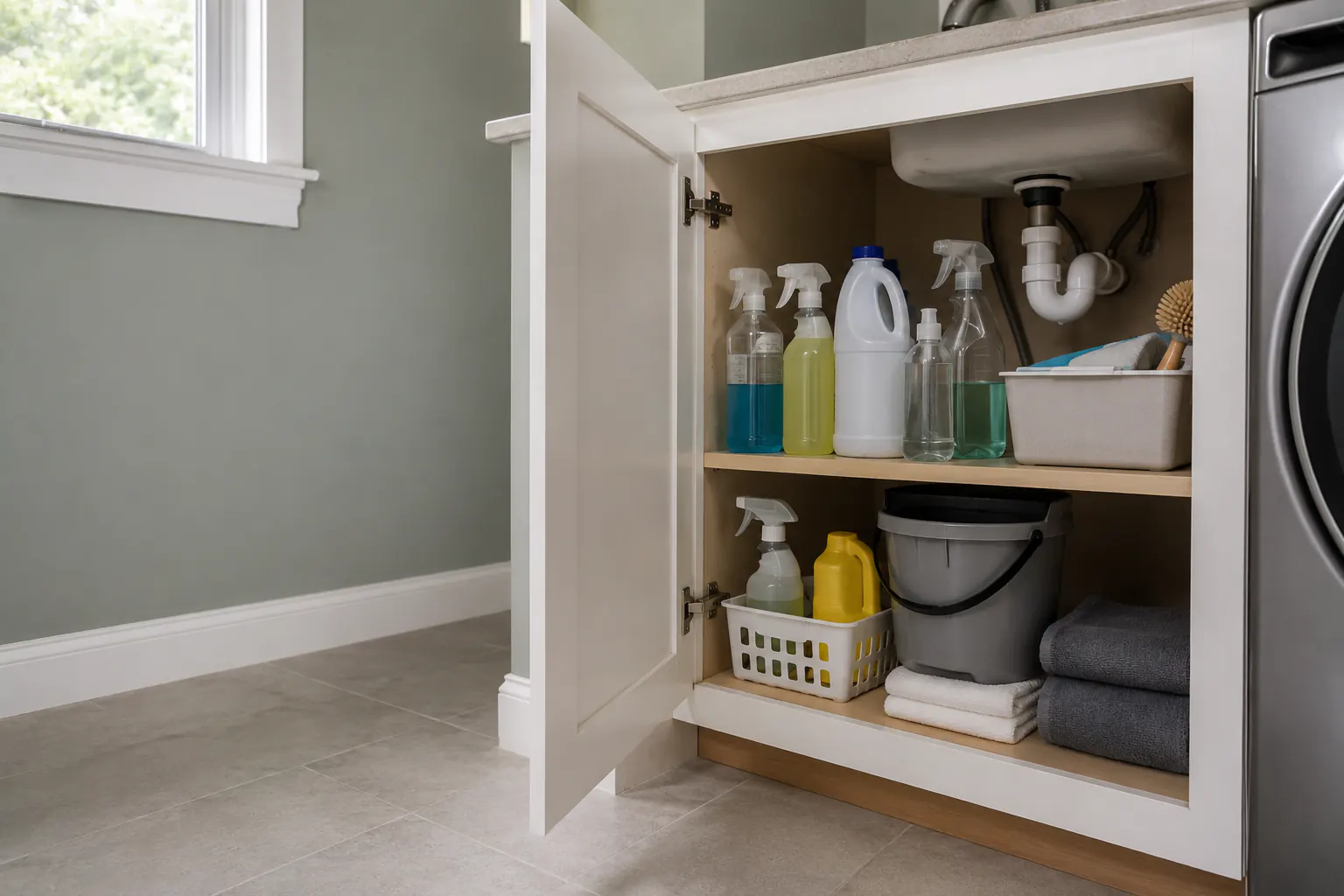
If cleaners may already have mixed
- Stop adding products immediately.
- Do not lean over the container, smell it closely, stir it, cover it, or carry it through the home.
- Move people and pets away toward fresh air without crossing the release.
- Leave the building for an indoor release when that is the safe route.
- Call 911 for breathing difficulty, chest pain, choking, severe coughing, confusion, fainting, collapse, severe eye symptoms, or another immediate threat.
- In the United States call Poison Control at 1-800-222-1222 for case-specific instructions.
- Follow fire department, public-health, poison-center, and building directions before re-entry.
Do not attempt to neutralize the mixture with another chemical or dilute it by carrying it to a sink. Do not run a household fan through the contaminated area. Ventilation decisions depend on the release, weather, outdoor air, HVAC, and ability to act without exposure.
Never combine bleach with another cleaner
CDC and EPA advise never mixing household bleach or disinfectants with other cleaners or disinfectants. That includes products whose ingredients are not obvious from the front label.
Keep bleach separate from:
- ammonia and ammonia-containing glass or multipurpose cleaners;
- acids, including many toilet-bowl, lime, rust, and mineral removers;
- vinegar and acid-based DIY cleaners;
- drain opener and clog-removal chemicals;
- another disinfectant or sanitizer;
- hydrogen-peroxide products;
- alcohol products;
- pesticides, solvents, fuel, and pool chemicals;
- unknown residues in a bucket, spray bottle, toilet, drain, or floodwater.
This is not a complete reaction table. The practical rule remains one product, one original label, one intended surface, one use sequence.
Do not combine cleaners with each other
Products without bleach can still be incompatible. Never mix:
- two drain openers;
- a drain opener with another cleaner;
- toilet cleaner with another product;
- two disinfectants;
- a commercial product with a homemade mixture;
- chemicals from damaged or unlabeled containers;
- a cleaner with hot water unless the label directs the exact temperature;
- concentrated products in a shared bottle or bucket.
Do not assume a product is mild because it is marketed as natural, green, scented, oxygen-based, or multi-purpose. Read active ingredients, precautionary statements, first aid, ventilation, surfaces, dilution, storage, and disposal.
Clean before deciding whether to disinfect
Cleaning with soap or detergent, water, and physical action removes soil and many germs. CDC states that cleaning alone is sufficient in many ordinary household situations. Disinfection is more likely to be relevant when someone is ill or when an authoritative procedure calls for it.
Disinfectant products regulated by EPA have label directions for:
- organisms or claims reviewed;
- surfaces and use sites;
- pre-cleaning;
- dilution when required;
- application method;
- contact time while the surface stays visibly wet;
- ventilation and protective equipment;
- rinsing for food-contact surfaces when required;
- storage and disposal.
Adding another chemical does not improve that label. It can make the product hazardous or ineffective.
Read the full label before opening the product
Check:
- Is the container original, intact, and clearly labeled?
- Is the product intended for this task and surface?
- Does it require pre-cleaning?
- Is it ready to use or a concentrate?
- What ventilation and protective equipment are specified?
- What contact time must be maintained?
- Is a food-contact rinse required?
- How must leftover product and the container be stored or disposed of?
If the label is missing, unreadable, or inconsistent with the contents, do not use the product. Contact the local household hazardous-waste authority.
Do not copy a dilution from an old article onto a product with a different concentration or formulation. Splashless, scented, color-safe, pool, industrial, and other chlorine products are not interchangeable with regular household bleach.
Never decant cleaners into food or drink containers
Keep products in original containers with labels and child-resistant closures. Do not use a water bottle, soda bottle, food jar, cup, or unlabeled travel sprayer.
An emergency kit should not contain mystery liquids. If a smaller approved work container is explicitly allowed by the product and workplace or household procedure, it still needs compatible material, complete identification, and controlled use; do not invent that system from this page.
Store products upright, closed, protected from damage, and separated as the label requires. Keep them away from children, pets, food, medication, heat, flame, batteries, and direct sun.
Be careful around toilets, drains, and flood residue
A toilet or drain may already contain cleaner, drain product, wastewater gas, sewage, or an unknown chemical. Do not add bleach or another product to “sanitize” a backed-up fixture.
Floodwater may bring fuel, pesticides, cleaners, sewage, and industrial chemicals into a building. EPA advises against mixing bleach with chemicals brought in by floodwater. Unknown contamination belongs to qualified assessment, not a stronger household mixture.
Use the sewage backup warning and flooded-home cleanup guide before any product decision in those conditions.
Ventilation is not permission to mix
Opening windows and doors can reduce exposure during label-directed use when outdoor conditions and building safety allow. It cannot make an incompatible mixture safe.
Do not ventilate by:
- entering a contaminated room;
- turning on HVAC that spreads vapor through the building;
- using a fan that blows toward occupied rooms;
- opening a window into wildfire smoke, extreme heat, severe cold, or another outdoor hazard without weighing the tradeoff;
- creating an ignition risk around a flammable product.
Follow emergency services or Poison Control after a release.
Protect people with higher exposure risk
Children, older adults, people with asthma or other lung disease, people with limited mobility or cognition, pregnant people, pets, and anyone unable to leave independently may need a more protective plan.
Do not assign chemical work to a person who cannot read the label, use required PPE, ventilate safely, or recognize symptoms. Keep children and pets out of the work area for the period specified by the label and care guidance.
Never apply household disinfectant to skin, wounds, food, drinking water, animals, or medical equipment unless the exact product label and authoritative instructions approve that use.
Avoid unsafe cleanup myths
- More concentrate is not automatically more effective.
- Two disinfectants are not twice as protective.
- A strong odor does not prove a surface is disinfected.
- No odor does not prove the air is safe.
- Hot water does not universally activate a cleaner and may increase vapor or splash risk.
- Gloves do not protect lungs or eyes and can spread contamination.
- A mask selected for dust does not make chemical vapor safe.
- A DIY neutralizer can create another reaction.
- An online bleach recipe does not override the current product label.
Build a one-product-at-a-time routine
- Define whether the task needs cleaning, sanitizing, or disinfecting.
- Remove people, pets, food, and unrelated products from the area.
- Read the full label in good light.
- Put away every other cleaner.
- Use only the directed amount and method.
- Maintain contact time and ventilation exactly as required.
- Complete any rinse and drying step.
- Close and return the product to approved storage.
- Wash hands after glove removal.
- Record the use if the household is operating an extended sanitation plan.
The compact apartment sanitation kit deliberately limits the chemical module so users can identify every product.
Know exposure symptoms and escalation
Chemical exposure can irritate or burn eyes, skin, nose, throat, and lungs. Symptoms can include coughing, burning, chest tightness, nausea, dizziness, headache, tearing, or breathing difficulty. Some effects can worsen after leaving the area.
Move away and get expert guidance. Do not induce vomiting, apply a neutralizer, or follow a generic first-aid step without knowing the product and exposure route. Have the original label available only if it can be obtained without re-entry or contact.
Call 911 for severe symptoms. Contact Poison Control at 1-800-222-1222 in the United States for case-specific advice. Follow clinician guidance for ongoing symptoms.
Sources reviewed
- EPA: Biological Contaminants and Indoor Air Quality; Registered Disinfectants; Flood Cleanup
- CDC: Cleaning and Disinfecting With Bleach; Disaster Cleaning; 2026 Ammonia Chemical Fact Sheet
Sources reviewed July 14, 2026. Product labels, Poison Control, emergency services, public-health instructions, and qualified hazardous-material response control actual exposure decisions.