
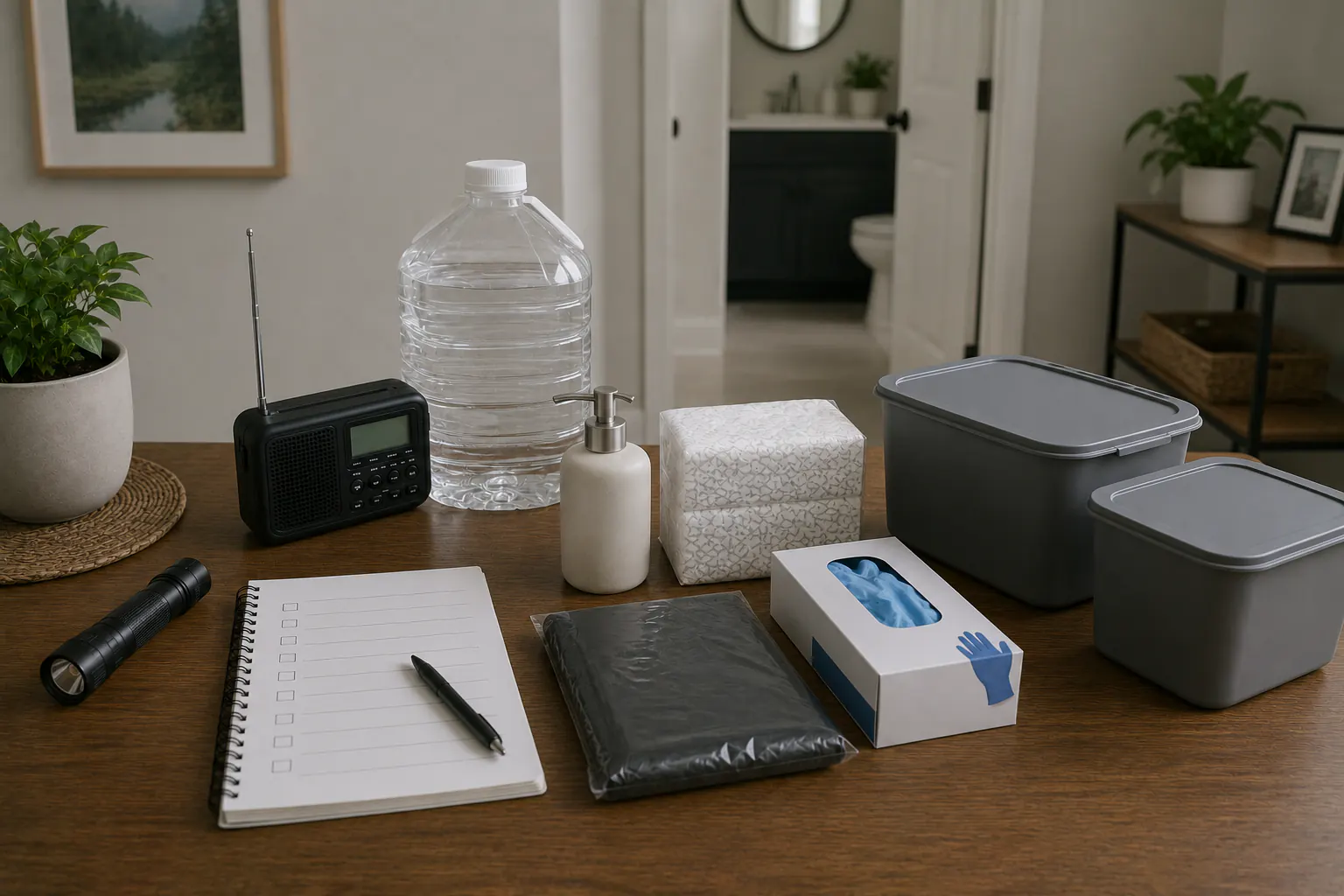
If a toilet stops working during an outage, first check with the wastewater utility or building management whether flushing is permitted. A working faucet does not answer that question. If sewage is entering the home, use the immediate steps below and keep people and pets away.
A power outage may stop a well pump, apartment booster pump, sewer lift station, grinder pump, or building access system. A water outage may leave the sewer usable, or it may occur alongside a wastewater failure. Flooding can overload municipal sewers and septic systems. The household must identify which service has failed before deciding to flush, collect waste, or relocate.
This hub does not replace an incident-specific water advisory, wastewater notice, landlord direction, health-department order, or local disposal rule.
If sewage is entering the home
- Keep people and pets out of the affected area.
- Stop using toilets, sinks, showers, washing machines, and dishwashers that may add wastewater.
- Avoid contact with sewage, contaminated surfaces, wet electrical equipment, and unknown chemicals.
- Call the wastewater utility, landlord or property manager, and a qualified plumber or septic professional as applicable.
- Call 911 for immediate danger, electrical arcing, fire, collapse, severe symptoms, or another life threat.
- Document the condition from a safe location for management or insurance.
Do not enter a septic tank, sewer, manhole, pump chamber, flooded crawlspace, or other confined space. Do not open a cleanout, cap a pipe, operate an unfamiliar valve, or use a chemical drain product to diagnose a backup.
The sewage backup stop-rules guide separates warning signs, immediate isolation, and professional cleanup boundaries.
Identify what failed before using a toilet
Ask the water and wastewater utility or building management:
- Is drinking water unavailable, unsafe, or merely low pressure?
- Is the sewer or septic system accepting wastewater?
- Is toilet flushing permitted, restricted, or prohibited?
- Does the building rely on pumps or electronic controls?
- Is there a boil-water, do-not-drink, do-not-use, or wastewater notice?
- Where are approved public toilets or portable sanitation facilities?
- How will collected human waste be stored and disposed of?
- When will the next official update be issued?
Do not infer sewer status from a working faucet or a toilet that flushed once. The next fixture, lower unit, or pump cycle may reveal a wider problem.
Use a decision ladder for toilet continuity
Choose the highest safe option that authorities confirm:
| Situation | Preferred response | Stop condition |
|---|---|---|
| Home toilet and wastewater system confirmed available | use the fixture normally or under utility conservation instructions | slow drainage, gurgling, backup, odor, or official restriction |
| Sewer available but water supply interrupted | follow utility/building instructions for permitted flushing and water type | sewer status uncertain, septic flooding, pump dependency, or backup sign |
| Home plumbing unavailable | use an approved functioning toilet or official portable facility | unsafe route, inaccessible facility, contamination, or closure |
| No functioning facility available | activate the preplanned temporary collection system allowed locally | no secure storage, no hand hygiene, vulnerable user cannot use it safely |
| Waste cannot be contained or household needs cannot be met | relocate early to a safe destination with sanitation | do not wait for overflow or illness |
The toilet sanitation guide explains temporary collection without claiming that one disposal method is legal everywhere.
Build the sanitation system around clean and dirty zones
Mark a clean zone for safe water, food, medications, infant feeding, clean towels, and hygiene supplies. Keep a toilet and waste zone separate. Use a third location for sealed waste awaiting approved collection when possible.
The flow should be one-way:
- take clean supplies into the toilet or diapering area;
- contain waste without touching surrounding surfaces;
- remove gloves correctly when used;
- clean hands immediately;
- clean and, when needed, disinfect the appropriate hard surface under its product label;
- return only clean items to the clean zone.
Do not place toilet supplies beside stored drinking water, food, cookware, pet bowls, medical equipment, or children’s play materials. Keep all waste inaccessible to children, pets, insects, and rodents.
Protect handwashing first
CDC recommends washing with soap and clean running water for at least 20 seconds. During an emergency, important times include after toilet use, diapering, handling garbage or animal waste, and before food preparation, eating, wound care, or caring for someone who is ill.
If a sink does not work, a stable water container with a controlled spout can support a temporary station. Catch wastewater in a separate container if it cannot enter the drain, and dispose of it only as local instructions permit. Do not let hands contact a shared basin of standing wash water.
When soap and water are unavailable, CDC advises an alcohol-based hand sanitizer containing at least 60 percent alcohol. Sanitizer is less effective on visibly dirty or greasy hands, does not remove every germ, and may not remove harmful chemicals. Store it away from heat and flame and supervise children.
The limited-water hand hygiene guide covers priorities, station setup, sanitizer limits, wounds, diapers, and water advisories.
Separate safe water by task
Water that is acceptable for toilet flushing is not automatically safe for drinking, handwashing, dishes, bathing, wound care, brushing teeth, infant feeding, or cleaning food-contact surfaces. Follow the exact advisory.
Reserve the safest known water for consumption and high-consequence hygiene. Use the emergency water storage guide to estimate drinking and sanitation needs, then keep the toilet plan from silently consuming the drinking reserve.
Never use floodwater, sewage-contaminated water, water with fuel or toxic chemicals, or a toilet tank containing cleaning products as an improvised drinking source.
Isolate household waste by category
Human waste, diapers, food waste, ordinary dry trash, sharps, batteries, medications, chemicals, and disaster debris do not share one universal disposal path.
Create labeled categories without putting sensitive health information on the exterior. Keep containers closed, upright, protected from weather, and away from food and water. Do not combine leaking chemicals, unknown containers, batteries, fuel, disinfectants, or medical sharps with ordinary sanitation bags.
EPA directs households to local environmental, health, and solid-waste agencies for household hazardous-waste options. Never pour chemicals into a toilet, drain, storm sewer, yard, or water body merely because collection is delayed.
The household waste isolation guide covers storage, pest control, categories, and collection records.
Treat cleaning products as controlled tools
Cleaning removes dirt and many germs. Disinfecting uses a regulated product for defined organisms, surfaces, dilution, and contact time. More chemical is not more protective.
EPA warns never to mix cleaning products or add bleach to other chemicals. Mixing bleach with ammonia, acids, or unknown products can release toxic vapors. Read the entire label, provide the ventilation it requires, use only on listed surfaces, keep the surface wet for the stated contact time, and store the product in its original labeled container away from children.
If irritating vapor, breathing difficulty, chest tightness, severe coughing, confusion, or collapse occurs, move to fresh air without entering a contaminated area, call 911 for severe symptoms, and contact Poison Control in the United States at 1-800-222-1222 for case-specific guidance. Do not create another exposure while attempting cleanup.
Read the cleaning-products mixing warning before planning disinfectants for an outage kit.
Plan for apartments and vulnerable household members
Apartment sanitation depends on shared sewers, pumps, management, elevators, trash rooms, ventilation, and neighboring units. A problem may appear first in a lower unit. Report gurgling, slow drains, sewage odor, wastewater at a fixture, alarm, or management notice promptly.
The system must also work for:
- children in diapers or toilet training;
- menstruation and incontinence care;
- older adults or people who need transfer assistance;
- mobility, grip, balance, vision, or cognitive limitations;
- ostomy, catheter, wound, or other clinician-directed care;
- people with diarrhea, vomiting, immune compromise, or skin conditions;
- pets and service animals;
- residents who cannot carry water or waste on stairs.
Do not improvise changes to medical devices or personal-care procedures. Follow the clinician and product instructions. Relocate early when safe care, privacy, ventilation, water, or waste containment cannot be maintained.
The compact apartment sanitation kit focuses on small-space storage and accessibility.
Use a two-week operating plan, not a two-week pile
Inventory people, care tasks, water, toilet capacity, handwashing, bags, absorbent material, paper goods, menstrual and incontinence products, diapers, cleaning supplies, PPE, pet waste, and approved storage space. Estimate daily use, then establish a review and relocation trigger.
Track:
- utility and advisory status;
- number of users and changes in care needs;
- clean water remaining by task;
- sealed waste units and available secondary containment;
- hand hygiene supplies;
- symptoms or wounds needing medical attention;
- collection instructions and next pickup;
- indoor temperature, ventilation, pests, and odor;
- the time or condition that will trigger relocation.
The two-week household hygiene checklist turns these dependencies into a daily routine.
Sources reviewed
- CDC: Water, Sanitation, and Hygiene Emergencies; Personal Hygiene; Preventing Diarrheal Illness; Clean Hands FAQ
- Washington State Department of Health: Toilet Use During an Emergency
- EPA: Sanitary Sewer Overflows; Biological Contaminants; Household Hazardous Waste
Sources reviewed July 14, 2026. Local water, wastewater, solid-waste, public-health, building, landlord, and emergency instructions control actual toilet use, storage, cleanup, and disposal.