
Store at least one gallon of water per person per day for three days for drinking and sanitation. The CDC recommends trying to store a two-week supply when possible. Plan more for hot climates, pregnancy, illness, pets, and higher physical activity.
This page is for building a reserve before service is disrupted. If an advisory or interruption is already active, start with the water advisory action log and follow the issuing utility or health authority.
Use this water-preparedness family
This hub owns household quantity, food-grade storage, labeling, rotation, advisory basics, and a dispensing drill. Use the distinct guides when the decision becomes more specific:
- Calculate a household reserve while keeping clinician, veterinarian, lifting, and structural limits outside the arithmetic.
- Record a water advisory without confusing boil-water, do-not-drink, and do-not-use instructions.
- Understand filtration, purification, and treatment limits before relying on a device or certification claim.
- Respond after flooding when a well, cistern, public system, or stored supply may have been exposed.
- Move and store water without a working elevator for apartment access, delivery, and stair constraints.
Water also connects to sanitation and hygiene, medical-device and medication continuity, pet emergency planning, and the family communication plan. Those specialists retain their own clinical, animal, waste, and contact decisions.
Calculate the baseline
Use:
people × days × 1 gallon = minimum stored gallons
A four-person household needs at least 12 gallons for three days. A two-week target is 56 gallons before adding pet and special-needs water. One U.S. gallon of water weighs about 8.3 pounds, before the container. Check the filled weight against the container, shelf, and location’s documented limits; this quantity estimate does not approve a floor or shelf for that load.
The CDC recommends at least one gallon per person per day for three days and says households should try to store a two-week supply when possible. More may be needed for pregnancy, illness, pets, hot climates, and physical activity. (Source: CDC, How to Create and Store an Emergency Water Supply.)
| Household | 3-day baseline | 7-day baseline | 14-day baseline |
|---|---|---|---|
| 1 person | 3 gal | 7 gal | 14 gal |
| 2 people | 6 gal | 14 gal | 28 gal |
| 4 people | 12 gal | 28 gal | 56 gal |
| 6 people | 18 gal | 42 gal | 84 gal |
These are starting quantities, not guarantees. Add water for pets and needs identified with a clinician. Then test whether the household can store, move, open, and dispense the planned amount.
Audit how water will actually be used
Separate needs before an outage:
- drinking and medication;
- preparing food and infant formula;
- oral hygiene and hand hygiene;
- pet drinking water;
- cleaning food-contact items;
- limited bathing or body cleaning;
- toilet flushing or alternative sanitation;
- medical or accessibility-related use.
This audit reveals why a single gallon can be a tight daily baseline. It also helps reserve known-safe water for ingestion while identifying tasks that may use a separately stored nonpotable source when local authorities say that is appropriate.
Choose containers safely
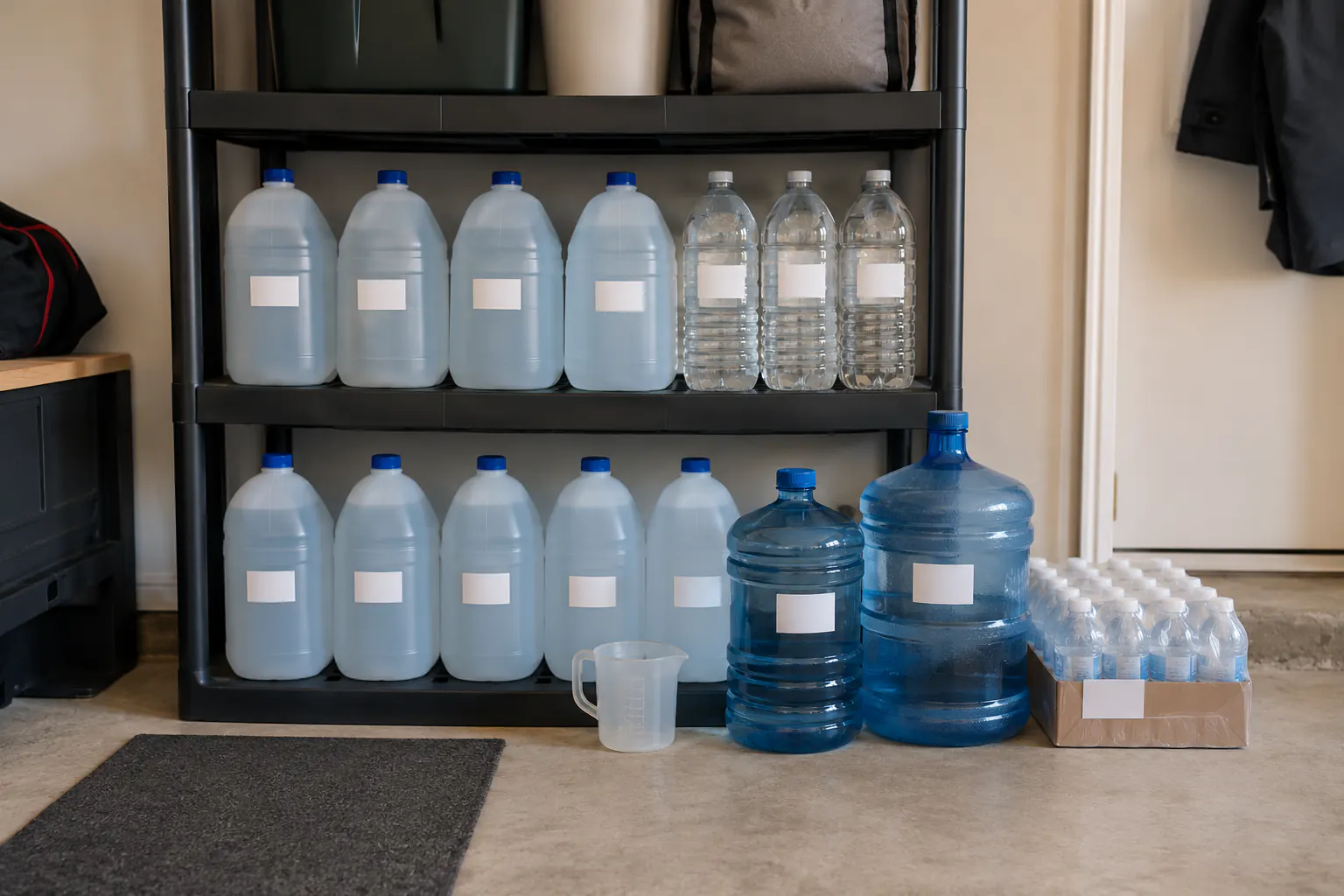
Unopened commercially bottled water is the safest and most reliable emergency supply. For water filled at home, use durable food-grade containers with tight-fitting closures. Do not reuse containers that held toxic chemicals, and avoid vessels that are difficult to clean or dispense without touching the water.
Before filling, follow CDC cleaning and sanitizing instructions. Use water from a safe public supply or water treated according to official guidance.
Choose a mix of sizes. Large containers use space efficiently but may be impossible for one household member to lift or pour. Smaller containers are easier to rotate and carry during evacuation, but create more caps and surfaces to manage. The container comparison weighs the categories — bottled cases, jugs, stackable bricks, drums, and tub liners — against weight, space, and rotation reality.
Check that every container:
- is explicitly intended for food or drinking-water storage;
- closes tightly and can be cleaned at the opening;
- can be dispensed without hands, cups, or dirty taps entering the water;
- has no crack, odor, discoloration, or damaged gasket;
- fits on a surface that can support its full weight;
- can be removed without blocking other supplies or an exit.
Do not use containers that previously held chemicals. Avoid ordinary milk or juice jugs for long-term emergency storage because they can be difficult to clean and are less durable.
Label, store, and rotate
- Label each home-filled container “drinking water” and add the storage date.
- Replace home-filled water every six months.
- Keep it in a cool place away from direct sunlight.
- Keep containers away from gasoline, pesticides, and other chemicals.
- Store containers where a leak will not damage electrical equipment or block an exit.
- Use smaller containers when household members cannot safely lift a large jug.
Do a twice-yearly check: leaks, damaged seals, readability, access, and enough volume for current household members and pets.
Use a rotation record with container ID, fill or purchase date, volume, location, and replacement date. The CDC recommends replacing water filled at home every six months. Follow the manufacturer’s date and storage instructions for commercially bottled water.
Do not stack beyond the exact container or shelving rating. If a support or floor’s suitability is uncertain, ask the manufacturer, property manager, or qualified building professional before filling or stacking there. Keep water accessible without overhead lifting, and away from panels, battery systems, furnaces, fuel, and important records that a leak could damage.
Separate drinking and sanitation decisions
Your one-gallon baseline includes both drinking and sanitation, but real use varies. Keep the cleanest known water reserved for drinking, food preparation, oral hygiene, medications, and infant needs. Identify a separate sanitation plan so the drinking reserve is not consumed by tasks that can use nonpotable water when public health guidance allows it.
Never assume water from a home water heater, pool, rain barrel, stream, or flood is safe to drink. Each source has different contamination and treatment concerns. During an advisory, follow local instructions rather than a generic internet recipe.
Understand advisory language
Local notices may use different wording, but the action depends on the contaminant:
- Boil-water advisory: usually addresses possible germs; follow the local boiling time and all affected uses.
- Do-not-drink advisory: boiling may not make the water safe; use the alternative source specified by authorities.
- Do-not-use advisory: avoid contact for the uses listed by authorities, which may include bathing or washing.
Water containing fuel, toxic chemicals, or radioactive material cannot be made safe by boiling or household disinfection. The CDC directs people to use a different source and contact the health department in that situation. (Source: CDC, How to Make Water Safe in an Emergency.)
Do not rely on color, taste, smell, a camping filter, or a home refrigerator filter to identify or remove every hazard. Treatment depends on what is wrong with the source.
If official guidance says to boil water
Follow the local notice first. CDC general guidance says that when bottled water is unavailable, clear water should be brought to a rolling boil for one minute, or three minutes above 6,500 feet, then cooled and stored in clean sanitized containers. Cloudy water should be filtered or allowed to settle before drawing off clearer water for boiling. (Source: CDC, How to Make Water Safe in an Emergency.)
Boiling kills germs; it does not remove fuel or toxic chemicals. During a power outage, do not create an indoor combustion hazard merely to boil water. Use a safe approved cooking method and the generator and combustion safety guide.
Apartment and evacuation planning
Water weight and stairs are the central constraints. Store a distributed reserve in manageable containers, keep a small carry-out quantity with the go bag, and identify where the remainder can be safely left if evacuation is required. Do not obstruct hallways, fire doors, balconies, mechanical rooms, or shared egress.
For a vehicle evacuation, secure containers so they cannot become projectiles or leak into electronics, medications, and documents. Do not leave the only reserve permanently in a vehicle exposed to heat, freezing, or theft.
Run a dispensing drill
Once every six months:
- Ask the person assigned to handle the reserve to check access, opening, and any assistance needed. Do not require children or anyone with lifting, balance, or mobility limits to carry a full container.
- On a stable, approved surface, dispense water into a bottle and cooking vessel without touching the opening. Follow the container instructions; do not improvise a lifting or support arrangement.
- Time how long it takes to locate the reserve and paper advisory contacts.
- Check whether a pump, spigot, wrench, or lifting aid is missing.
- Use the rotated water for cleaning or plants when appropriate, refill safely, and update the dates.
The drill tests access, not potability. If a seal, container, or stored water is questionable, replace it.
With the reserve in place, use the household water continuity plan to connect it to water access, utility notices, sanitation, and restocking. During an active advisory, the issuing authority’s instructions still come first.
Power outages can become water outages
Private wells usually require electricity. Municipal pressure and treatment can also be affected by wider failures. Fill containers before a forecast storm, but do not rely on a bathtub as a protected drinking-water container.
Place a paper copy of your water utility’s contact information and local alert channel with the supply. A boil-water advisory and a “do not use” advisory require different actions.
Return to the power outage preparedness hub, connect the reserve to the family communication plan, and use the food safety guide for refrigerator and cooler decisions. When a notice is active, use the water advisory action log rather than relying on memory.
Sources reviewed
- CDC: How to Create and Store an Emergency Water Supply
Source reviewed July 13, 2026. This guide supports a household storage plan; it does not replace current authority instructions.