
Start with the container you could actually open and dispense from during an outage. Where would it sit, who would handle it, and would it need to move? A gallon of water weighs about 8.3 pounds before the container, so a large reserve can solve a quantity problem while creating an access problem.
I have not tested these containers or ranked exact products. This comparison helps you choose a category for a household job; it does not establish that a model is leakproof, safe to stack, or suitable for your floor.
Use the water storage calculator for quantities and the storage hub for safe filling, siting, and rotation. Containers follow that plan, not the other way around.
The rules that come before container choice
CDC identifies unopened commercially bottled water as the safest and most reliable emergency source. For home-filled reserves, choose food-grade water containers, follow its cleaning and sanitizing directions, and keep water cool, out of sunlight, and away from chemicals. Replace home-filled water every six months and follow store-bought water’s dates and instructions. (Source: CDC, How to Create and Store an Emergency Water Supply.)
Never reuse a container that held toxic chemicals. If its history or drinking-water suitability is uncertain, choose another container rather than judging by appearance.
Storage is not treatment. An attractive jug or a tight lid does not make an uncertain source safe. The treatment limits guide explains why the authority’s notice comes first.
Compare the household job
| Category | A reason to consider it | What to check on the exact item |
|---|---|---|
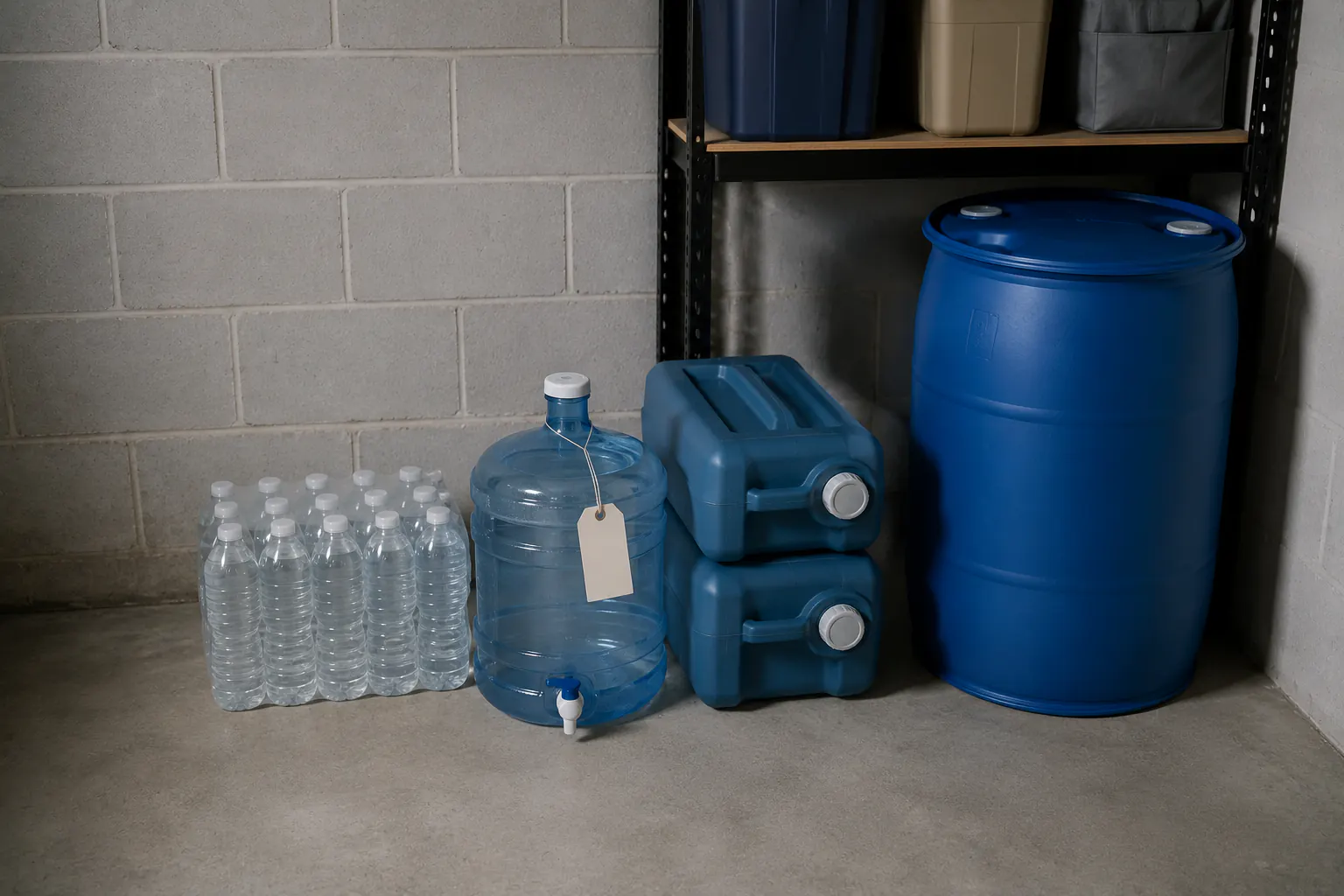
| Retail bottled water | A sealed supply without home filling | Package condition, dates, storage instructions, and accessible opening |
| Portable jugs | A refillable reserve that can be dispensed or moved as needed | Filled weight, cleaning access, cap and spout instructions, and handling |
| Stackable containers | Several smaller units in a measured space | Explicit filled stacking limits, support rating, and access to lower units |
| Drums | A larger reserve at a suitable fixed location | Filled load, building approval where needed, dispensing, cleaning, and rotation |
| Tub liners | Temporary additional capacity when there is warning time | Drinking-water suitability, allowed filling source, dispensing, and loss of tub access |
None is automatically the best value or easiest to handle. Compare the actual dimensions, filled weights, instructions, and total cost of the models you are considering.
Bottled water: a sealed first reserve
For someone starting without a reserve, sealed bottled water avoids a home-filling step. Different bottle sizes let you choose between individual portions and larger containers; opening, grip, and pouring still need to work for the intended user.
Before adding cases, check where you will keep them. Follow packaging instructions rather than assuming cases can be piled indefinitely. Keep reserve quantities distinct from daily drinks, and count what remains after normal use.
Check seals and dates without opening every bottle. A bottle whose cap or packaging has been exposed to floodwater needs the public-health decision in safe water after a flood, not an assumption that wiping it makes it usable.
Portable jugs: choose by filled weight, not the handle
A 5-gallon jug contains about 42 pounds of water; a 7-gallon jug contains about 58 pounds. Add the empty container’s weight. A handle does not make either load manageable for everyone.
Check the complete route from filling to storage to dispensing:
- Can it be filled and cleaned according to its instructions?
- Can the assigned person open the cap and operate the spout?
- Can water be dispensed from a stable, suitable surface without lifting the full jug?
- If it must move, is the size manageable for that person and route?
- Are replacement caps, seals, or spouts available for this model?
Do not assume a jug fits a sink or is approved for stacking because another jug does. Do not rely on stairs as the replacement for a failed elevator; the water access guide helps plan delivery and assistance without requiring an unsafe carry.
Stackable containers: verify the whole stack
Several smaller containers may fit a space that cannot accommodate one large unit. Measure the exact containers, including caps, handles, and room to remove or dispense from them.
A 3-gallon unit holds about 25 pounds of water and a 4-gallon unit about 33 pounds, before the container. Those are still substantial loads. Smaller does not establish safe handling for a child, older adult, or anyone with a mobility or lifting limit.
Look for the manufacturer’s explicit stacking instructions for filled containers: orientation, number of units, supporting surface, and any required restraint. Check the shelf or floor separately. An interlocking shape is not proof of stability or building suitability.
If the limits are absent or unclear, do not improvise a wall of water. A container on the bottom also needs access for inspection, dispensing, and rotation.
Drums: resolve the location before filling
A 55-gallon drum holds roughly 457 pounds of water before its own weight or accessories. Ask the property manager or a qualified building professional about an uncertain floor or location before filling it. This article cannot approve a structural load.
Plan how water will enter and leave the drum without moving it full. Check a drinking-water-compatible dispensing arrangement, cleaning access, inspection, and a permitted way to empty and refill it. Keep leaks away from electrical equipment and other vulnerable supplies.
A drum is worth considering only if those steps are feasible. Do not select it from capacity or an assumed low price per gallon alone.
Tub liners: capacity that depends on warning time
A tub liner can provide additional temporary storage only if the exact product is suitable for the intended water use and can be filled from an approved source before service fails. An advisory may make filling from the tap inappropriate.
A liner still occupies the tub once filled. Consider whether someone needs that space for bathing or care, and check the product’s filling, dispensing, storage-duration, and disposal instructions. Do not treat an ordinary bathtub or an unspecified liner as protected drinking-water storage.
It does not supply water already on hand during a sudden interruption. Keep that distinction visible in your plan.
Make rotation possible
Choose containers you can inspect, label, clean, and refill under the instructions. A larger container is not an improvement if the household cannot maintain it.
For each home-filled unit, record the volume, location, fill date, and next replacement date. For sealed retail water, retain the package’s date and storage instructions. If a container or water is questionable, do not use taste or smell to clear it.
The storage hub keeps the routine together. You do not need to buy all five categories to build a workable reserve.
A short decision path
- Size the reserve with the water storage calculator, including household-specific needs.
- Measure an accessible location and check its support limits, exit clearance, and protection from leaks and chemicals.
- Choose one suitable category for that location and the person who will handle it. Smaller sealed supplies or manageable refillable containers may be enough.
- Check the exact item, not a category-wide promise: drinking-water suitability, dimensions, filled weight, cleaning, closure, dispensing, and permitted stacking.
- Write down rotation and assistance, including a safe way to obtain more water if the reserve cannot cover the plan.
- Keep advisories separate. Use the water advisory action log when an official notice affects the source.
Evidence to ask for, not a test to improvise
Ask for model-specific instructions and documented evidence behind leak, stacking, durability, and storage claims. Check whether the tested conditions match the intended use and whether replacement parts are available.
Do not drop, freeze, overload, or contaminate a container at home to prove a marketing claim. A normal access check can reveal a difficult cap or an awkward pouring position; it cannot establish water safety, structural approval, or long-term durability.
My testing methodology explains the evidence required before I call a product tested. No such container recommendation is active here.
Sources reviewed
- CDC: How to Create and Store an Emergency Water Supply
- CDC: How to Make Water Safe in an Emergency
- EPA: Emergency Disinfection of Drinking Water
- Ready.gov: Water
Container preparation, water safety, storage, and rotation follow the named authorities. Weight figures are approximate arithmetic using 8.3 pounds per U.S. gallon, before container weight. Exact manufacturer instructions, current local advisories, and qualified building guidance control the actual setup.