
Count the people in your household and start with three days. This calculator gives you a water volume to plan around; the next job is finding containers you can actually store, reach, and pour from.
CDC’s emergency-water storage guidance starts at at least one U.S. gallon per person per day for three days and encourages a two-week supply when possible. More may be needed for hot climates, pregnancy, illness, physical activity, and pets. Add only an extra daily amount you have already identified; the tool does not choose medical, infant-feeding, animal, climate, or activity needs.
Interactive worksheet
Emergency water reserve planner
How much water should you make room for? Start with the CDC's one gallon per person per day, then add any extra amount you have planned for your household. Nothing entered here is saved or sent.
Planning arithmetic only. One gallon per person per day is an emergency storage baseline for drinking and sanitation, not a hydration prescription or guarantee. The weight uses 8.34 pounds per U.S. gallon and excludes containers, shelving, and equipment; it does not determine a safe lifting, carrying, floor, or shelf load.
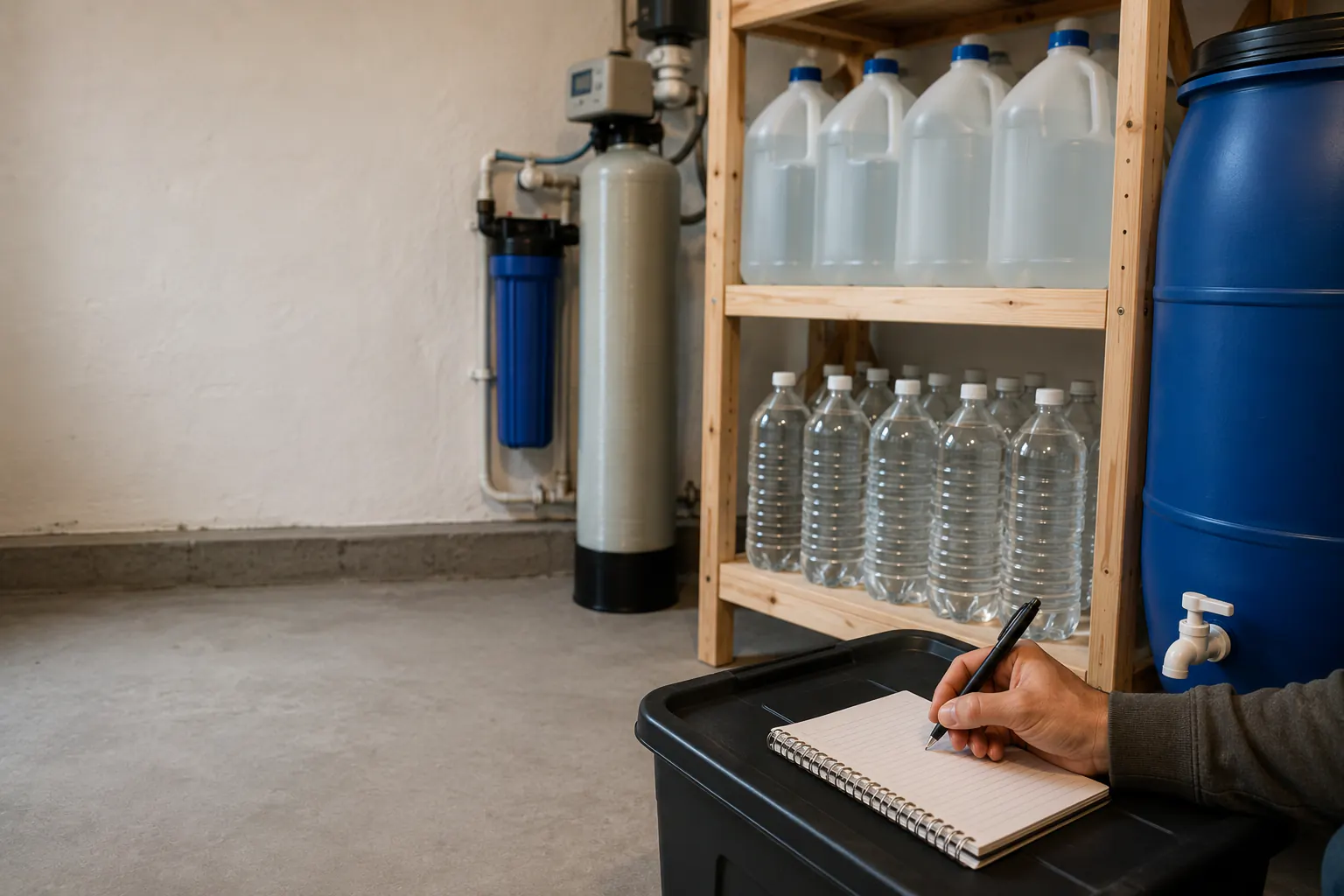
Read the result as a planning baseline
The core calculation is deliberately visible:
people x days x 1 U.S. gallon = CDC household baseline
The tool then adds:
household-added gallons per day x days = added amount
The result is a storage target for the entries supplied. It is not proof that every person will have enough water in every condition. One gallon per person per day covers both drinking and sanitation in the emergency-storage guidance, while actual use varies. A person with clinician-directed needs, an infant-feeding plan, a service animal, a pet, extreme heat exposure, or unusually physical work may need a separately confirmed amount.
Do not hide uncertainty inside an average. If one need is not yet known, write “pending confirmation” next to that person or use rather than inventing a number.
Build a household water worksheet
After calculating, create one row for each layer of the reserve:
| Reserve layer | Record before buying or filling containers |
|---|---|
| General household baseline | People, days, calculated gallons, and review date |
| Individual health need | Person, exact use, confirmed amount, source of instruction, and backup contact |
| Infant feeding | Feeding plan, safe-water requirement, ready-to-feed alternative if directed, and caregiver owner |
| Pets or service animals | Animal, daily amount confirmed with the appropriate plan, portable portion, and veterinarian contact |
| Food preparation | Meals that require water, gallons or quarts by recipe, and lower-water alternative |
| Evacuation layer | Quantity that can leave immediately without making the bag or vehicle unsafe |
| Sanitation layer | Tasks that may use a separately identified nonpotable source when authorities allow it |
Keep this detailed worksheet on private paper or in your own controlled record, not in the calculator. The tool asks for numbers only. The table prevents double counting: water included for food preparation should not also be treated as unused drinking water. A portable evacuation amount should either be part of the home total or be clearly recorded as an additional layer.
Convert gallons into real containers
A large total can look reassuring while remaining unusable. Convert the result into an exact container plan with size, count, location, opening method, dispensing method, fill or purchase date, and next inspection date. The container comparison covers which category fits which household before anything is bought.
Use durable food-grade containers with tight closures for water filled at home. Unopened commercially bottled water is the safest and most reliable emergency supply. Do not reuse a container that held toxic chemicals. Follow the CDC cleaning and sanitizing method before filling a suitable container, and use water from a safe source.
Mixing sizes can improve access. Large containers use space efficiently but can be hard to move or pour. Smaller containers may be easier to rotate and take during an evacuation, but add more caps, seams, and items to inspect. The right mix is the one that the actual household can reach, open, and dispense without contaminating the opening.
Use the Emergency Water Storage hub for container selection, labeling, six-month replacement of home-filled water, and a dispensing drill.
Treat the weight as a constraint, not a carrying target
The calculator reports approximate water-only weight using 8.34 pounds per U.S. gallon. That figure excludes the container, shelf, cart, straps, and other equipment. It does not establish a safe shelf load, floor load, lifting limit, stair-carrying limit, or vehicle cargo arrangement.
Never turn the weight output into “one person should carry this.” People, stairs, grip, temperature, mobility, pain, containers, route width, and urgency differ. Keep heavy water low on sound storage, away from exits and electrical equipment, and within the rated limits of the container and shelving. Ask a property owner or qualified professional when structural or mounting capacity is uncertain.
Apartment residents should use Moving and Storing Water Without a Working Elevator to plan deliveries, manageable transfers, floor-specific dependencies, and help before an outage. The article intentionally sets no universal safe carry limit.
Separate drinking water from sanitation planning
The baseline includes drinking and sanitation, but it does not mean every household task must consume the same protected supply. Reserve known-safe water for drinking, food, ice, oral hygiene, medication preparation, infant needs, and other uses identified by the current public-health notice.
Build a separate emergency sanitation plan for toilet continuity, hand hygiene, waste, and limited-water cleaning. Authorities may allow certain nonpotable sources for limited tasks, but permission depends on the contaminant and advisory. Do not assume rainwater, pool water, a water heater, a boiler, a stream, a well, or floodwater is safe for a particular use.
Plan around food, medicine, and animals
Water dependencies often sit outside the water shelf. Review the emergency food storage plan and mark meals that require boiling, rehydration, dishes, or cleanup. A pantry dominated by dry foods can consume far more water and fuel than expected.
Medication preparation, refrigerated medicines, medical devices, wound or equipment cleaning, and clinical nutrition belong in the medical-device and medication continuity plan. The water calculator cannot interpret a prescription or substitute for manufacturer and clinician instructions.
For animals, use the pet emergency preparedness hub. Species, body size, diet, illness, heat, medication, and travel can change needs. The extra-water field exists to record a household-defined amount, not to generate veterinary advice.
Test a three-day plan before scaling it
Start with the three-day baseline and run an access drill under ordinary conditions. Do not intentionally stop safe household water service. Instead, retrieve one container, open and dispense it into the vessels normally used for drinking and food, and note every dependency.
Check:
- Can each responsible household member find the reserve in low light?
- Can the intended person open the closure and control the pour?
- Does the plan need a clean pump, spigot, funnel, adaptive grip, or stable surface?
- Is any container blocked by stored items or an evacuation route?
- Could a leak reach a breaker panel, battery, fuel, medication, or important documents?
- Are the dates readable and is the rotation record current?
- Is a portable portion assigned without compromising mobility?
Correct the access problems before expanding toward seven or fourteen days. More volume does not compensate for a reserve that cannot be reached or safely dispensed.
Recalculate when the household changes
Review the worksheet at least every six months, when home-filled water is replaced, and after a move, pregnancy, birth, health change, new pet, caregiver change, seasonal heat plan, evacuation-plan change, or shift in household size. A guest or relative who may shelter with the household should be counted deliberately rather than assumed.
Keep the calculator output with a paper inventory. Record the utility and health-department alert channels separately. The arithmetic should still be understandable when a phone battery or network is unavailable.
Do not use this result during an advisory without the notice
A stored quantity does not decide whether tap water is safe. Boil-water, do-not-drink, and do-not-use notices can require different actions. Use the Water Advisory Decision Tree and Action Log to copy the exact authority wording and assign household tasks.
If fuel, toxic chemicals, radioactive material, or unknown chemical contamination is known or suspected, boiling, ordinary disinfection, and a typical household filter cannot be assumed to make the water safe. Use the alternative source and contact path identified by authorities. After flooding, private wells and cisterns require the specific safe-water-after-flood plan.
Sources reviewed
ReadyLience reviewed CDC emergency water storage and emergency treatment guidance and Ready.gov emergency-kit guidance on July 15, 2026. Current utility and public-health instructions, container labels, property limits, clinician and veterinarian guidance, and household access conditions control the final plan. This calculator helps frame a household plan; it does not replace those controlling sources.