
Start with one device the household depends on. Find its current instructions and the clinician or supplier’s contact, then ask what the plan is if power fails. You do not need to finish an equipment inventory before making that call. Clinical limits, approved power sources and departure decisions must come from the treating clinician, exact device instructions and supplier, not a household calculator.
This is advance preparation, not a troubleshooting or treatment procedure. Emergency help and necessary departure come before finding paperwork, making measurements or retrieving supplies. Do not interrupt care to inspect or move equipment. The wider household plan lives in the power outage preparedness hub; keep the individual’s clinical plan separate and private.
Seasonal variants specialize this plan: the winter medical-device and vulnerable-household plan adds cold, and the heat power-outage plan adds heat. The CPAP backup planning questions work one device in depth.
If treatment is failing right now
Call 911 if a person’s condition is deteriorating, if required treatment cannot continue, or if you are unsure. Do not spend the outage troubleshooting equipment while someone declines.
Follow the clinician’s emergency instructions and the device manufacturer’s documented procedure. FDA advises device users to plan for power, moisture, contamination, and supply continuity in emergencies, and to follow the device labeling. (Source: FDA, Emergency Situations and Medical Devices.)
Do not improvise a substitution, a setting change, or a workaround because a device is unavailable. If the plan has failed, the answer is professional help or relocation, not invention.
Keep the exact device information together
Begin with the device in front of you. A short private note can help when you contact the supplier; unanswered fields are questions, not estimates to fill in. Add other required equipment with the person’s professional care team as the plan develops. Incomplete notes never delay help.
Confirm the relevant details without interrupting treatment or handling equipment in unsafe conditions:
| Question | Who confirms it |
|---|---|
| Exact model | Existing instructions or supplier record; keep identifying details private. |
| Required therapy and interruption limits | The treating clinician, including the emergency plan. |
| Power requirements and startup behavior | Exact manufacturer instructions or supplier documentation, not an improvised trial. |
| Approved supply, battery and adapter | The manufacturer or supplier for this exact device. |
| Documented runtime at required settings | The manufacturer and supplier; the clinician determines what care requires. |
| Consumables and reserve | The supplier and clinical plan. |
| Alarms and operation while charging | The manufacturer’s documented procedure. |
An energy figure does not establish how long therapy can be interrupted. Keep clinical decisions with the clinician and exact power compatibility with the manufacturer and supplier. FDA’s emergency-device guidance emphasizes power, moisture, contamination and supply continuity; a general article cannot approve a connection.
Get documented power requirements before using a calculator
Ask the manufacturer or supplier which documented power figures apply to the exact model and required settings. A label maximum, ordinary appliance estimate or measured watt value is not a clinical runtime guarantee or connection approval. Leave unknowns unresolved until the relevant professional answers.
The plug-in watt-meter guide concerns ordinary appliance measurements; it does not authorize inserting a meter into a medical-device supply. The backup power load worksheet can organize documented household figures, not decide clinical reserve or device compatibility.
Two hard limits apply:
- Do not disconnect or cycle required equipment for a measurement or trial. Ask the supplier how any necessary verification can occur without interrupting care.
- Watts are an energy input, not a clinical guarantee. Arithmetic does not establish approved runtime, safe interruption or an evacuation threshold.
Ask the clinician, manufacturer, and supplier directly
Ask these questions during advance planning. Do not wait for a routine appointment if required care is failing or urgent help is needed.
Clinician:
- How long can this therapy be interrupted, and what are the warning signs?
- At what point do we go to a hospital or a facility rather than continue at home?
- What changes during heat, cold, smoke, or illness?
- What must never be improvised or substituted?
Manufacturer:
- Which external power sources are approved for this exact model?
- What is the approved battery, and what runtime is documented at our settings?
- Can it operate while charging? What happens on power loss?
- What are the temperature, humidity, and cleanliness limits?
Supplier / pharmacy / utility:
- What is the emergency contact and after-hours procedure?
- How fast can consumables or a replacement be delivered during a regional event?
- Is there a utility medical registry or baseline program, and what does it actually provide?
Keep a concise private copy of the confirmed answers if that helps the person and caregiver. A missing document is not a reason to delay help or departure.
Ask the utility whether a medical program exists and what it actually provides. Registration is not a guarantee of uninterrupted power or faster restoration; it cannot replace the person’s backup and relocation plan.
Power the device without creating a second emergency
Discuss the permitted options with the device team rather than treating this as a shopping list:
- An approved battery or adapter must be confirmed for the exact model, settings and care plan; a matching plug alone does not establish suitability.
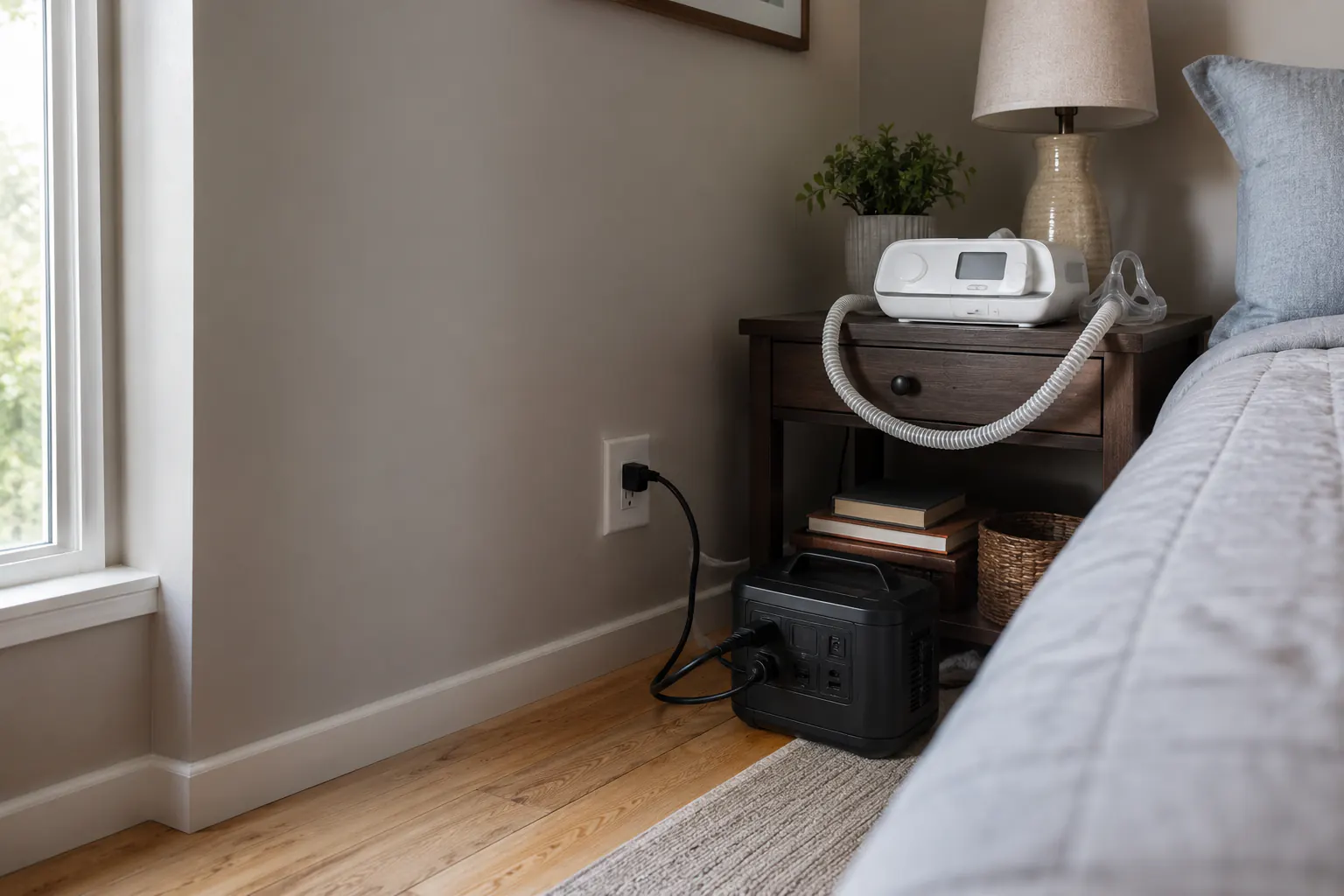
- A portable power station may support some equipment, subject to continuous output, surge, waveform, port, and grounding requirements — all of which the manufacturer, not a spec sheet, must confirm. See the backup power hub.
- A portable generator is a separate hazard plan, not a power source you simply add. It never runs indoors, in a garage, or near openings. Read the generator carbon monoxide warning first; the alarm response guide covers what happens if it goes wrong.
- Never feed household wiring through an improvised cord, and never backfeed. Any transfer arrangement requires listed equipment and a qualified electrician.
- Where oxygen is in use, follow the supplier’s written fire and ignition precautions. FDA advises battery-powered flashlights or lanterns rather than gas lights or torches. Equipment and oxygen instructions control the actual setup.
Keep the required clinical reserve under the person’s professional plan, separate from discretionary household loads. Do not assume other care, heating, cooling or communication needs can wait. The outage load-reduction guide helps consider ordinary loads without changing prescribed care.
Write the trigger table
The most valuable page of this plan is the one that decides when to stop trying. Decide it in advance, in calm conditions, with the clinician.
| Question | Who confirms it | Plan to obtain |
|---|---|---|
| Clinical warning signs | Treating clinician | The emergency instruction; never delay necessary help. |
| Required backup reserve | Clinician, manufacturer and supplier | The approved reserve and timely relocation plan, not a calculator threshold. |
| Consumables running short | Supplier and clinician | Resupply contacts and care-continuity instructions. |
| Medication storage concern | Pharmacist or manufacturer | Individual instructions; no general disposal or substitution decision. |
| Unsuitable home conditions | Clinician and relevant authorities | A confirmed suitable destination and assistance. |
| Transport disruption | Local authorities and care team | Departure and transport arrangements while they remain available. |
Medication-specific questions belong in the refrigerated medication plan, with the pharmacist or manufacturer directing the decision.
Written triggers help the person and caregiver recognize when to seek help or leave; they do not guarantee that conditions will follow the plan. Follow current emergency instructions rather than waiting to complete the table or reach an estimated battery threshold.
Plan the destination and the trip
Relocation is a legitimate primary plan, not a failure. Decide in advance:
- two destinations that can support the equipment, with their requirements confirmed;
- how the person and equipment travel, including who carries what;
- what goes in a grab bag: device, approved batteries, adapters, consumables, medication list, clinician and supplier contacts, and the written plan;
- who assists someone who cannot self-evacuate;
- how the household communicates if phones are unreliable — see the family communication plan.
CDC’s preparedness guidance for people with specific personal needs covers medication, assistive technology, and device planning as its own category rather than a footnote. (Source: CDC, Personal Needs.)
Rehearse without interrupting treatment
Discuss the plan in ordinary, safe conditions with the person and care team. Check only the tasks they permit without interrupting care:
- locating the private plan and contacts with normal safe lighting;
- asking the supplier how approved backup and alarm checks can be verified without interrupting treatment;
- checking that everyone knows the triggers and who calls whom;
- verifying contacts are current.
Do not rehearse by interrupting therapy, cycling a life-sustaining device, or testing a substitution. Ask the supplier how to verify readiness without risk.
Review the plan with the relevant professionals after a change in device, prescribed settings, supplier, home or care needs, and at the interval they specify.
What this page will never do
It will not tell you how long a person can go without treatment. It will not endorse a battery, adapter, or power station for a specific device. It will not offer a substitution when a device or medication is unavailable. And it does not replace the clinician, the manufacturer’s labeling, the supplier, or 911.
Its useful next step is one confirmed answer from the clinician or device supplier. Add that to the person’s private plan without turning paperwork or a battery calculation into proof that care will continue.
Sources reviewed
ReadyLience reviewed current FDA guidance on medical devices in emergency situations and natural disasters, CDC guidance on emergency power sources and personal needs, and Ready.gov disability preparedness guidance. This page contains no medical advice and no clinical thresholds; every runtime, interruption tolerance, approved power source, substitution, and evacuation trigger must come from the treating clinician, the device manufacturer’s labeling, and the supplier. Utility medical registration is described as one input that may not guarantee faster restoration; no product is recommended.