
Refrigerated medicine turns a power outage into a clock. The household knows the refrigerator is warming; what it usually does not know is what that means for the specific product, and that gap gets filled with guesswork at the worst possible moment.
This page exists to replace the guesswork with published ranges, a temperature record, and a phone number — obtained before the outage. It contains no medical advice. Every decision about a specific medicine belongs to the pharmacist, the manufacturer, or the prescribing clinician.
It is the medication half of the medical device continuity plan.
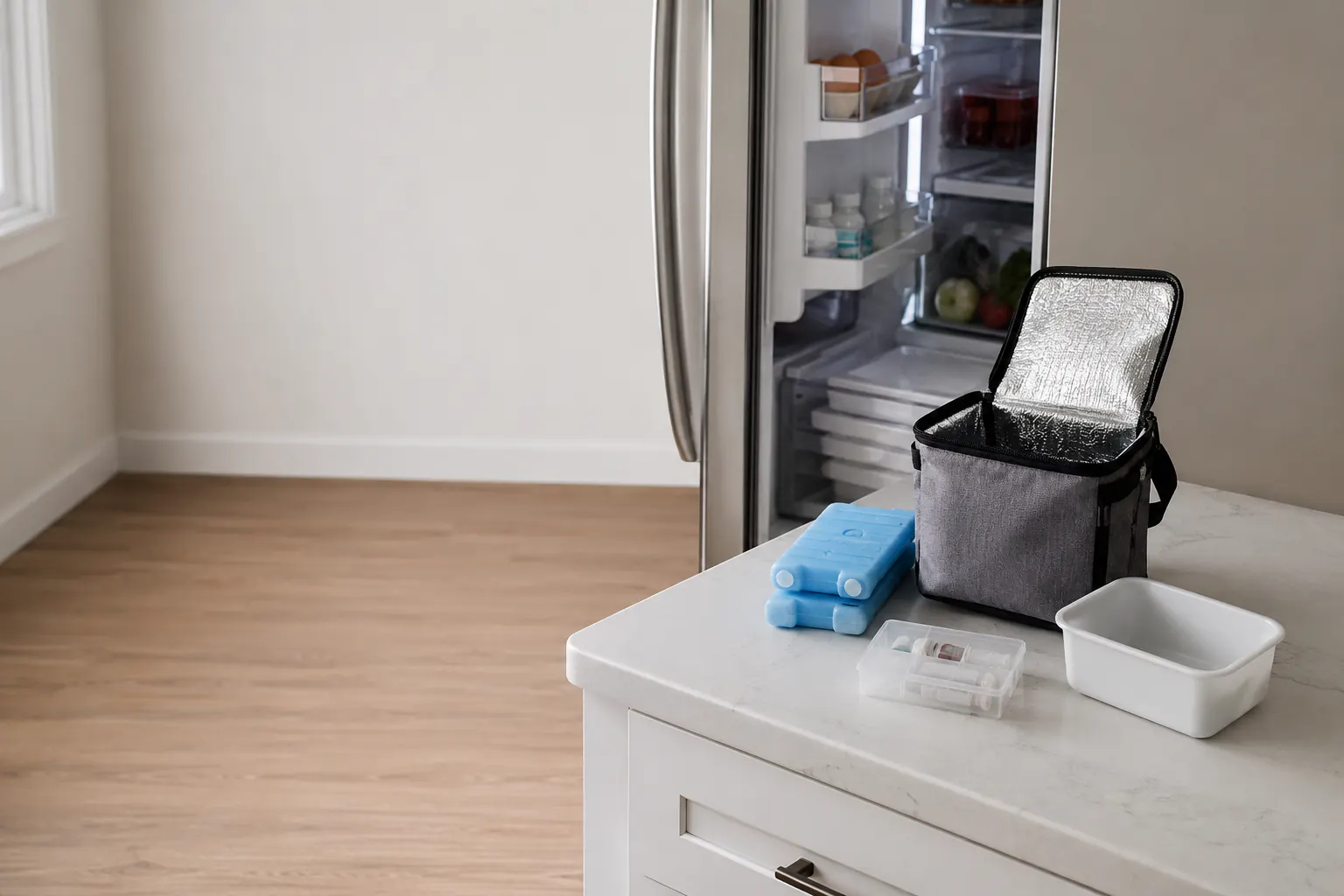
The rule that prevents the worst mistakes
Do not discard prescribed medication on your own judgment, and do not keep using it on your own judgment either. Both errors are common and both are dangerous.
After any temperature excursion, the question is not “does it look fine?” — appearance does not establish potency. The question is what the pharmacist or manufacturer says about that exact product, at that temperature, for that duration. Which is why the temperature log below matters more than any rule of thumb.
Food-safety intuition actively misleads here. The power outage food safety rules are about pathogens; medication is about potency and stability. They are different problems with different thresholds, and applying one to the other produces confident, wrong answers.
What FDA publishes about insulin
Insulin is the most common refrigerated medicine in households, and FDA publishes specific emergency guidance. These are the published figures, not instructions for your situation:
- Insulin is normally stored in a refrigerator at approximately 36°F to 46°F.
- Insulin in vials or cartridges supplied by the manufacturer, opened or unopened, may be left unrefrigerated between 59°F and 86°F for up to 28 days and continue to work.
- Insulin that has been altered for dilution or removed from the manufacturer’s original vial should be discarded within two weeks.
- Insulin loses some effectiveness when exposed to extreme temperatures, and the longer the exposure, the less effective it becomes, which can result in loss of blood glucose control over time.
- Under emergency conditions you might still need to use insulin stored above 86°F. Keep it as cool as possible, and if you are using ice, avoid freezing the insulin.
(Source: FDA, Information Regarding Insulin Storage and Switching Between Products in an Emergency. CDC publishes related guidance in Managing Insulin in an Emergency.)
Three cautions on how to read that:
- It is product-specific. “Insulin” is a category. Your product’s labeling governs, and it may differ.
- The 28-day figure is not a licence. It describes unrefrigerated storage in a stated range — not survival of a hot car, a freezing garage, or a week at 95°F.
- Freezing is its own failure. Ice in a cooler is a real risk to the product, which is why the FDA caution about avoiding freezing is explicit.
Other refrigerated medicines are not insulin
Many household medicines require refrigeration and have entirely different tolerances: some biologics, certain eye drops, some antibiotics in suspension, some injectables, and vaccines.
Do not generalize insulin’s published range to any of them. For each refrigerated product in the home, get the answer in advance from the pharmacist:
- What is its normal storage range?
- What happens if it warms, and for how long is that acceptable?
- What happens if it freezes?
- What should we do after an excursion — and who do we call?
- Is there an emergency supply or replacement path during a regional event?
Write the answers on one page and keep it with the medicine. That page is the deliverable of this article.
Measure, do not estimate
You cannot report an excursion you did not measure, and “it felt cold” is not a temperature.
- Keep an appliance thermometer in the refrigerator where the medicine is, not on a shelf across the compartment. A plug-in watt meter tells you what the refrigerator costs; a thermometer tells you what the medicine experienced.
- Log the excursion: when the power failed, what the temperature was when you first checked, the highest reading, how long it was above the range, and whether it ever froze.
- Keep the door closed. Every opening costs cold you cannot get back. The refrigerator continuity guide covers cycling the appliance on backup power honestly.
That log is what the pharmacist needs. Without it, they cannot advise, and the conservative answer becomes “replace it” — which may be impossible during a regional event.
Cooling without destroying the product
If the plan involves a cooler:
- Do not place medicine in direct contact with ice or gel packs unless the product instructions specifically allow it. Freezing is a failure mode for many refrigerated medicines, including insulin.
- Use a barrier and keep a thermometer inside the cooler with the medicine.
- Aim for the published range, not “as cold as possible” — colder is not automatically better.
- A cooler is a delay, not a solution. It buys hours. The plan still has to end somewhere.
Backup power for a refrigerator is a legitimate layer, subject to the honest arithmetic in the backup power hub — a compressor’s surge is often the limiting factor, not capacity.
Build the reserve before the season
The supply question is decided long before the outage:
- Ask the pharmacist and insurer what refill timing is possible and whether an emergency supply is available. Do not stockpile by skipping doses.
- Know the pharmacy’s after-hours and regional-event procedure, and identify a second pharmacy.
- Keep the medication list, doses, prescriber, and pharmacy contact on paper in the grab bag, because phones fail.
- CDC’s preparedness guidance treats medication, specialty food, assistive technology, and devices as a planning category of its own rather than an afterthought. (Source: CDC, Personal Needs.)
The decision path during an outage
- Keep the door closed and check the thermometer rather than opening to look.
- Start the log at the first check. Times and temperatures.
- Protect the reserve — medication cooling is one of the few loads worth spending backup power on.
- Do not freeze it while trying to keep it cold.
- Call the pharmacist with the exact product, temperature, and duration once you can. Not a forum, not a friend, not an article.
- Relocate if the clock beats the plan. A pharmacy, clinic, or facility that can store the medicine correctly is a legitimate destination, and leaving early is easier than leaving late.
- Never change a dose or substitute a product to stretch a supply.
A one-page medication record
| Product | Normal range | Published excursion limit | If frozen | Pharmacist / manufacturer contact | Reserve on hand |
|---|---|---|---|---|---|
Fill it with a pharmacist, not from the internet. Keep it with the medicine and in the grab bag, review it at each refill, and update it whenever a product changes.
What this page will never do
It will not tell you whether your medicine is still good. It will not give you a dose, a substitution, or permission to use or discard anything. It will not extend FDA’s insulin figures to another product. And it does not replace the pharmacist, the manufacturer, the prescribing clinician, or 911.
Return to the medical device continuity plan for the device half, and the winter medical-device plan for the cold-weather variant.
Sources reviewed
ReadyLience reviewed current FDA guidance on insulin storage and switching between products in an emergency, CDC guidance on managing insulin in an emergency, FDA guidance on medical devices in emergency situations, CDC personal-needs preparedness guidance, and FoodSafety.gov outage guidance for the explicit purpose of distinguishing food-safety rules from medication stability. FDA figures are reproduced as published ranges for insulin specifically and must not be generalized to other refrigerated medicines. This page contains no medical advice, no dose guidance, and no substitution guidance; the pharmacist, manufacturer labeling, and prescribing clinician control every decision about a specific product.