
Backup power can help a refrigerator maintain safe temperatures during an outage, but electricity is not the evidence that food remained safe. The evidence is the appliance’s time and temperature history, supported by a thermometer and current food-safety guidance.
A refrigerator normally keeps food safe for up to four hours without power when its door stays closed. FoodSafety.gov advises keeping it at 40°F or below and discarding refrigerated perishables after four hours without power. A full freezer can hold temperature for about 48 hours and a half-full freezer for about 24 hours when unopened. Those windows are planning baselines, not a promise for every appliance or room. The actual keep-or-discard decision belongs to Power Outage Food Safety, whatever the backup power plan promises.
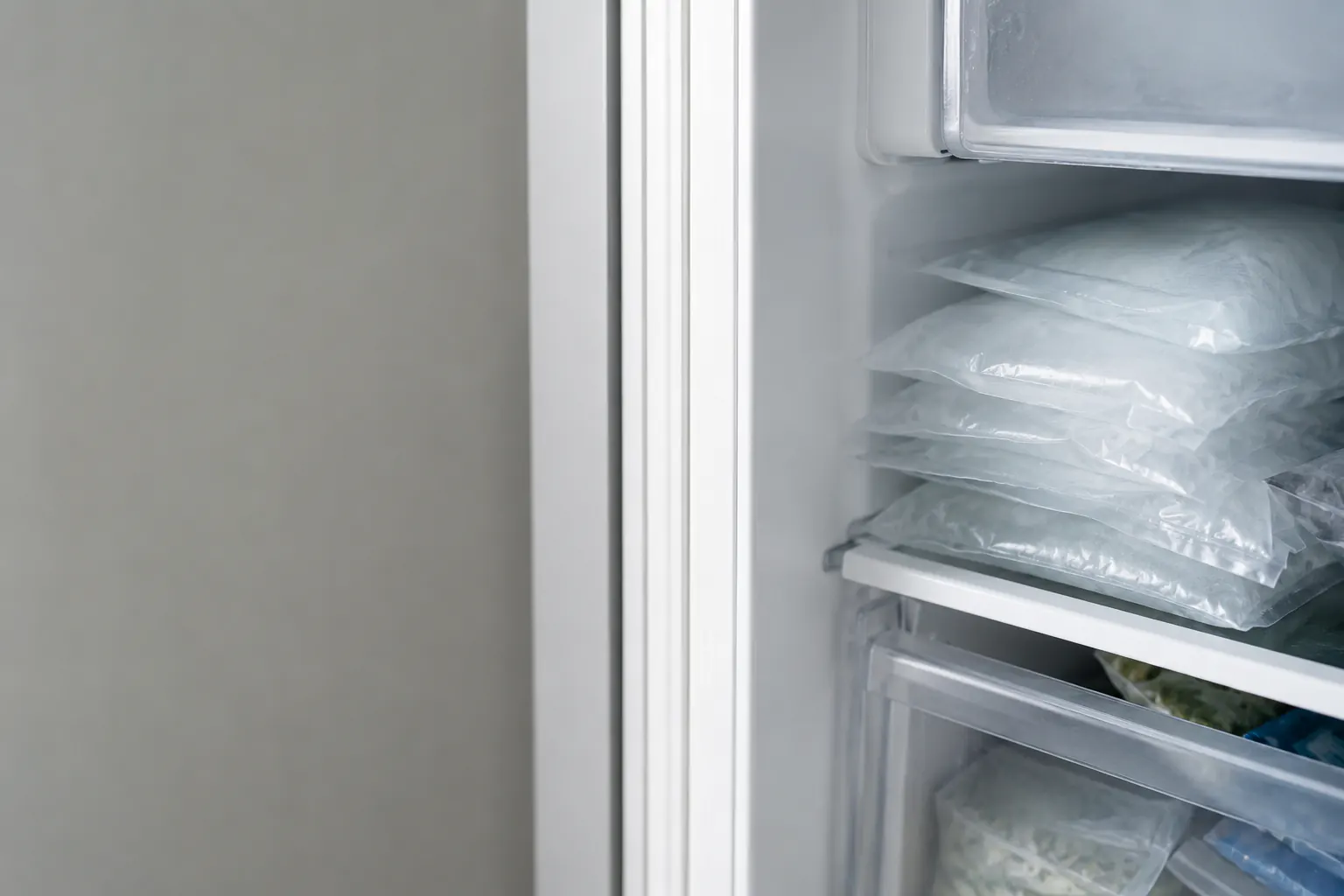
Prepare the food plan before the power plan
Place appliance thermometers in the refrigerator and freezer while utility power is normal. Verify that the refrigerator is at 40°F or below and the freezer at 0°F or below. Record where the thermometers can be read with a brief door opening.
Maintain:
- the current FoodSafety.gov keep-or-discard chart;
- a cooler large enough for priority refrigerated items;
- frozen gel packs or a plan for ice;
- leak-resistant separation for raw meat;
- shelf-stable meals that require no refrigeration;
- the outage start time and each observed temperature;
- a plan for medication or human milk that follows product-specific guidance rather than food rules.
Do not put food outdoors or in snow. Outdoor temperature, sun, animals, meltwater, and contamination are uncontrolled.
Measure the refrigerator as a cycling load
A refrigerator has at least three different electrical questions:
- Running watts: demand while the compressor or other component operates.
- Startup surge: brief demand when a compressor starts.
- Energy over time: watt-hours consumed across compressor cycles, defrost events, fans, controls, and door openings.
The label or manual is a starting point. The U.S. Department of Energy notes that measured use can be more accurate than a simple nameplate estimate. For an ordinary cord-connected refrigerator, a compatible plug-in electricity monitor may be used within its instructions and rating. Do not pull out an appliance unsafely, use damaged wiring, defeat grounding, or test where water is present.
Measure for at least a complete representative period, preferably long enough to include multiple cycles. Record room temperature, refrigerator and freezer temperatures, door openings, contents, settings, defrost behavior, running watts, peak start behavior if the monitor can capture it, and total watt-hours.
Hot rooms, newly loaded warm food, frequent opening, poor ventilation, dirty condenser areas, damaged seals, and aging equipment can increase demand. A cool-weather measurement may underestimate an extreme-heat outage.
Check the battery station in the right order
First, verify that the station’s continuous AC output supports the refrigerator and every other simultaneous load. Second, verify the documented surge behavior against the compressor start. Third, estimate energy:
planned output Wh = advertised Wh × availability × AC efficiency × reserve fraction
Then:
estimated hours = planned output Wh ÷ measured average refrigerator watts
Use the runtime calculator to keep availability, efficiency, reserve, running load, duty cycle, and surge separate. A result is a planning estimate, not a food-safety guarantee.
Some stations automatically shut down under low loads, while refrigerators cycle between higher draw and very low draw. Confirm that the station remains active through an actual cycle. Also verify grounding, waveform, outlet, cable, operating temperature, and whether the manufacturer permits the load.
Do not place the station behind the refrigerator, on a soft surface, in a wet area, or where the appliance blocks its ventilation or controls. Keep the station and cord route within all product instructions and clear of exits.
Use generator power only within the full generator plan
A generator can support refrigeration for longer outages when safe outdoor placement, weather protection specified by the manufacturer, fuel, maintenance, and electrical connection are all feasible.
Under current CPSC guidance, operate a portable generator outdoors at least 20 feet from the home, with exhaust directed away from the home and other buildings where people can enter. Never use one in a garage, basement, crawlspace, shed, porch, or carport. Opening doors and windows is not sufficient.
If the refrigerator connects directly, use only an intact, appropriately rated cord permitted by both manuals, routed dry and protected from damage. Do not run a cord through standing water or create a trip, pinch, fire-door, or egress hazard. Review extension-cord safety.
Powering a refrigerator circuit through home wiring requires qualified installation of listed transfer equipment or another method approved for the exact panel and jurisdiction. Never backfeed a receptacle. Use the generator versus power station comparison and CO safety guide before operating.
Cycling power requires temperature evidence
Some households schedule refrigerator operation to conserve battery or generator fuel. A universal on/off schedule is unsafe because refrigerators, rooms, food loads, and power systems differ.
If the appliance and power-source manufacturers permit planned cycling:
- start with food already at safe temperature;
- keep doors closed;
- monitor refrigerator and freezer temperatures;
- record every powered and unpowered interval;
- verify that each restart succeeds without overload;
- preserve enough energy for communication and other critical loads;
- move food to a properly iced cooler before the safety window is lost;
- follow official discard rules whenever the time-temperature history is uncertain.
Running the compressor for a few minutes does not instantly make warm food safe. Air temperature can fall faster than the center of food, while a display may sample only one location. Do not repeatedly warm and cool perishables around the unsafe range.
Use coolers as a parallel strategy
Before the refrigerator’s four-hour baseline expires, move priority perishables to a cooler if the outage will continue and you can maintain 40°F or below.
Pre-chill the cooler, place a thermometer inside, separate raw food in leak-resistant packaging, surround contents with ice or frozen packs, and keep it closed in a cool safe location. Replenish ice as needed. Do not let meltwater contaminate food.
Dry ice introduces ventilation and cold-burn hazards. Follow supplier and public-health instructions and never touch it with bare skin. A powered refrigerator plan should still include a cooler because the inverter, fuel, appliance, or recharge source can fail.
Preserve the freezer differently
The freezer’s larger passive window can make leaving it closed more valuable than opening it to inspect frequently. Group foods and maintain an inventory before the outage. Freeze water containers with expansion space to fill unused volume.
When power returns, frozen food that still contains ice crystals or is 40°F or below may be refrozen or cooked under current CDC and FoodSafety.gov guidance, although quality may decline. Evaluate each item. Food that thawed and later refroze can look frozen again, so the final appearance does not reconstruct its temperature history.
Handle special contents separately
Refrigerated medication
Use the label, pharmacist, clinician, and manufacturer. Food temperature rules do not determine whether a medication remains usable. Record temperature without freezing the product and seek product-specific advice after an excursion.
Human milk and infant formula
Follow current CDC and clinician guidance for expressed human milk and prepared or opened formula. Do not apply the general leftovers rule.
Food exposed to floodwater
Floodwater contamination can require disposal regardless of temperature. Follow public-health guidance for containers and surfaces. Do not energize or touch a refrigerator that was wet or stands near water until the electrical and structural conditions are professionally cleared. When the outage ends in a discard decision, cleaning the refrigerator afterwards has its own sequence and boundaries.
Run a controlled refrigerator drill
Test before storm season with ordinary food conditions and within every product instruction.
Record the station or generator, output connection, room temperature, refrigerator settings, starting food temperatures, running watts, startup behavior, watt-hours over time, battery or fuel used, temperature trend, cord condition, and all alarms. Stop for overload, unusual heat, odor, noise, damaged wiring, unstable power, or any manual warning.
Do not intentionally let perishable food warm for a test. Use water containers or another safe thermal load if needed, while recognizing that it may not perfectly reproduce normal operation.
The drill should answer four questions:
- Can the source start the compressor every time?
- How much energy does the appliance consume under recorded conditions?
- Can the household replenish that energy before reserve is reached?
- At what temperature, time, or power threshold does food move to a cooler or get discarded?
Store the answers with the home backup load worksheet. Return to Backup Power for Home for system planning and use Power Outage Food Safety for the actual keep-or-discard decision.
Sources reviewed
- FoodSafety.gov: Avoid Foodborne Illness During Temporary Power Outages
- FoodSafety.gov: Food Safety During Power Outage chart
- U.S. Department of Energy: Estimating Appliance and Home Electronic Energy Use
- U.S. Consumer Product Safety Commission: 2026 winter storm and generator safety warning
Sources reviewed July 14, 2026. For a real outage, follow current public-health guidance and the appliance manual; do not make a food or electrical safety call from appearance alone.