
Home backup power is two sizing problems, not one. Watts determine whether the source can start and run the equipment connected at the same time. Watt-hours determine how long that equipment can run before the stored energy or fuel plan is exhausted.
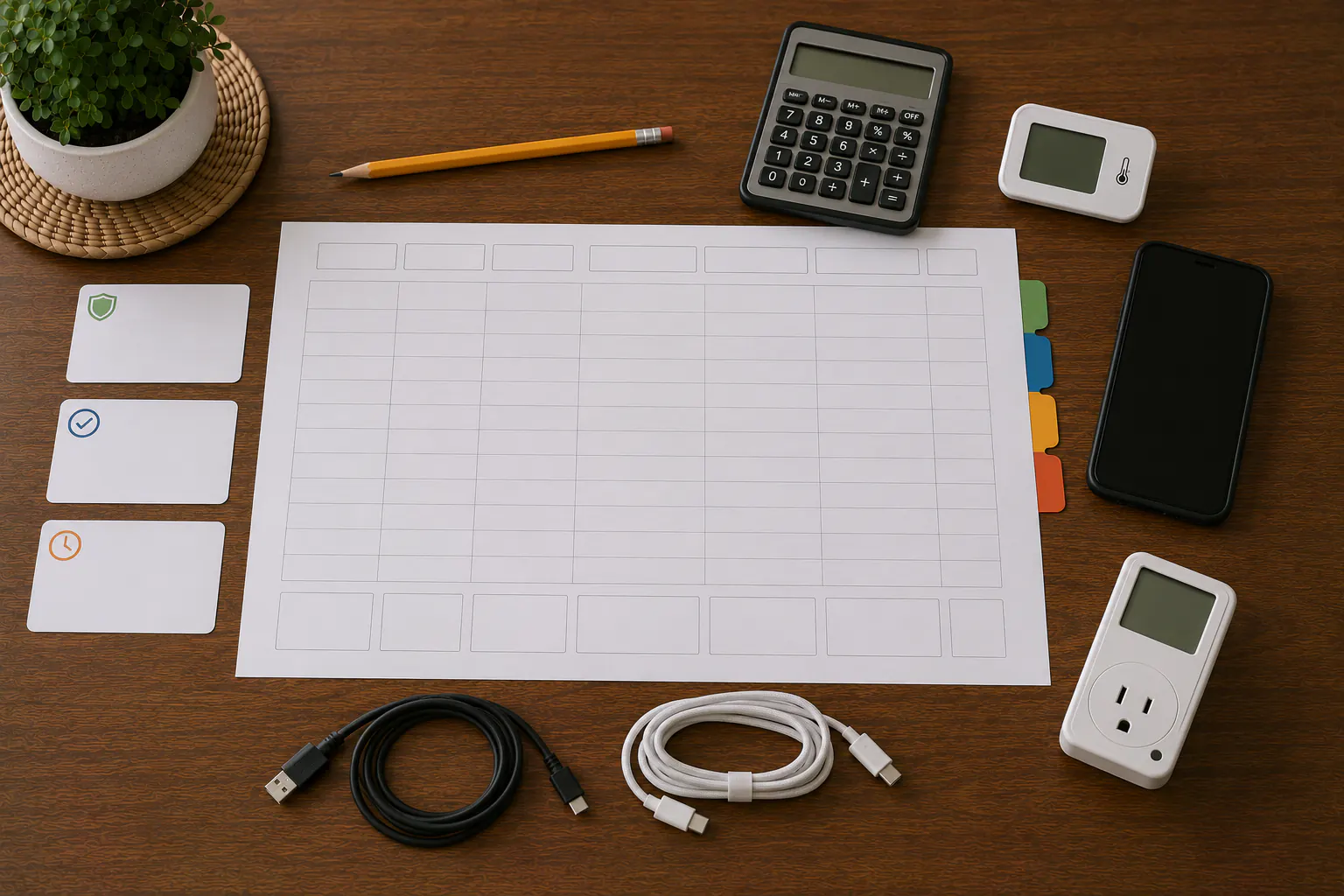
A useful calculation starts with the service you need, not a product capacity. This worksheet produces a planning range for batteries, generators, or a mixed system. It does not approve a wiring method, guarantee appliance compatibility, or replace a medical continuity plan. Sizing comes first; choosing and operating the equipment belongs to the home backup power hub.
Write the outage job before listing devices
Describe what the system must accomplish in one sentence. Examples include:
- maintain food-safe refrigerator temperatures while preserving phone power for 24 hours;
- support internet equipment, task lighting, and two phone charges between daily recharges;
- run an approved medical device until the household reaches a verified destination;
- operate a sump pump or well system under a professionally confirmed electrical plan.
The sentence needs a duration and a consequence. “Power the house” is not a usable requirement. “Keep one refrigerator monitored, charge communications, and provide four hours of task lighting for one day” can be measured.
Separate the household’s loads into critical, essential, and deferrable groups. Prescribed medical equipment and building-protection loads need independent stop rules and professional input. Electric resistance heat, large cooking appliances, clothes dryers, and whole-home air conditioning often dominate a small backup budget; reducing or replacing the task can matter more than buying a larger battery.
Create one row for every intended load
Record the actual device, not a generic category.
| Field | What to enter |
|---|---|
| Device | model or household label, such as kitchen refrigerator |
| Running watts | measured average or documented operating draw |
| Startup watts | documented or measured short surge, when applicable |
| Hours per day | planned operating time |
| Duty cycle | percentage of that time the device actually draws its running load |
| Port | AC outlet, USB, or manufacturer-approved DC connection |
| Consequence | what happens if the device is unavailable |
| Fallback | ice, relocation, manual method, second battery, or another safe plan |
The U.S. Department of Energy explains that appliance labels can show a maximum or design value rather than normal consumption. A compatible plug-in electricity monitor can provide stronger household evidence for ordinary cord-connected appliances when it is used within its rating and instructions; the plug-in watt meter guide covers the method and its limits. Do not disconnect life-sustaining equipment, open electrical equipment, defeat grounding, or meter a load in a way the manufacturer does not permit.
Measure long enough to capture a meaningful cycle. A refrigerator observed for five minutes may not include compressor starts, defrost operation, door openings, or a warm-room period. Record the room temperature, test duration, appliance setting, and starting condition so the number remains interpretable.
Convert each load into daily energy
For a continuously operating load:
running watts × hours = watt-hours
For a cycling load:
running watts × hours × duty cycle = estimated watt-hours
Write duty cycle as a decimal. A 120-watt appliance planned for 24 hours at a 35% duty cycle uses this simplified estimate:
120 × 24 × 0.35 = 1,008 Wh per day
Do not assume that example represents your refrigerator. Duty cycle changes with ambient temperature, insulation, door openings, contents, thermostat setting, defrost behavior, and equipment condition. For food, temperature history remains the safety evidence; battery runtime alone does not prove safe storage. Use the refrigerator outage guide with the food safety rules.
Add the watt-hours for all planned loads. Then decide how many hours or days may pass between realistic recharge opportunities. A two-day requirement with one dependable recharge each day is different from a system that must store the full two days at once.
Translate load energy into battery capacity
A battery station does not deliver every advertised watt-hour to every output. Internal limits, battery condition, temperature, conversion, inverter overhead, cable losses, and reserve all affect planned output.
Use:
required advertised Wh = load Wh ÷ (availability × output efficiency × reserve fraction)
If the load plan needs 900 Wh, assumed battery availability is 90%, AC output efficiency is 88%, and the household keeps 15% in reserve, the planning estimate is:
900 ÷ (0.90 × 0.88 × 0.85) = about 1,337 advertised Wh
Those percentages are assumptions until the actual system is tested. Keep them separate so field results can replace one assumption without hiding the others. The runtime calculator exposes all four variables and also checks continuous and surge limits.
Battery capacity still does not answer whether the station can run the load. Add the simultaneous running watts for equipment that may overlap. Compare that figure with the station’s continuous output for the intended port. Then compare the largest credible combined startup event with the product’s documented surge behavior, including duration.
A station labeled 2,000 Wh and 1,500 W might store more energy than a 1,000 Wh, 2,000 W station, while the smaller battery supports a larger simultaneous load. Capacity and output are not interchangeable.
Size generator demand separately
For a portable generator, calculate simultaneous running watts and the startup event that can occur while other loads remain on. Do not simply add every nameplate maximum if the operating plan deliberately schedules loads at different times. Also do not omit a pump or compressor surge merely because it lasts only seconds.
Generator selection must include the operating location, weather limits, cord route, transfer method, CO alarms, fuel, cooling before refueling, maintenance, noise, and a shutdown plan. A generator that cannot be placed safely at least 20 feet from the home and openings under current CPSC guidance is not a viable backup for that location. Read generator carbon monoxide safety before comparing output.
Directly connected cord loads must stay within product and cord ratings. Supplying household circuits requires listed transfer equipment or another jurisdiction-approved method installed by a qualified electrician. Never feed a receptacle to energize home wiring.
The generator versus battery comparison turns these constraints into a decision rubric.
Add recharge as a daily energy budget
Stored energy is only the first cycle. For each recharge path, record:
- source: grid, vehicle, solar, generator, or verified community location;
- maximum input accepted by the station and the source;
- realistic energy recovered during the available window;
- weather, access, fuel, noise, or travel dependency;
- whether the recharge can occur without interrupting a critical load;
- a fallback if the source is unavailable.
A nominal 200-watt solar panel does not promise 200 watts all day. Cloud, shade, sun angle, heat, wiring, controller limits, station input limits, and daylight change harvest. The portable solar guide shows how to compare measured watt-hours returned with the household’s daily watt-hour demand.
The system is energy-sustainable only when realistic daily recharge meets or exceeds daily consumption with reserve. Otherwise, the plan needs load reduction, more storage, another recharge path, or an earlier relocation trigger.
Build three plans instead of one oversized plan
Minimum continuity
Include only the loads that protect life, communication, safe movement, food decisions, or the building. Define the earliest trigger to seek another powered location.
Expected outage
Add the loads that make the most likely event manageable. Use local outage history and hazard planning, not a universal number of days.
Extended disruption
Assume normal recharge, fuel resupply, internet, elevators, or transport may fail. The answer may be relocation rather than a much larger portable system.
For an apartment, use the apartment power-station guide to screen building rules, egress, charging, storage, weight, and noise before applying a capacity number. For prescribed equipment, use the CPAP backup planning guide only as a question set for the care team and manufacturer.
Run a controlled validation drill
Test ordinary non-medical loads under normal, dry conditions and within every manual. Record:
- initial battery percentage or fuel level;
- exact connected loads and settings;
- measured running watts and startup behavior;
- elapsed time and energy used;
- cord, plug, adapter, inverter, and equipment warnings;
- recharge energy and duration;
- ambient temperature and any automatic shutdown;
- the difference between predicted and observed performance.
Stop if equipment becomes unusually hot, damaged, swollen, noisy, odorous, unstable, or displays a fault. Do not run an intentional failure test on medical equipment, building pumps, refrigeration containing irreplaceable food, or any system whose interruption creates a hazard.
Update the worksheet after each drill and at least when a device, battery, household member, or outage requirement changes. The useful output is not a shopping number. It is a traceable set of loads, assumptions, limits, tests, and fallbacks that another adult can operate safely.
Sources reviewed
- U.S. Department of Energy: Estimating Appliance and Home Electronic Energy Use
- U.S. Consumer Product Safety Commission: 2026 winter storm and power outage safety warning
- U.S. Food and Drug Administration: Emergency Situations and Medical Devices
Sources reviewed July 14, 2026. For an exact device or connection, follow its current manual and use a qualified electrician where the work or safety boundary requires one.