
The best portable power station for an apartment blackout is not automatically the largest one that fits the budget. It is the smallest system that can support a written set of essential loads, can be charged and stored under the building’s rules, can be moved by the household, and still leaves a clear exit when the outage changes elevators, heat, smoke, water, or access.
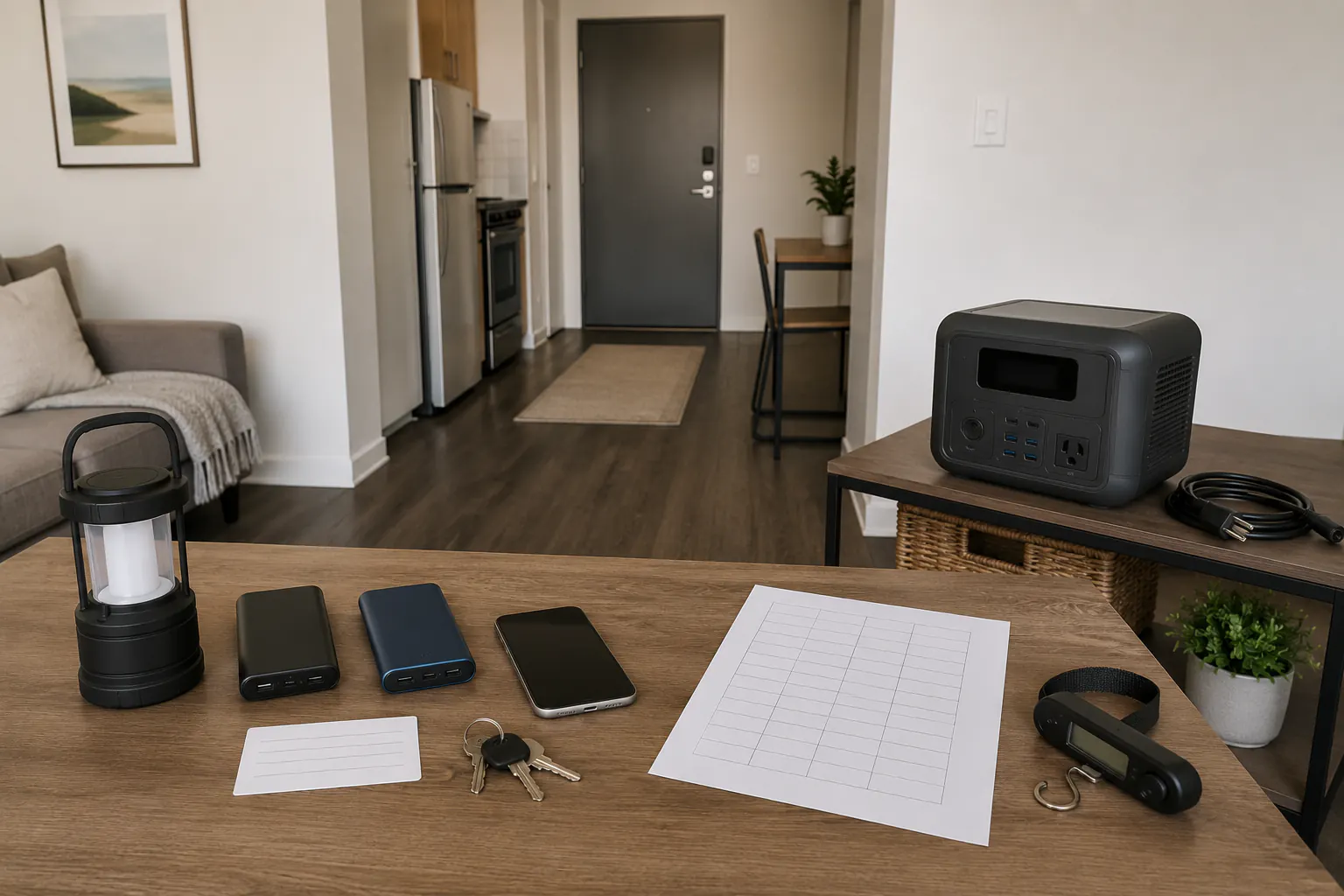
ReadyLience has not yet completed hands-on comparative testing of named stations. This is a research-based selection framework, not a product ranking. Any later affiliate recommendation must disclose the product source and document usable energy, output, recharge, noise, thermals, and test conditions.
Confirm what the apartment allows
Read the lease, condominium rules, emergency plan, and current fire guidance before buying. Ask management in writing about:
- portable battery charging and storage;
- maximum unit size or energy capacity;
- balcony and hallway restrictions;
- outlets supported by building emergency power;
- elevator and electronic-access behavior during an outage;
- fire-alarm, sprinkler, and emergency-lighting continuity;
- package-delivery or mobility constraints for a heavy station;
- whether a designated charging room or community location exists.
Do not assume a balcony makes a portable generator acceptable. Generator exhaust can enter your unit or a neighbor’s window, door, vent, corridor, or air intake. A garage, balcony, hallway, roof, fire escape, carport, or shared courtyard is not a generic safe operating location. For most apartments, a fuel-burning generator is not a workable household option.
A portable battery station has no engine exhaust, but it still contains high-energy cells and power electronics. It belongs in a dry, stable, manufacturer-permitted location away from heat, direct sun, water, combustible clutter, children, pets, and impact. It must not narrow an exit, stair, or accessible route.
Define the apartment load tiers
Use the home backup load worksheet before comparing capacities.
Tier 1: communication and safe movement
Phones, a battery radio, task lighting, and perhaps a low-power network device. These loads may be better served partly by separate USB power banks and lights so one station failure does not remove every communication path.
Tier 2: refrigeration and household continuity
A refrigerator, internet gateway, larger lighting plan, laptop, or accessibility equipment. Refrigerators introduce startup surge and variable duty cycle. Use a thermometer and the refrigerator continuity guide; occasional operation is not proof that food remained safe.
Tier 3: health and climate
Prescribed breathing equipment, mobility-device charging, temperature-sensitive supplies, or limited cooling. These loads need manufacturer and care-team confirmation. A consumer station and calculator must not become the only continuity plan. Extreme heat or cold can make early relocation safer than trying to extend a finite battery.
Write the maximum simultaneous watts, daily watt-hours, startup surge, and required reserve. Then run the figures through the runtime calculator. Reject any candidate that passes capacity but fails continuous output, surge, port, waveform, grounding, temperature, or device-compatibility requirements.
Compare the specifications that change real use
| Criterion | Why it matters in an apartment | Evidence to seek |
|---|---|---|
| Usable energy | Advertised Wh are not all delivered to AC loads | repeatable discharge result at relevant loads |
| Continuous output | Limits simultaneous appliances | documented rating and overload behavior |
| Startup behavior | Compressors and power supplies may surge | measured start with the actual load |
| Low-load behavior | A station may shut off when a router draws little | controllable timeout and overnight test |
| AC and DC efficiency | Port choice changes runtime | energy-in versus energy-out measurement |
| Recharge time | Short utility restoration windows may matter | measured wall recharge without unsafe heat |
| Input limits | More solar panel wattage may not increase charging | voltage, current, connector, and watt limits |
| Noise | Fans can disturb sleep or neighbors | sound level and fan cycling at relevant loads |
| Weight and handles | Elevators may fail | household carry test without blocking egress |
| Display and alarms | Users need meaningful remaining-energy information | readable status, fault history, and manual |
| Warranty and service | A sealed pack may be difficult to repair | support path, shipping rules, parts, and recall process |
Capacity expansion can be useful, but each extra battery adds weight, storage, charging time, cost, and another connector. Verify that expansion batteries are approved for the exact model and that the combined arrangement remains within the product listing and building rules. Do not improvise parallel battery connections.
Look for credible safety evidence
The U.S. Fire Administration recommends choosing certified lithium-ion products, using the manufacturer-provided charger, storing batteries away from combustible materials, and stopping use when a product shows odor, excess heat, shape or color change, leakage, or unusual noise. The CPSC lists UL 2743 among standards relevant to portable power packs.
Look for a certification mark from a Nationally Recognized Testing Laboratory that can be verified for the exact model, not a vague phrase such as “built to a standard.” Certification does not eliminate misuse, damage, recall, or charging risk. Check the CPSC recall database and the manufacturer’s current notices before purchase and periodically afterward.
Use only the supplied or explicitly approved charger and cables. Do not cover the station, place it on a bed or sofa, charge it in an exit path, or leave a damaged unit connected. Follow the manual’s operating, charging, and storage temperature ranges. A station brought in from freezing conditions may need to warm within the allowed range before charging.
If a battery swells, vents, smokes, hisses, leaks, becomes unusually hot, or develops a strong odor, do not carry it through the building or attempt a repair. Move people away, close a door only if that can be done without approaching the hazard, use the building alarm process, and call 911. Never put a lithium-ion battery in household trash or ordinary recycling.
Decide where and how it will recharge
Wall charging is usually the primary method. Confirm that the outlet is intact, grounded as required, accessible, and permitted for the charger. Do not create a chain of power strips or adapters to reach the station. The outage extension-cord guide explains temporary cord boundaries.
Portable solar may help where the building allows safe, secure outdoor panel placement, but many apartments have no unshaded permitted location. Do not hang a panel or cable from a window, fire escape, railing, roof, or facade. A panel behind ordinary window glass may perform poorly, and a cable through a door or walkway can create egress and damage hazards. Use the portable solar planning guide only after the building approves the location.
Community charging, a workplace, a relative’s home, or a vehicle may be a more realistic second source. Verify hours, accessibility, transport, security, and whether the whole neighborhood is likely to share the outage.
Match common apartment profiles
Communication-first resident
Prioritize independent phone banks, radio, task lights, and a modest station for router or laptop continuity. Low-load efficiency and automatic shutoff behavior matter more than a very high inverter rating.
Household protecting refrigerated food
Measure the specific refrigerator across complete cycles, verify startup compatibility, and keep a thermometer and cooler plan. Favor a system that reports energy clearly and can be recharged before the planned reserve is consumed. Do not size from refrigerator running watts alone.
Remote worker
Separate electricity from connectivity. A powered router cannot restore an upstream cable, fiber terminal, cellular network, or building telecom room. Keep local copies of critical work, a phone hotspot plan, and a destination with verified power and internet.
Caregiver or CPAP user
Start with the exact device manual and provider. Ask about approved DC adapters, humidifier and heated-tube demand, battery reserve, alarms, and the trigger to relocate. Follow the CPAP outage planning questions, not a generic list of “CPAP-ready” products.
Heat-vulnerable household
A station can run fans or limited equipment only while those measures remain medically and thermally appropriate. It is not a substitute for air conditioning, a cooling center, or evacuation from unsafe indoor heat. Use the apartment extreme heat plan and leave while elevators and transport still work.
Use a purchase scorecard without fake precision
Score each candidate as pass, conditional, or fail on these gates:
- exact load and startup compatibility;
- required usable energy with reserve;
- building and fire-rule compatibility;
- verified third-party safety certification;
- undamaged, non-recalled exact model;
- safe charging and storage location;
- manageable weight without an elevator;
- realistic second recharge source;
- understandable controls, warnings, and manual;
- warranty, service, and end-of-life path.
A fail on safety, building rules, a medical requirement, or load compatibility is not offset by a lower price. Among the remaining candidates, compare cost per tested usable watt-hour, not advertised capacity alone.
Test before depending on it
Run a controlled test with ordinary non-medical loads. Record actual energy delivered, startup behavior, fan noise, case temperature, display accuracy, low-load shutdown, recharge time, and the accessibility of every cable. Keep the station on a stable manufacturer-permitted surface with clear exits and working smoke alarms.
Do not intentionally deplete prescribed equipment, overload the station, simulate a battery failure, obstruct ventilation, or leave a refrigerator unmonitored. The result should update the household’s written load plan and relocation trigger.
Return to Backup Power for Home to compare apartment batteries with other backup approaches and to the Power Outage Preparedness hub for the complete household plan.
Sources reviewed
- U.S. Fire Administration: Battery Fire Safety
- U.S. Consumer Product Safety Commission: High-Energy-Density Battery Standards
- UL Solutions: Portable Power Pack Testing and UL 2743 overview
- U.S. Department of Energy: Estimating Appliance and Home Electronic Energy Use
Sources reviewed July 14, 2026. Named product recommendations remain pending documented ReadyLience testing or a clearly labeled research methodology.