
Start with your exact CPAP model and a call to the prescribing clinician, equipment provider, or sleep-care team. Ask which backup supply is approved and what you should do if therapy cannot continue. A battery’s advertised capacity cannot answer those questions.
Put the answers in a written plan: approved power sources, the reserve that triggers relocation, and a destination that can support your care. This guide supplies the questions; it does not prescribe treatment or declare any consumer battery medically suitable. Runtime depends on the exact machine, prescribed configuration, accessories, battery condition, environment and approved power connection.
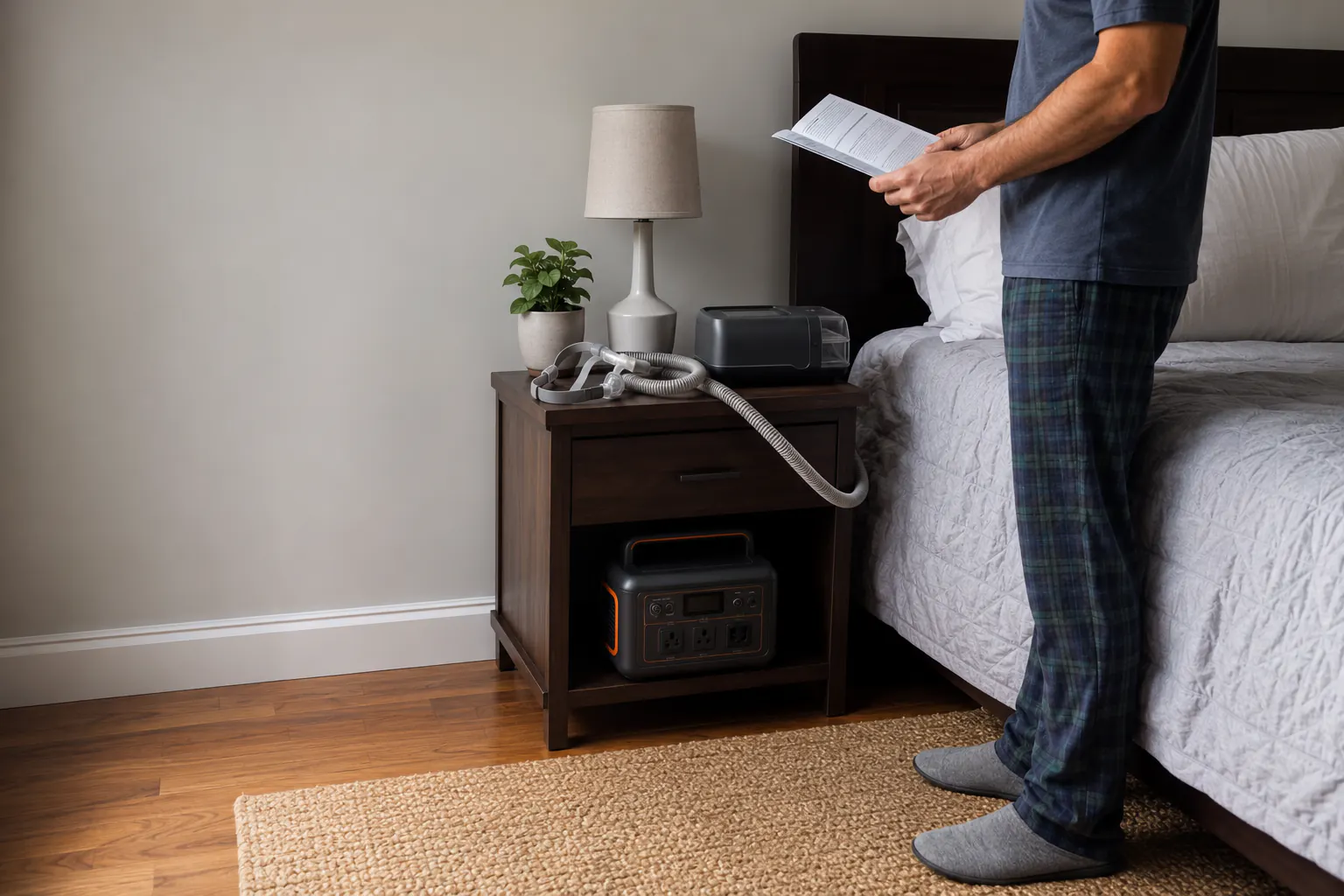
Start with the clinical stop rule
This page works one device in depth. The household-wide frame — inventory, measured loads, supplier questions, and the trigger table — is the medical device continuity plan.
Ask the prescribing clinician or sleep-care team:
- What should I do if CPAP is unavailable tonight?
- Which symptoms require urgent medical advice or 911?
- How does my diagnosis, oxygen use, heart or lung condition, medication, or daytime sleepiness change the plan?
- May any comfort feature be changed during an outage, and who may authorize that change?
- How much power reserve must remain before I relocate?
- Which powered destination can provide the required care and accessibility?
- What transport risks apply if the outage occurs during smoke, heat, cold, flood, or blocked roads?
Do not independently lower pressure, change modes, disable alarms, remove prescribed oxygen, or alter treatment to make a battery last longer. A forum estimate or retailer label cannot replace patient-specific advice.
If a required device fails, urgent symptoms appear, or the clinical plan says emergency help is needed, call 911. Tell dispatch the device, diagnosis-relevant need, symptoms, power status, remaining approved backup, access barriers, and exact location.
Record the exact CPAP system
Create an inventory from the device label, manual, provider, and manufacturer:
| Field | Record |
|---|---|
| Device | manufacturer, exact model, serial number kept privately |
| Prescription | mode and settings, without changing them for this worksheet |
| Power input | voltage, current, original AC supply, approved DC option |
| Accessories | humidifier, heated tube, cellular modem, oxygen connection |
| Approved batteries | model-specific internal or external options |
| Runtime evidence | manufacturer data and household test under approved conditions |
| Environment | operating and storage temperature, humidity, altitude |
| Contacts | clinician, equipment provider, manufacturer, insurer, utility |
| Trigger | provider-defined battery reserve, symptoms, temperature, or travel time |
Keep the manual, prescription information, power-supply labels, and provider contacts with the travel case. Photograph the labels and connectors, but keep serial numbers and health information out of public documents.
FDA advises medical-device users to understand how loss of power, moisture, contamination, heat, and humidity can affect equipment and to prepare for supply disruption. The device manufacturer is the authority for approved power adapters and post-outage checks.
Ask the manufacturer about power compatibility
An AC outlet on a battery station does not prove compatibility. Ask the manufacturer or authorized equipment provider:
- Is the exact CPAP approved for an inverter or portable power station?
- Is pure sine-wave output required?
- Is there an approved DC-to-DC adapter, and for which battery voltage?
- May the device operate while the battery or station charges?
- What continuous watts and startup behavior should be expected at the prescribed settings?
- How do humidification and heated tubing affect energy demand?
- Does the machine retain settings and therapy data after abrupt power loss?
- What alarms occur when power fails, and will the user wake or hear them?
- What grounding, cable, fuse, polarity, and connector requirements apply?
- Which batteries are approved for air travel or vehicle use?
Use only approved adapters. A connector that physically fits can still have the wrong voltage, polarity, current capacity, communication, fuse, or grounding arrangement. Do not splice cables or use a generic automotive adapter unless the device manufacturer explicitly approves it.
Estimate energy without turning it into a guarantee
Use manufacturer data first. If the manufacturer and clinician permit a household measurement, use a compatible meter without interrupting therapy or altering settings. Never disconnect a life-sustaining device merely to test it.
Record energy for a complete normal sleep period under the prescribed configuration. Include every powered accessory that will be used. Heated humidification and tubing may materially change demand, but only the clinician can decide whether a feature may be adjusted.
For a power station:
planned output Wh = advertised Wh × battery availability × output efficiency × reserve fraction
Then:
estimated nights = planned output Wh ÷ measured Wh per prescribed night
The runtime calculator can organize those assumptions. Its output is not a clinical runtime, certification, or permission to use the source. Battery displays, cold, age, conversion, unplanned waking, leaks, delayed transport, and an additional night can reduce the reserve.
Keep separate energy for phones, lighting, heated rooms, or other loads. Do not silently add a refrigerator or space heater to the same battery after the CPAP plan is approved.
Prefer a layered power plan
A resilient plan can include:
- normal utility power;
- an approved device-specific battery or station;
- a second verified recharge or powered destination;
- a communication and transport trigger before reserve is exhausted.
Register for a utility medical program where available, while recognizing that enrollment may not guarantee priority restoration. Verify whether the planned shelter, hotel, cooling center, warming center, or relative’s home can support the device, power, oxygen, accessibility, privacy, and overnight stay. An ordinary public charging outlet is not automatically a clinical destination.
For an apartment, ask management about elevators, emergency outlets, fire alarms, electronic doors, accessible exits, and generator-backed areas. Use the apartment power-station guide for storage and egress questions.
Treat generator use as a separate hazard plan
A portable generator may recharge or operate approved equipment only when every device, electrical, and generator requirement is met. It must run outdoors at least 20 feet from the home under current CPSC guidance, with exhaust directed away from the home and other occupied buildings and openings. Never operate it in a garage, porch, carport, shed, basement, or crawlspace.
Working CO alarms are essential. A CO-shutoff feature is not permission to move a generator closer. If a CO alarm sounds or exposure is suspected, get outside immediately and call 911. Do not reenter to shut off equipment.
The power connection, transfer equipment, cords, wet-weather operation, grounding, fuel, and refueling all require their own safe plan. Read Generator Carbon Monoxide Safety and the generator versus battery comparison.
Add oxygen and fire constraints explicitly
If prescribed oxygen is used with CPAP or another device, create the plan with the oxygen provider and clinician. Oxygen can make materials burn more intensely. Keep the system away from smoking, flame, candles, fuel, sparking equipment, petroleum products, and heat sources as directed.
Do not alter oxygen flow, tubing, connection, or device settings. Verify which battery source, inverter, outlet, and destination the providers approve. Keep battery lighting available rather than introducing flame during an outage.
Plan for heat, cold, smoke, and travel
The battery may not be the first limit. Unsafe indoor heat, extreme cold, wildfire smoke, floodwater, a failed elevator, or an evacuation order can require earlier movement.
Write observable triggers:
- the approved battery reaches the provider-defined reserve;
- indoor temperature reaches the clinician-defined boundary;
- a smoke or evacuation order requires leaving;
- the destination or accessible transport announces reduced service;
- the device alarms, fails, gets wet, overheats, or behaves unexpectedly;
- symptoms reach the care plan’s call or emergency threshold.
The winter medical-device plan expands transport, medication, oxygen, caregiver, and temperature questions. Add the family communication plan with a named person responsible for each call and departure decision.
Rehearse the plan without interrupting therapy
Run a tabletop drill first:
- read a simulated outage notice;
- confirm the approved battery is charged and undamaged;
- identify cables without connecting the wrong adapter;
- call the backup contact and destination;
- pack the CPAP, mask, approved power, accessories, medication, documents, and cleaning supplies;
- state the exact reserve and symptom triggers;
- time accessible movement to the vehicle or destination;
- record one unresolved question for the clinician or manufacturer.
Only perform a powered runtime test if the clinician and manufacturer say it is appropriate, normal therapy will not be interrupted, and the approved source is used exactly as directed. Do not intentionally exhaust the battery, disable alarms, or wait until the last estimated minute.
After any outage, inspect the device and power equipment according to the manuals. Verify settings, clock, alarms, humidifier, filters, data, and battery state before the next use. Contact the provider for water exposure, contamination, heat, damage, fault codes, or uncertain operation.
Return to Backup Power for Home for the household energy hierarchy, while keeping the CPAP reserve separate from convenience loads.
Sources reviewed
- U.S. Food and Drug Administration: Emergency Situations and Medical Devices
- U.S. Food and Drug Administration: Unique Considerations in the Home
- Centers for Disease Control and Prevention: Prepare Your Health, Power Sources
- U.S. Consumer Product Safety Commission: 2026 generator and CO safety warning
Sources reviewed July 14, 2026. The patient’s care team, provider, and device manufacturer remain the authority for the exact therapy and backup plan.