
Write down the equipment you need to keep running and where a backup source could operate at your property. Those two answers come before a battery-versus-generator choice. A generator converts fuel into electricity while it operates; a battery station stores a finite amount of electricity and must be recharged.
The useful question is not which technology is universally better. It is which system can support a defined load at the actual property, under the expected weather and outage duration, without relying on unsafe placement, improvised wiring, unavailable fuel, or optimistic recharge.
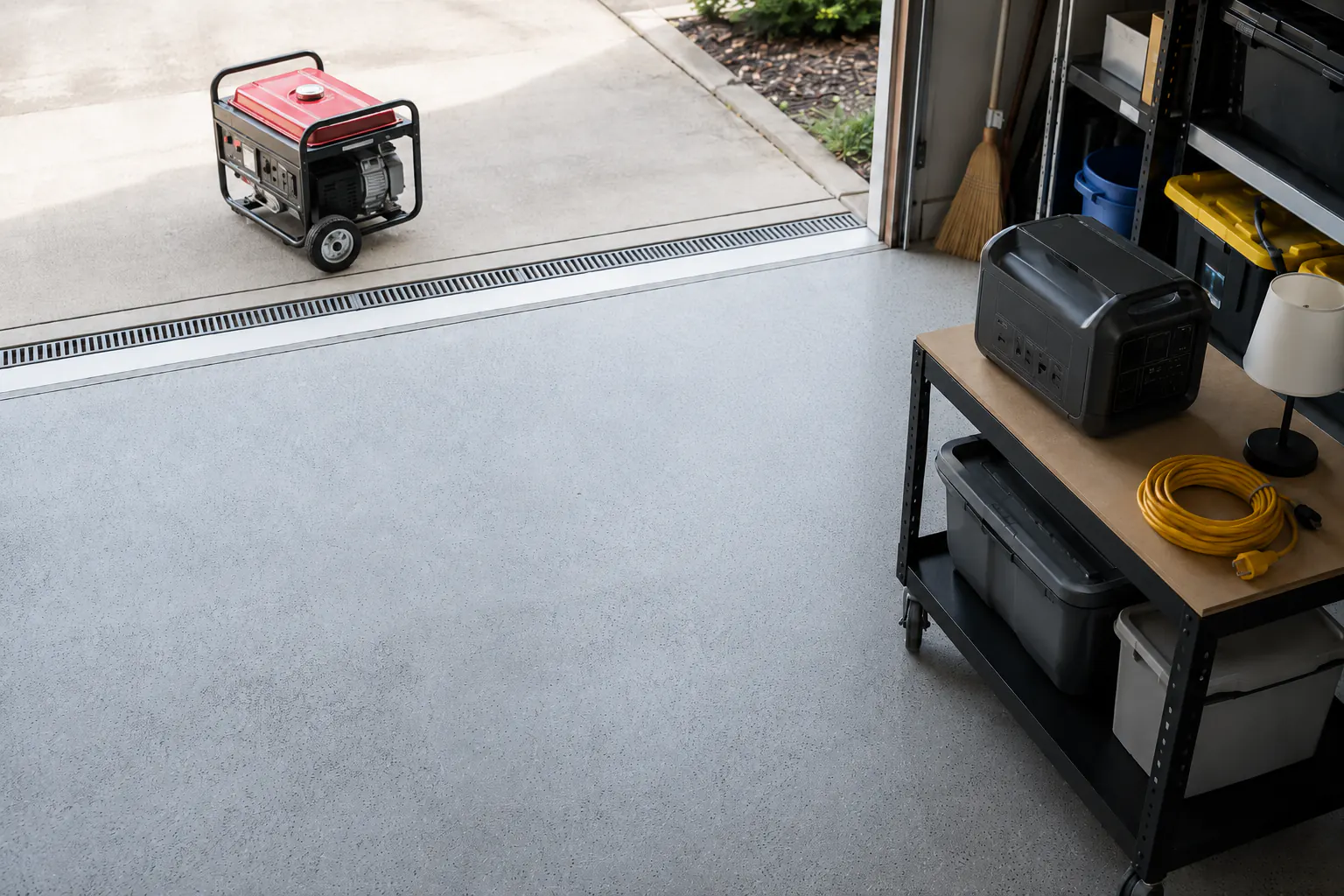
Eliminate any option that cannot be used safely
A portable generator is not viable unless it can operate outdoors at least 20 feet from the home under current CPSC guidance, with exhaust directed away from the home and other occupied buildings, windows, doors, vents, and air intakes. A garage, basement, crawlspace, shed, porch, or carport is not made safe by an open door. Rain and snow add electrical-shock and equipment constraints; follow the exact generator manual.
Apartment residents and closely spaced properties may have no acceptable generator location. Noise rules, leases, fire codes, fuel storage, theft, shared ventilation, and a neighbor’s openings can make an otherwise capable generator unusable.
A battery station has no engine exhaust and can support permitted indoor loads, but it is not hazard-free. It needs an intact, certified product; approved charger and cables; a dry, stable location; clear ventilation; temperature limits; and a route that does not block exit. Stop using a battery that becomes swollen, damaged, leaking, unusually hot, discolored, odorous, hissing, or smoking. Leave and call 911 for fire, smoke, venting gas, or immediate danger.
If either option fails the location, building, fire, electrical, or household-operation gate, capacity does not rescue it.
Compare the systems by the job they perform
| Decision factor | Portable power station | Portable generator |
|---|---|---|
| Energy source | stored battery energy | gasoline, propane, diesel, or another approved fuel |
| Indoor operation | permitted only within product and building rules | never for fuel-burning portable generators |
| Possible fit | selected electronics and appliances within the exact output and stored energy | loads within the exact output, with permitted fuel and operating location |
| Primary limit | finite Wh and recharge rate | CO, fuel, weather, noise, maintenance, and operating location |
| Output check | continuous inverter, surge, ports, waveform | running watts, starting watts, receptacles, voltage regulation |
| Refueling/recharging | grid, solar, vehicle, generator, or another location | cool-down and safe refueling plus resupply |
| Maintenance | battery condition, firmware, charger, cycling, storage state | engine exercise, oil, fuel system, starting battery, plugs, filters |
| Electrical connection | direct loads unless an approved integrated system says otherwise | direct loads or professionally installed transfer equipment |
| Failure mode to plan | depleted battery or failed recharge | no fuel, failure to start, CO, wet operation, mechanical fault |
The table describes categories, not every model. Large battery systems can support substantial loads; small generators can be limited. Compare the exact equipment with the load worksheet.
Use watts and watt-hours correctly
Add simultaneous running watts. For each startup event, include the starting load and the other loads running at that moment. Compare both requirements with the exact source and device instructions; watts alone do not establish compatibility. Then estimate daily watt-hours for battery planning and use the generator’s relevant fuel-consumption data for a fuel plan.
A refrigerator may draw modest power after startup but briefly need more when its compressor begins. A station with enough watt-hours can still reject that surge. A generator with adequate running output can still bog down when several motors start together.
For a battery, calculate planned energy after availability, conversion efficiency, and reserve. Use the runtime calculator, then verify the actual appliance.
For a generator, use the manufacturer’s fuel-consumption data only as a starting point. Consumption changes with load, fuel, engine, temperature, maintenance, and operating mode. A tank-runtime claim does not establish how much legally and safely stored fuel the household can maintain.
Where a battery usually fits better
A portable station is often the more practical first layer when the household needs:
- phones, radio, task lighting, router, laptop, or other modest loads;
- quiet overnight operation;
- indoor use within the product’s rules;
- immediate power without engine starting or fuel handling;
- a system an apartment resident can lawfully store and move;
- short outages with dependable grid recharging;
- a buffer while deciding whether to relocate.
It can also pair with a generator. The generator may run outdoors during planned periods to support larger loads or recharge batteries, while the battery handles quiet intervals. This does not reduce generator placement, CO, weather, fuel, or electrical requirements.
A battery is usually a poor substitute for long-duration electric resistance heat, large central air conditioning, electric water heating, or indefinite whole-home operation unless the system was specifically engineered for those loads. Load reduction and a safe destination may be more realistic.
Where a generator may fit better
A generator may be appropriate when a detached property has a compliant outdoor location and needs:
- longer operation between utility restorations;
- pumps, refrigeration, tools, or multiple loads beyond a small inverter;
- a repeatable fuel and maintenance plan;
- selected household circuits through professionally installed transfer equipment;
- an independent recharge source for batteries.
The household must be able to deploy and operate it safely under the event conditions. A generator stored behind debris, too heavy for the operator, unable to run in the current weather, or dependent on fuel that cannot be stored or obtained is not resilient.
Read Generator Carbon Monoxide Safety and Generator Fuel Storage before counting generator wattage.
Direct cords and household circuits are different plans
Some portable equipment is designed to power individual cord-connected loads. Use only properly rated, intact cords and receptacles, protect connections from water and damage, and follow the manual. The extension-cord safety guide covers routing and temporary-use boundaries.
Energizing selected household circuits requires listed transfer equipment or another method accepted for the exact panel and jurisdiction, installed by a qualified electrician. Never connect a generator to a home receptacle and never use a double-male cord. Backfeeding can energize wiring unexpectedly and endanger occupants, utility workers, and responders.
Likewise, a portable battery pack should not be treated as a permanently installed home energy storage system merely because an accessory cable or panel is advertised. Verify the exact listing, installation instructions, permits, and electrician requirements. Keep all panel work inside the licensed-electrician boundary.
Compare resilience over a multiday outage
Create a daily ledger for each option.
Battery ledger
- usable watt-hours at the intended loads;
- daily consumption;
- reserve that will not be spent;
- wall, solar, vehicle, generator, or community recharge;
- realistic watt-hours returned per day;
- time when relocation begins if recharge fails.
Generator ledger
- load schedule and measured fuel use;
- fuel safely and lawfully available;
- cool-down and refueling intervals;
- maintenance and oil requirements;
- operator shifts, noise limits, security, and weather;
- time when loads are reduced or relocation begins if resupply fails.
Neither ledger should assume stores, gas stations, roads, cellular service, or sunshine remain available after a regional disaster. A mixed system can diversify failure modes, but only when the household can maintain both safely.
Treat medical and food loads as separate decisions
For CPAP or other prescribed equipment, ask the clinician and manufacturer which batteries, adapters, settings, alarms, and reserve are approved. Do not infer compatibility from an AC outlet or a “medical” marketing label. The CPAP backup guide creates the question set and relocation trigger.
For refrigeration, measure temperature, not merely generator or battery runtime. Use the refrigerator backup guide and official food-discard rules. If backup power stops, the temperature history continues; it does not reset because the appliance ran earlier.
Ask for evidence for the exact models
For a battery station, look for documented usable AC and DC energy, continuous and startup behavior, low-load shutdown, fan noise, display accuracy, recharge time, input limits, temperature limits, charger, certification, warranty and repair path. Check the conditions behind any measured result; a different load or setting can change it.
For a generator, ask for documented starting and load behavior, professionally evaluated output quality, consumption at relevant loads, noise, maintenance, CO-shutoff feature, receptacle protection, weather instructions, warranty and service network. This is a question list, not a procedure for measuring electrical output at home. A CO shutoff feature is an additional safeguard, never permission to operate close to a building.
This page compares the two approaches from published guidance. It does not report hands-on tests of named models.
A practical decision sequence
- Define critical, essential, and deferrable loads.
- Calculate simultaneous watts, startup demand, and daily watt-hours.
- Reject any option without a safe, legal operating and storage location.
- Decide whether loads connect directly or require professional transfer equipment.
- Model battery recharge or generator fuel for the expected duration.
- Add weather, noise, mobility, household skill, and maintenance constraints.
- Keep independent lighting, communication, food, and relocation fallbacks.
- Read the exact operating procedures and rehearse the contact and relocation plan. Use equipment only as permitted; do not induce overloads or failures to practice.
Return to the Backup Power Systems hub for the full cluster and the Power Outage Preparedness guide for actions beyond electricity.
Sources reviewed
- U.S. Consumer Product Safety Commission: 2026 generator and carbon monoxide warning
- U.S. Consumer Product Safety Commission: Generators and Engine-Driven Tools
- U.S. Fire Administration: Battery Fire Safety
- U.S. Department of Energy: Estimating Appliance and Home Electronic Energy Use
Sources reviewed July 14, 2026. Generator connections, fuel-burning equipment, and household wiring still require the manufacturer guidance, applicable local rules, and qualified help where the work calls for it.